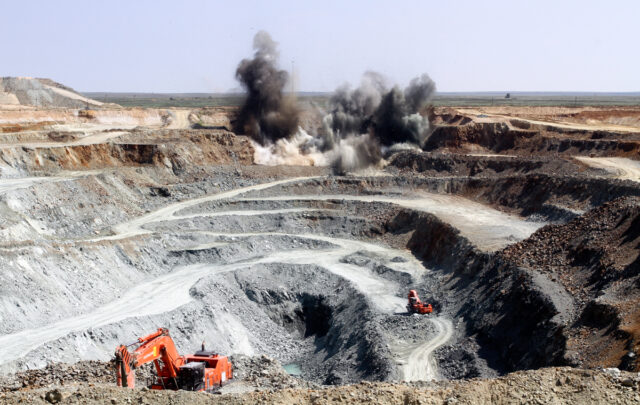
Libya’s time of greatness as an oil-producing nation was around 1970 when they had their maximum production of over 3 million barrels per day (Mb/d). This then declined to a stable production of 2 Mb/d until 1980. During the 1980s their production sank for a few years to just above 1 Mb/d. It was clear that Libya’s oilfields had past their first phase of oil extraction during which the fields’ innate initial pressure is the force driving oil flow. They needed help with modern technology to increase oil flow.
Despite the “Lockerbie” attack on Pan Am Flight 103 in 1988 it seems as though the required help arrived since production increased to around 1.4 Mb/d during the 1990s. Despite this increase, there was still the possibility of further expansion but that would require the advanced technologies possessed by the international oil companies and could not occur in secret. The September 11 attack on the World Trade Centre in 2001 opened doors for Gaddafi and he played his cards well. In a French documentary recently broadcast in Sweden one could see how keen were all those from the West who wanted access to Libya’s oil. The highpoint for Gaddafi was when he was invited to meet President Bush. The result of the West’s efforts was that oil production began to increase in 2004 and now lies at around 1.8 Mb/d. Libya’s domestic consumption is low at, maybe, 100,000 barrels per day so most of Libya’s oil is exported to the West. The total volume of world oil production that is exported is a little under 50 Mb/d and Libya’s share of this is a bit over 3%.
The International Energy Agency asserts that current global reserve capacity is high – at least 6 Mb/d – and that should mean that a loss of 1.5 Mb/d from Libya is easy to cope with. However, the rising oil price is telling a different story. For a long time I have stated that the world’s reserve capacity is overestimated so it will be interesting to see how the situation develops in the near future.
The current situation for oil production in Libya looks like this: When the unrest began the production level was 1.6 Mb/d. The international oil companies such as Italy’s Eni (that produces 250,000 barrels/day, b/d, in Libya) and Spain’s Rapsol (producing 45,000 b/d) have closed down their production. German Winterhall (100,000 b/d) and French Total (60,000 b/d) are thought to be producing only a fraction of former volumes. Deliveries of natural gas to Italy which account for approximately 10% of Italy’s imports are closed off. On March 1 the head of Libya’s National Oil Corporation said that oil production had been halved (although by that he could mean either that half of Libya’s production is stopped or that half of the company’s production is stopped). They will keep producing for as long as they can but their international expertise has left the country. International Energy Agency tells us that the production is down with 800,000 to 1,200,000 b/d.
Saudi Arabia has large underground stores of oil that can be tapped relatively quickly but only for a limited time. According to our research and that of the IEA, crude oil production from the world’s existing fields is falling by 4 Mb/y (6%) per year. The world’s oil companies must continuously replace this oil and to do this while simultaneously compensating for Libya’s decreased production during the next 12 months may be more than they are capable of. But it also means that the oil from Libya that we would otherwise have used today can now be used in the future.
Libya has a refinery in Ras Lanuf that can meet that nation’s oil product needs if it can be run without foreign expertise.