Click on the headline (link) for the full text.
Many more articles are available through the Energy Bulletin homepage
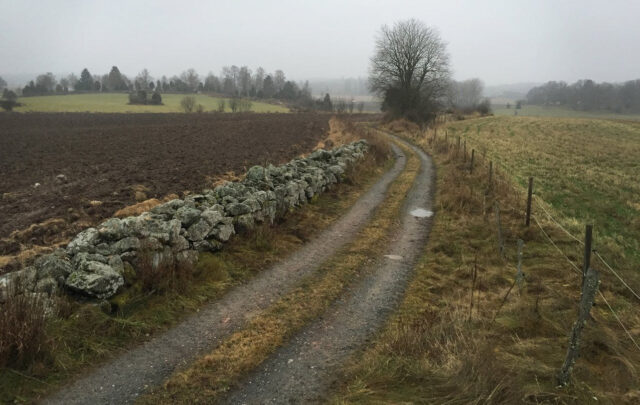
Masanobu Fukuoka, 1913-2008
Long live ‘do-nothing farming’
Tom Philpott, Gristmill
I was aiming at a pleasant, natural way of farming which results in making the work easier instead of harder. “How about not doing this?” “How about not doing that?” — that was my way of thinking.
I ultimately reached the conclusion that there was no need to plow, no need to apply fertilizer, no need to make compost, no need to use insecticide. When you get right down to it, there are few agricultural practices that are necessary.
The reason that man’s improved techniques seem necessary is that the natural balance has been so badly upset beforehand by those same techniques that the land has become dependent on them.
— Masanobu Fukuoka, The One-Straw Revolution
Masanobu Fukuoka died last week at the age of 95.
Like the 20th century’s other great critic of industrial agriculture, Albert Howard, Fukuoka got his start as a conventional plant pathologist. Both spent lots of time staring into microscopes looking to “solve” the various problems associated with teasing food out of the earth.
They came of age when plant science was beginning to splinter into a set of specializations, each viewing particular aspects of agriculture in isolation.
Fukuoka and Howard both decided that the conventional scientific approach led to disaster: a downward spiral of “solutions” to problems created by the previous solution. As Fukuoka, Japan’s most celebrated alternative farmer, put it in his masterpiece, The One-Straw Revolution:
Specialists in various fields gather together and observe a stalk of rice. The insect disease specialist sees only insect damage, the specialist in plant nutrition considers only the plant’s vigor.
… As Fukuoka well knew, you can’t just take over a piece of farmland, “do nothing,” and expect a bumper harvest. He tells an anecdote about his first attempt to farm without chemicals after abandoning his science career. He took over a patch of tangerine trees owned by his father, and proceeded to “do nothing.” The result: “the branches became intertwined, insects attacked the trees, and the entire orchard withered away in no time.” He concludes:
I had acted in the belief that everything should be left to take its natural course, but I found that if you apply that way of thinking all at once, before long, things do not go so well. This is abandonment, not “natural farming.”
In our time, small-scale farmers operate under brutal economic pressure — and the resources needed to develop a truly sustainable agriculture too often lie beyond their grasp. So we slog on, doing our best, often falling short.
Fukuoka’s vision offers a beacon, a goal, an ideal to strive for. Making predictions is arrogant, but I’ll venture one anyway: As long as humans are still scratching their sustenance out of the earth, Fukuoka’s work will remain an inspiration.
(26 August 2008)
Treehugger has another notice with a photo: Natural Farming Pioneer Fukuoka Masanobu Dies, 95 Years Old.
Also see: The Fukuoka Farming Website
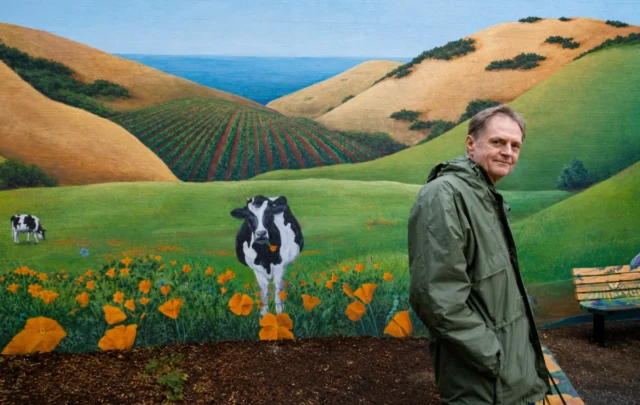
Australia’s gardening icon Peter Cundall going strong at 81
Carla Grossetti, Sydney Morning Herald
It’s survival of the fittest
… While he may have retired from his 39-year stint as a weekly presenter on ABC’s Gardening Australia show, [Peter] Cundall still writes at least 1000 words every day for various newspaper and magazine columns around the country and is close to completing two books: one he describes as an “erratic memoir” because it is not a chronological account of his life; and the second work, also as yet untitled, is a serious look at the global food crisis and how we can survive it.
At this year’s Gardening Australia Expo – which is to be his last – Cundall will be showing visitors how to plot and plant their own little “survival crop” in a freshly hoed replica of Pete’s Patch, based on the garden used on the popular ABC-TV show.
“One of the tiny gardens I have created is only the size of a bloomin’ big room, yet it can keep a family in all the vegetables it needs for most of the year and that is very encouraging for people to see first-hand,” Cundall says.
“I want to show people that they can produce their own food even if they live in a small, inner-city area. Gardens can thrive anywhere where there is a bit of sun and the amount of production from a small area is phenomenal. If you don’t have a balcony or your garden doesn’t get any sun, then find your nearest community garden.
… At 81, Cundall is the embodiment of good health, an example to all of us that grubbing about in the dirt and growing things is “absolutely bloody marvellous” for our physical and mental wellbeing.
“I look at myself in the mirror and I am amazed. The last time I went to a doctor was 1951. It’s so lovely to go decade after decade with no medical bills. I don’t even use glasses. It’s lovely.
“Most of the ills haunting the human race can be traced back to what we are consuming. If people want to get away from the madness of society then go out into a garden. It’s there that you are back to the truth,” he says.
(27 August 2008)
This man looks great at 81 – see photo at the original. Whatever he’s doing, I want to be doing it too! -BA
Michael Lardelli writes:
Peter Cundall is an Australian gardening phenomenon who, in his final edition of the Gardening Australia programme on ABC TV, pointedly mentioned the looming oil and food crisis and stressed the importance of growing your own food.
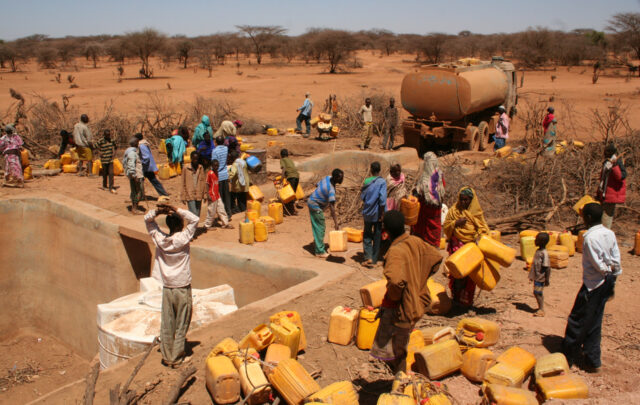
Rich countries once used gunboats to seize food. Now they use trade deals
George Monbiot, Guardian
The world’s hungriest are the losers as an old colonialism returns to govern relations between wealthy and poor nations
—
In his book Late Victorian Holocausts, Mike Davis tells the story of the famines that sucked the guts out of India in the 1870s. The hunger began when a drought, caused by El Niño, killed the crops on the Deccan plateau. As starvation bit, the viceroy, Lord Lytton, oversaw the export to England of a record 6.4m hundredweight of wheat. While Lytton lived in imperial splendour and commissioned, among other extravagances, “the most colossal and expensive meal in world history”, between 12 million and 29 million people died. Only Stalin manufactured a comparable hunger.
Now a new Lord Lytton is seeking to engineer another brutal food grab. As Tony Blair’s favoured courtier, Peter Mandelson often created the impression that he would do anything to please his master. Today he is the European trade commissioner. From his sumptuous offices in Brussels and Strasbourg, he hopes to impose a treaty that will permit Europe to snatch food from the mouths of some of the world’s poorest people.
… As global food supplies tighten, rich consumers are pushed into competition with the hungry. Last week the environmental group WWF published a report on the UK’s indirect consumption of water, purchased in the form of food. We buy much of our rice and cotton, for example, from the Indus valley, which contains most of Pakistan’s best farmland. To meet the demand for exports, the valley’s aquifers are being pumped out faster than they can be recharged.
(26 August 2008)