


Click on the headline (link) for the full text.
Many more articles are available through the Energy Bulletin homepage
Thoughts On Economic “Inevitability”
Gene Logsdon, Organic To Be (group blog)
Sometimes I believe that all the lessons of life can be learned at home. Just this morning I heard a nationally renowned agricultural economist on the radio make a prediction that I have a hunch will embarrass him greatly if he lives long enough. (Perhaps all our attempts at predicting the future would embarrass us if we lived long enough.) He said that an agriculture of huge grain farms and huge animal factories was “inevitable.” He did not state that observation as his opinion, but as a fact that sentimental old fools like me had better get used to. He also seemed to think that inevitable carried with it the notion of forever.I wonder if he would have made that prediction had he known deeply the history of any one place.
I need look no farther than right here in the fields of home to learn a lesson in not making grand prophecies like that. As long as I can remember – 60 years – the land around me, including my own, has been devoted to grain and livestock farming. But in the mid 1800s, sheep were the principle agricultural commodity. My great-grandfather went to work for one of those sheep ranches, which were then growing in acreage dramatically especially on the native prairie parts of our county, where there were fewer trees to whack off. Had there been agricultural economists in those days, I can imagine them saying with all the pomposity due their royal offices, that huge sheep ranches were “inevitable.”
But economic conditions are more fickle than an April whirlwind. Within a generation, money was finding different pathways to follow.
Obviously, the lesson of history is otherwise. Changing economic conditions make it just as possible that agriculture could revert to small, intensive garden farming coupled with small intensively grazed animal farms.
…Another even more graphic example of how “progress” is not always from forest primeval to farm to strip mall comes from Mississippi. The first officially recorded 300-bushel corn yield was grown in that state, much to the chagrin of the Corn Belt. That was back in 1952 and how well I remember the excitement and the chagrin. How the farm magazine rhetoric flowed at the announcement of that record-smashing yield. Soon of course, 300-bushel corn would be common, said all the idiot economists, and if Mississippi could do it, the Corn Belt with the help of increased fertilizers and chemicals and hybrid vigor, yawn yawn, would soon ring up a 400-bushel yield. The word “inevitable” was flung around very loosely on that occasion too.
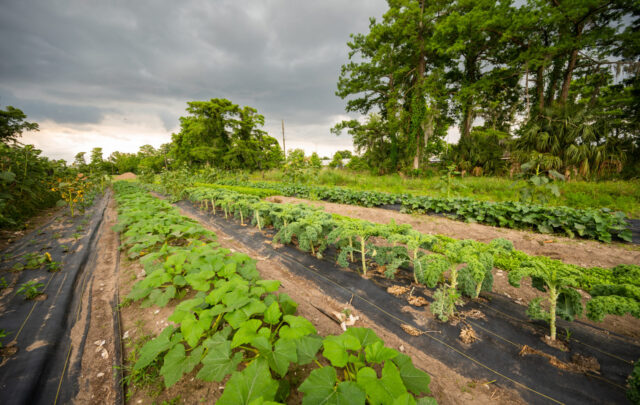
Today, forty some years later, the field that grew the first 300-bushel corn is a forest again! Furthermore yields of 300 bushels per acre have been achieved only in three or four more isolated instances. Ironically, it would appear now that if 300-bushel yields are to become commmonplace, as predicted, it will happen on biointensively-managed raised-bed garden plots, not large scale agribusiness farming. There are contrary gardeners doing it now.
~~
Gene and Carol Logsdon have a small-scale experimental farm in Wyandot County, Ohio.
Current Books:
All Flesh Is Grass: Pleasures & Promises of Pasture Farming
The Lords of Folly (novel)
The Mother of All Arts: Agrarianism and the Creative Impulse (Culture of the Land)
[and many others, spanning a writing career of decades]
(15 September 2007)
Recommended by amygwh at comments at Casaubon’s Book. -BA
UN backs organic farming
Sam Burcher, People and Planet
The organic food movement has received endorsement from the United Nations leading agency on food and agriculture, the FAO. In a new report, it says that organic farming fights hunger, tackles climate change, and is good for farmers, consumers and the environment. —
The UN Food and Agricultural Organisation (FAO) has come out in favour of organic agriculture. Its report Organic Agriculture and Food Security explicitly states that organic agriculture can address local and global food security challenges.
Organic farming is no longer regarded as a niche market within developed countries, but a vibrant commercial agricultural system practised in 120 countries, covering 31 million hectares (ha) of cultivated land plus 62 million ha of certified wild harvested areas. The organic market was worth US$40 billion in 2006, and expected to reach US$70 billion by 2012.
Nadia Scialabba, an FAO official, defined organic agriculture as: “A holistic production management system that avoids the use of synthetic fertilisers and pesticides, and genetically modified organisms, minimises pollution of air, soil and water, and optimises the health and productivity of plants, animals and people.”
The strongest benefits of organic agriculture, Scialabba said, are its reliance on fossil fuel independent, locally available resources that incur minimal agro-ecological stresses and are cost effective. She described organic agriculture as a ‘neo-traditional food system’ which combines modern science and indigenous knowledge.’
The FAO report strongly suggests that a worldwide shift to organic agriculture can fight world hunger and at the same time tackle climate change.
(5 October 2007)
The FAO report is online: Organic Agriculture and Food Security (PDF).
How to Fertilize Urban Food Deserts
Erica Barnett, World Changing
The urban “food desert,” a neighborhood in which residents typically must travel twice as far to reach the closest supermarket or other mainstream grocer as people in better appointed neighborhoods, is not just a problem of social or economic justice; it’s about public health as well. Faced with a lengthy trek to stock the kitchen with fresh food, many residents of food deserts instead rely on “fringe” retailers — convenience stores, liquor stores, gas stations, and drug stores — to provide basic food items. The result is a serious nutrition gap between those who live in areas of plenty and those who lack access to the basics. And poor nutrition leads to poor health and premature death.
In Detroit, Michigan, for example, more than half the city’s 1,000-plus food retailers are fringe locations that offer little or nothing in the way of fresh or healthy food.
(5 October 2007)



Comments
Welcome to the new Resillience commenting system!
We have moved from the former Disqus commenting system to a new system as of September 10, 2026.
We made this change because of privacy concerns regarding Disqus. It's also part of a set of changes to bring more services to the Resilience community under a single login: commenting, (coming September 2026), and online courses (coming 2027). Unfortunately, your old Disqus comments may not reliably link to your account in this new system. Please contact us if you have any questions or concerns.