

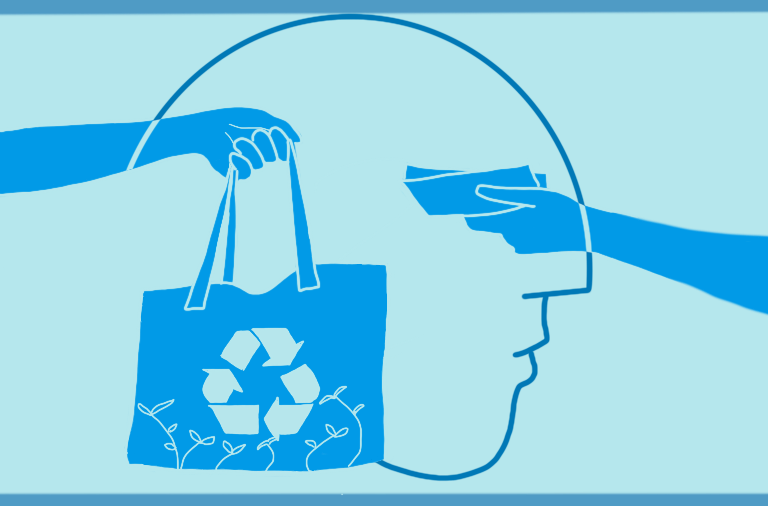
Click on the headline (link) for the full text.
Many more articles are available through the Energy Bulletin homepage
Privatizing Responsibility: the Times On Green Consumerism
Alex Steffen, WorldChanging
Getting misunderstood by the New York Times is a strange experience: it’s a bit frustrating, but you have to still be kind of flattered that it happened at all.
So I certainly have a mixed emotions about the Times’ story today, Buying Into the Green Movement: [see following story]
…Actually, as i told Alex Williams (who, it should be noted, did an otherwise excellent job), I believe something quite different: that the genuine solution is not a matter of consumer choice at all.
There is no combination of purchasing decisions which will make the current affluent American lifestyle sustainable. You can’t shop your way to sustainability, as I’ve put it before. On a planet running up against so severe a set of deadlines — global warming, the extinction crisis, the poverty crisis, etc. — prosperity as currently delivered is frankly immoral, even when purchased with an eco-chic package.
That doesn’t mean that I think prosperity itself is wrong. Quite the opposite. Nor do I think we could talk people out of wanting prosperity if we tried — heck, I hope for a generous amount of prosperity myself, one day. But we need to redesign prosperity, using innovation, new thinking and new technologies to render it sustainable.
And here’s the essential break between lite green and bright green thinking: the reality is that the changes we must make are systemic changes. They involve large-scale transformations in the ways we plan our cities, manufacture goods, grow food, transport ourselves, and generate energy. They involve new international regulatory regimes, corporate strategies, industrial standards, tax systems and trading markets. If we want to change the world, we need to forge ourselves into the kinds of citizens who can effectively demand such things.
…Over the next decade we need a real reckoning of the ecological limitations we face, a public commitment to redesign our civilization to produce widespread prosperity within those limits, collective visions of what such a sustainably prosperous (bright and green) future might look like and a whole lot of innovation on tools for building that future.
(1 July 2007)
I’m not sure whether it’s me or WorldChanging, but they seemed to have become more deeply green over the last year: less enamored with gadgets, more open to traditional sustainable practices, more “systemic” as Alex Steffen puts it. -BA
Buying Into the Green Movement
Alex Williams, NY Times
HERE’S one popular vision for saving the planet: Roll out from under the sumptuous hemp-fiber sheets on your bed in the morning and pull on a pair of $245 organic cotton Levi’s and an Armani biodegradable knit shirt.
Stroll from the bedroom in your eco-McMansion, with its photovoltaic solar panels, into the kitchen remodeled with reclaimed lumber. Enter the three-car garage lighted by energy-sipping fluorescent bulbs and slip behind the wheel of your $104,000 Lexus hybrid.
Drive to the airport, where you settle in for an 8,000-mile flight— careful to buy carbon offsets beforehand — and spend a week driving golf balls made from compacted fish food at an eco-resort in the Maldives.
That vision of an eco-sensitive life as a series of choices about what to buy appeals to millions of consumers and arguably defines the current environmental movement as equal parts concern for the earth and for making a stylish statement.
…Critics question the notion that we can avert global warming by buying so-called earth-friendly products, from clothing and cars to homes and vacations, when the cumulative effect of our consumption remains enormous and hazardous.
“There is a very common mind-set right now which holds that all that we’re going to need to do to avert the large-scale planetary catastrophes upon us is make slightly different shopping decisions,” said Alex Steffen, the executive editor of Worldchanging.com, a Web site devoted to sustainability issues.
The genuine solution, he and other critics say, is to significantly reduce one’s consumption of goods and resources. It’s not enough to build a vacation home of recycled lumber; the real way to reduce one’s carbon footprint is to only own one home.
…Paul Hawken, an author and longtime environmental activist, said the current boom in earth-friendly products offers a false promise. “Green consumerism is an oxymoronic phrase,” he said. He blamed the news media and marketers for turning environmentalism into fashion and distracting from serious issues.
“We turn toward the consumption part because that’s where the money is,” Mr. Hawken said. “We tend not to look at the ‘less’ part. So you get these anomalies like 10,000-foot ‘green’ homes being built by a hedge fund manager in Aspen. Or ‘green’ fashion shows. Fashion is the deliberate inculcation of obsolescence.”
He added: “The fruit at Whole Foods in winter, flown in from Chile on a 747 — it’s a complete joke. The idea that we should have raspberries in January, it doesn’t matter if they’re organic. It’s diabolically stupid.”
…For the most part, the critiques of green consumption have come from individual activists, not from mainstream environmental groups like the Sierra Club, Greenpeace and the Rainforest Action Network.
…It is not just ecology activists with one foot in the 1970s, though, who have taken issue with the consumerist personality of the “light green” movement. Anti-consumerist fervor burns hotly among some activists who came of age under the influence of noisy, disruptive anti-globalization protests.
Last year, a San Francisco group called the Compact made headlines with a vow to live the entire year without buying anything but bare essentials like medicine and food. A year in, the original 10 “mostly” made it, said Rachel Kesel, 26, a founder. The movement claims some 8,300 adherents throughout the country and in places as distant as Singapore and Iceland.
(1 July 2007)
Very good article. Two points off for perpetuating stereotypes with “tree-hugging hippies” and “noisy, disruptive anti-globalization protests.” See previous article by Alex Steffen of WorldChanging who was interviewed in the article. -BA
52 Weeks Down – Week 10 – Use it Up, Wear it Out, Make it Do, Do Without
Sharon Astyk, Casaubon’s Book
The famous quote about frugality “Use it up, Wear it Out, Make it do, or Do Without” applies very well to reducing one’s emissions and dependence on fossil fuels. Everything we buy has an embodied energy cost – that is, the energy to make it contributes to global warming. It also has personal energy costs – more of our hard earned dollars means more time spent at work, or more stress over our credit card bills. Frugality and environmentalism don’t have a 100 percent overlap, but often, doing the frugal thing is also doing the environmentally sound thing. Everytime we buy new, we say to that manufacturer “Make one more.” One more is often too many.
So how do we do this? First, we use things up – we extract every single last drop out of something. That means we scrape the pan thoroughly, so that we don’t end up throwing away food. It means we use our thumbs to get the last bit of egg out of the shell – do that with six eggs and you’ve got the equivalent of another. Take those scraps of ratty old tshirts and make a quilt, or handkerchiefs to substitute for tissues, or cloth tp to substitute for paper, or whatever. Take the time to really get all the use we can out of things. That includes pleasure, time and love – that is, if we get all the pleasure we can from our simple lives, we won’t always need more. If we make good use of all our time – rest and work – we won’t be running all the time. If we make full use of the love and support of others, we might look up one day and have a community to rely on.
Wear it out. That means making things last as long as possible. That means darning our socks, mending our jeans, reheeling our shoes instead of just chucking them and getting a new pair. The longer we can extend the lifespan of our things, the less we’ll need to buy. And with that in mind, it is often wisest to buy things that really last, and also things that have potential for long term reuse or repair. That means wood furniture, not plastic, metal tools, good quality clothing. It isn’t always frugal just because it is cheap – we need to start thinking about the whole lifespan of a object from where and how it was made to what we will do when it breaks or is worn out
(2 July 2007)
Sharon’s previous post reported on The First Month of Rioting for Austerity.
If you like the traditional wisdom that Sharon describes in this post, look at the Japan’s sustainable society in the Edo period (1603-1867). -BA
When Simple Things You Can Do Really Do Make a Difference
Emily Gertz, WorldChanging
I’m wary of the “50 simple things you can do to save the earth” approach to environmentalism and economic justice. Some things just aren’t that easy to do at the scale we need to do them. And this focus on tiny individual changes distracts us from demanding better environmental or economic decisions and actions from our elected and corporate leaders.
The first wave of this easy steps and shopping for a better world movement was in full swing about 20 years ago. It bottomed out in an overload of hype. Like the miraculous health-saving elixirs once touted in newspaper ads, the claims made for these products — both in how good they were for you and how much they’d change the world — were too good to be true. Face it: there is just so much turning an old spaghetti sauce jar into a vase does for saving endangered species or ending poverty.
But there are cheering developments in the current wave of consumer interest in things green. …there are signs that people are becoming more sophisticated about how to root out the substance behind these claims.
…I’m also heartened by the small but growing signs of political leadership. Mayor Mike Bloomberg had no particular reason to stick his political neck out on PlaNYC, except that he believes in it — there are probably easier ways to advance his well-established development agenda for the city’s brownfields and other real estate wastelands, as well as his national profile. Now, in concert with PlaNYC, the Bloomberg administration has launched the GreeNYC campaign, encouraging Gothamites to make 10 changes in our daily lives that will reduce the city’s carbon footprint (the amount of climate-disrupting carbon dioxide the city’s population as a whole adds to the atmosphere)
…How are these 10 tips of 2007 any different from the 50 simple things of 1987? Well, they are quite well-edited, for one thing. Rather than overpromising, these changes really will have a huge impact on cutting oil consumption, reducing energy use, increasing the clean power infrastructure, and cutting several kinds of serious environmental pollution if a significant percentage of city residents take them up.
(30 June 2007)
Rich world’s consumerism may cause African famines, experts warn
Agence France Presse (AFP)
Food production in developing countries will halve in the next 20 years unless wealthy nations lower their rate of consumption, the Stockholm Environment Institute warned at a weekend conference.
The livelihoods of more than three billion people in the world are being undermined by the wealth of the privileged few, the institute’s executive director, Johan Rockstroem, warned.
“The risk is that we might halve … food production in sub-Saharan Africa because of our lifestyles,” he told AFP on the sidelines of an international conference on climate change and sustainable development, held in the Swedish town of Taellberg.
Rockstroem said that as wealthy countries increase consumption they also increase their exploitation of the world’s natural resources, and in turn emit more greenhouse gases.
That ultimately speeds up the desertification of sub-Saharan Africa and other parts of the world.
(1 July 2007)





Comments
We changed commenting systems on September 10, 2026 as part of a site-wide functionality and security upgrade. Your past comments have not disappeared, and you can still log in with your old Disqus account credentials if you wish. Contact us with any questions.