


Click on the headline (link) for the full text.
Many more articles are available through the Energy Bulletin homepage
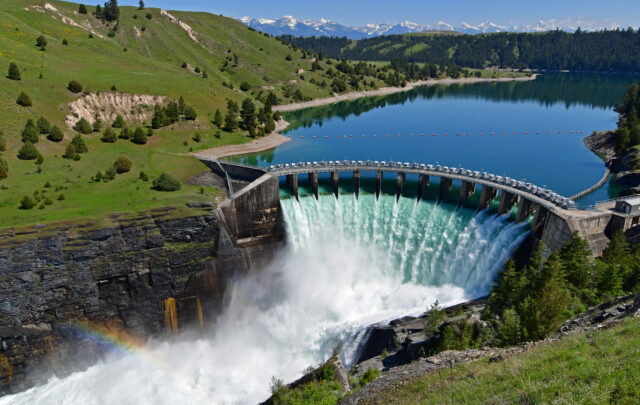
Energy, water demands are on collision course
Robert S. Boyd, McClatchy Newspapers
Like the old song, “Love and marriage, love and marriage . . . you can’t have one without the other,” so it goes with energy and water.
It takes a lot of water to produce energy. It takes a lot of energy to provide water. The two are inextricably linked, and claims on each are rising.
“The water supply is as critical as oil,” said Charles Groat, a geologist and expert on the problem at the University of Texas in Austin.
In return, “water use requires a tremendous amount of energy,” said Peter Gleick, the president of the Pacific Institute for Studies in Development, Environment and Security in Oakland, Calif.
As the United States tries to lower its dependence on foreign oil by producing more energy from domestic sources such as ethanol, however, it’s running low on fresh water.
Water is needed for mining coal, drilling for oil, refining gasoline, generating and distributing electricity, and disposing waste, Gleick said.
“The largest use of water is to cool power plants,” he said at a panel of experts on “The Global Nexus of Energy and Water” in Boston last month.
(12 March 2008)
The water-energy connection needs more attention – both in the mainstream media and in the sustainability blogosphere. It takes energy to supply water (especially drinking water), and it takes water to make energy. -BA
Kenya: Concerns Mount Over Country’s Food Security
Samuel Otieno, East African Business Week
As Kenya reels back towards recovery from post election violence, fear is ripe that some of the sectors perceived to be the backbone of the economy might not recover soon even as a report indicates steady growth of prices of food and agricultural products.
Stakeholders in the industry say the country’s optimum yield of agricultural produce may not be average after farmers fled from their farms for fear of being attacked by the local community during the violence.
Nyanza Provincial director of Agriculture, Mr. Otieno Owiro says the region may not produce even half of its optimum yield this year owing to lack of preparations for the field and the gig cost of farm inputs.
Preparation of fields for the planting season, which normally takes place between February and March, is yet to kick off, Nyanza Kenya federation of agricultural produce Wilfred Nyamula said that the delay has been occasioned by high cost of fuel and transport problems to most of the agricultural produce.
(17 March 2008)
Shortages of energy, food worry Pakistanis
Candace Rondeaux, Washington Post
… With consumer prices for basic goods hitting new highs in Pakistan, anxieties about the country’s economy are also on the rise. After seeing five years of strong gains under the government of President Pervez Musharraf, officials are scaling back expectations for growth in the face of wrenching food and energy shortages.
The crisis has taken a severe toll on Musharraf politically, and public frustration with rising prices helped the opposition win big in parliamentary elections last month.
…Salman Shah, Pakistan’s finance minister in the caretaker government, acknowledged that wheat smuggling and skyrocketing consumer prices have become serious problems. But he blamed increases in global prices for food and oil for much of the crisis. He pointed to strong gains on the Karachi stock market, the country’s largest, as a sign that the postelection economy is as viable as ever.
… Pakistan’s economic recovery efforts could be further complicated in the long term by widespread energy shortages, according to some analysts. Blackouts occur several times a day even in some of the most affluent areas of major cities.
(16 March 2008)
The Power Drain
Many Residents Stung By High Cost of Utilities
Kirstin Downey, Washington Post
George Mann, an $18-an-hour grocery store clerk in Waldorf, found himself trembling last month as he wrote the check to pay his $644 electricity bill.
Still financially recovering from a $549 electricity bill in January, Mann said he noticed he was “shaking” as he paid the bill, full of anxiety about how he would find the money to pay other household expenses for the three-bedroom rambler where he lives with his wife and four children.
“When they deregulated the market, there was supposed to be competition and prices were supposed to go down,” he said. “But why did the bills go in the opposite direction?”
That is a question being echoed in households across the region, particularly as heating bills rise in the coldest months of the year.
(16 March 2008)
Costs Surge for Stocking the Pantry
Andrew Martin & Michael M. Grynbaum, New York Times
The government announced Friday that the cost of food had gone up yet again. This came as no revelation to Bruce Newton, a single father of two children.
As he wheeled a cart full of groceries out of a Stop & Shop supermarket in Bloomfield, N.J., on Thursday night, Mr. Newton complained that the price of chicken had become “outrageous,” and eggs were so costly his mother sent him from store to store hunting for the cheapest ones. Essential breakfast items like milk, cereal and orange juice have become “so expensive, but what are you going to do?”
Mr. Newton’s pain is being felt in grocery checkout aisles across the country. Government figures released Friday showed that grocery costs had jumped 5.1 percent in 12 months, the latest in a string of increases. In fact, the nation is undergoing its worst grocery inflation since the early 1990s.
(15 March 2008)




Comments
We changed commenting systems on September 10, 2026 as part of a site-wide functionality and security upgrade. Your past comments have not disappeared, and you can still log in with your old Disqus account credentials if you wish. Contact us with any questions.