


Click on the headline (link) for the full text.
Many more articles are available through the Energy Bulletin homepage
Soil Association bans nanomaterials from organic products
Rebecca Smithers, Guardian
The Soil Association today said it had become the first organisation in the world to ban man-made nanomaterials from its certified organic products, claiming the new technology poses a serious threat to human health.
Cosmetics, food and clothing made with superfine particles called nanoparticles will be banned from carrying the pro-organic group’s logo, it announced today.
Nanotechnology involves manipulating material at the molecular level. At scales of a billionth of a metre, substances can behave in unpredictable ways and take on new properties. The technique is expected to lead to major breakthroughs in medicine and electronics.
But the Soil Association says there is insufficient evidence about the impact of nanotechnology on the environment and human health.
(15 January 2008)
Death Rates and Food Prices
Stuart Staniford, The Oil Drum
This post is a follow-on from my post last week Fermenting the Food Supply. I’ve been investigating biofuel and food issues further, in an effort to clarify the issues raised there. I’ll begin by briefly summarizing the argument of last week’s piece:
- The total biofuel equivalent of the entire world food supply is a small fraction of the world liquid fuel supply,
- Biofuel production is taking a rapidly expanding share of the (potential) food supply. The share in the US is higher than globally, but in both cases production is growing at around 25%/year.
- In the US, biofuel production has become highly profitable at times in the last few years, and would have been profitable even without subsidies part of the time; the profits are what have fueled the growth.
- If biofuel growth continues at the present rate for even a few more years, it will sharply affect the food supply (it already has had material effects).
- Demand for fuel in developed countries appears to be much less elastic than demand for food in poor counties, raising the specter of a significant fraction of the world’s population being unable to afford a minimal diet in the face of competition from the world’s drivers.
…I found my conclusions of last week very depressing and so I have been doing my best to falsify them. I have found at least some good news (“good” by the abysmal standards of last week’s post, at any rate). The portion of that post that I was most uncertain of was the connection between food prices and the impact on the global poor. I made a very simple argument based on the global income distribution, and the elasticity of demand for both food (in poor countries) versus fuel (in rich countries).
However, there are several complicating factors here – many people in poor countries are subsistence farmers, and some poor economies are not really connected to the global commodity markets. So this raises the question – how do death rates in poor countries really respond to global commodity markets? One way to explore this is to look at the global food crisis of the early 1970s.
…In summary, it still seems to me that a sustained increase in food prices by factors of several fold, and that lasts for years, has the potential to deprive a material fraction of the global poor of enough food to live. This would be a much worse food crisis than the 1970s food crisis. Whether biofuels have the potential to bring that on depends on the future trajectory of oil prices, a subject that will have to await a future post.
(14 January 2008)
Making More Food With Less
Erica Barnett, World Changing
“It takes about 15,000 to 30,000 square feet of land to feed one person the average U.S. diet. I’ve figured out how to get it down to 4,000 square feet. How? I focus on growing soil, not crops.”
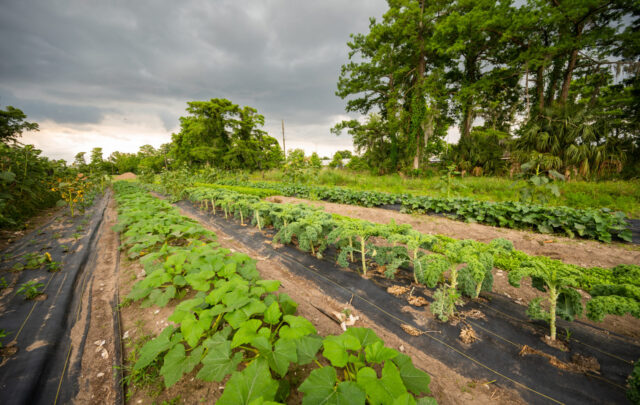
That’s organic/sustainable gardening guru and soil expert John Jeavons, author of the book “How to Grow More Vegetables Than You Ever Thought Possible On Less Land Than You Can Imagine,” talking to the San Francisco Chronicle a few years back (via Grist). Jeavons has spent the last 30 years touting small-scale, sustainable, organic farming–a method of closed-loop crop production he has dubbed “biointensive farming.”
Basically, biointensive farming incorporates many of the same practices as biodynamics, and takes them a few steps further. …
Some of biointensive farming’s practices strike me as impractical on both a small and a large scale–human-waste composting is never going to become all that popular, for example, and I can’t see many people doing the kind of intensive calories-per-square-inch calculations Jeavons calls for. Still, the method has some major advantages over conventional farming–the largest and most obvious being, of course, that it allows farmers to produce far more food per acre…
(15 January 2008)
Jeavons is a local figure here in the San Francisco Bay Area, with his main site north in Willitts. Many people are working on further developing the biointensive method, and I have seen it change and expand over the years.
I don’t remember that biointensive advocates human-waste composting, as mentioned by Erica Barnett in her post, but I’m glad she brought it up. Talking about human waste is taboo, but the way that we now handle it is ecological suicide. The process wastes clean drinking water merely to flush away excrement and urine. The coming droughts will make us realize how valuable water really is, and presumably motivate us to develop more water-efficient systems.
Longer term, our current process wastes nutrients (nitrogren, potassium and phospnorus) which have been in short supply throughout most of human history. These nutrients are energy-intensive to produce synthetically, and I suspect phosphorus may be the ultimate limiting factor on human populations. Once phosphorus has been dispersed into the environment (e.g. dumpted into the ocean with sewage), it is lost forever. See Peak Phosphorus for more. -BA.
UPDATE (Jan 16). Jason Bradford adds:
Ecology Action has a publication called “Future Fertility” about the cycling of human waste. John sometimes touches upon this in his lectures. It isn’t a big part of his discussion because it is controversial, but he does think about it.
Panic Shroom
Alastair Bland, MetroActive (Silicon Valley, California)
Are mushrooms and human hair the organic, 21st-century answer to toxic disasters like the spill in San Francisco Bay?
—
YOU ARE what you eat-unless you’re an oyster mushroom. In that case, you can indulge in some of the most toxic, noxious petroleum products available and turn them into delicious, photogenic morsels that go wonderfully in white wine cream sauces and Japanese stir-frys with not a carcinogen remaining.
Called mycoremediation, this impressive skill of the oyster mushroom has gained substantial press in the wake of the Nov. 7 Cosco Busan oil spill in the San Francisco Bay, and many environmental activists believe that, if pursued by biotechnology developers, mycoremediation could completely rewrite the guidebooks on how to handle the aftermath of future spills.
Mycologists have been speculating for years on the possibility of someday employing oyster mushrooms-Pleurotus ostreotus-in toxic waste cleanup projects, and when the freighter Cosco Busan scraped the Bay Bridge and spilled 58,000 gallons of sludgy bunker fuel into the bay, mushroom biologists from Monterey to Seattle quickly mobilized.
(9 January 2008)
Fiber CSA’s: Do You Know Where Your Yarn Has Been?
Ale1XSteffen, World Changing
We’re fans of knowing where the things in your life came from, and where they’re going when you’re done with them. This is especially true when it comes to food. We’re into the idea of having a connection with the people who grow our produce, brine our olives, cure our meats, brew our beers and even harvest our bananas. But even by our now somewhat jaded standards, the CSA Rebecca Blood just joined is pretty damn cool.
They sell you community-supported wool, as yarn:
After shearing, we’ll let our friends at the mill work their magic and soon you’ll receive your share of the harvest. The number of skeins, yardage, etc., will depend on the size of the clip but we are limiting our shareholders this first year to ensure that everyone gets a bountiful supply.
(7 January 2008)
Related from the Guardian
Few would dispute that agricultural subsidies needed overhauling, but the harsh effect on hill farmers could radically change the nature of Britain’s uplands as grazing sheep become a thing of the past.
.
Shattering Myths: ‘Can sustainable agriculture feed the world’
M. Jahi Chappell, PhD Candidate, University of Michigan Department of Ecology and Evolutionary Biology, Food First
For years, critics and proponents alike have worried that the related methods of organic, low-input, low- or no-pesticide, integrated, small-scale, and sustainable production may address environmental concerns, but cannot produce sufficient food to sustain the large and growing human population. Such skepticism was understandable—the so-called Green Revolution of the 1940s, 50s, and 60s had been credited with averting widespread hunger crises by drastically increasing agricultural production, while the downsides of its technological advancements only began to enter the popular consciousness in the years after Rachel Carson’s Silent Spring in 1962. Questioning the source of the cornucopia that provided plenty to people throughout the world seemed downright ungracious and backward. How could we be critical of the Green Revolution when it had staved off so much hunger?
(Fall 2007)
Discussion of the University of Michigan study from July 2007.


Comments
Welcome to the new Resillience commenting system!
We have moved from the former Disqus commenting system to a new system as of September 10, 2026.
We made this change because of privacy concerns regarding Disqus. It's also part of a set of changes to bring more services to the Resilience community under a single login: commenting, (coming September 2026), and online courses (coming 2027). Unfortunately, your old Disqus comments may not reliably link to your account in this new system. Please contact us if you have any questions or concerns.