The New York Times has an interesting article on the resurgence in interest in farming amongst the young and college educated
For decades, the number of farmers has been shrinking as a share of the population, and agriculture has often been seen as a backbreaking profession with little prestige. But the last Agricultural Census in 2007 showed a 4 percent increase in the number of farms, the first increase since 1920, and some college graduates are joining in the return to the land.
Jordan Schmidt, a crew manager here at Hearty Roots, studied environmental science at Wesleyan. Ms. Schmidt, 27, did not have so much as a garden growing up, but in college, she said, she worked at a student-run farm and fell in love with agriculture. So she gave up on research science and moved onto a farm in Pennsylvania after graduating. This is her third season at Hearty Roots.
Hearty Roots, about 100 miles north of New York City, spans 70 acres with a clear view of the Catskill Mountains to the west. At the height of the harvest this year, the farm produced 8,000 pounds of vegetables a week — including peppers, beets and kale — and employed 10 workers. None of them came from farming backgrounds and most had heard about the job through word of mouth.
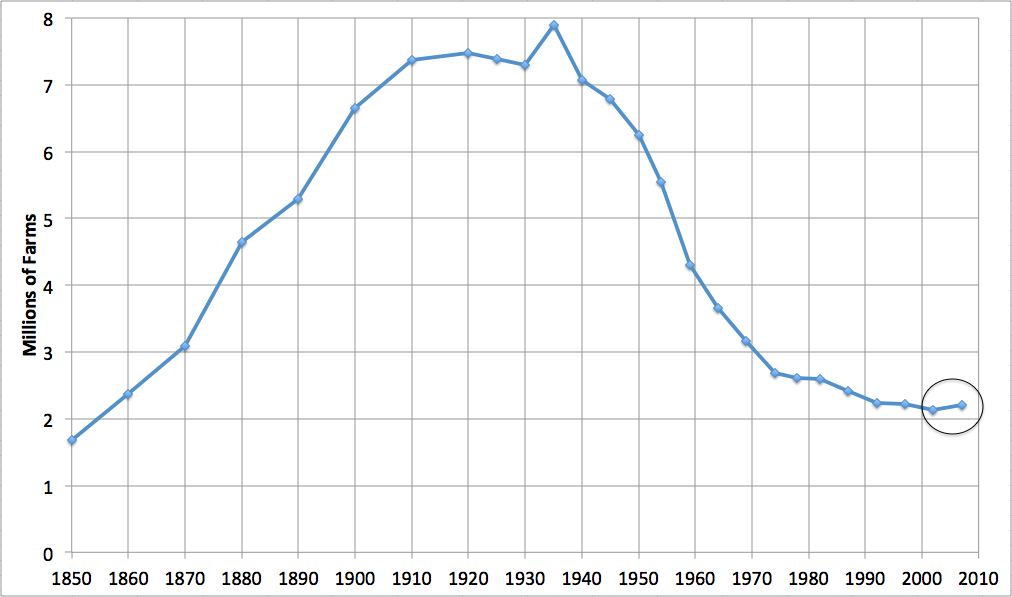
I wanted to know the backstory to the “4 percent” (incidentally – when did this become good style vs “four percent”?). Thus I made this graph of the number of farms going back to 1850 (from the US agricultural census).*
I’ve circled the 4% increase between 2002 and 2007. Note that the reporter is incorrect that this is the first such increase since 1920: there was a large increase in 1935, presumably due to the effects of people going back to the land in the great depression. Note also that the 2007 census is just before the great recession and it’s possible the 2012 census will show a larger increase given both the recession and, perhaps, an ongoing trend amongst young people of returning to agriculture.
So, we are a long way from Sharon Astyk’s Nation of Farmers, but it certainly looks like the giant loss of US farm count in the mid twentieth century has stabilized and perhaps now begun some kind of bounce back**.
* Technical data note: the 2007 census shows counts “adjusted for coverage” from 1997 on, and then unadjusted numbers from 1997 and before (ie they show both for 1997 and the adjustment is about 15% upward). Plotting both the adjusted and unadjusted numbers resulted in an obvious discontinuity in the graph at 1997. Therefore I rescaled all data before 1997 by the 1997 correction. Thus the absolute value of this data should be regarded as somewhat uncertain by something probably less than 15%. The shape is probably pretty much right though.
** Personal note: my family’s house was built as a farmhouse (in a valley in the hills of upstate New York) either in 1850 or 1870 – we were told both and haven’t figured it out yet – and ceased to be a working farm in the 1960s (as near as I can tell from examining satellite photos). So it pretty much exactly spans the US farming boom.