


The Nepal glacier debris inundation arrives at the Gyirong Port on the Nepal-China border, August 26. (Wikimedia Commons)
On August 22, the surface of the world’s oceans averaged 70°Fahrenheit, the hottest in recorded history and probably in 125,000 years.
This came in what may be the hottest summer on record. By August 5, the emerging record El Niño cooked Pacific Ocean temperatures beyond the peak reached by the monster 1997-98 El Niño. Berkeley Earth climate scientist Zeke Hausfather described the rise as “nothing short of astonishing.” This El Nino is tracking at the high end of projections with months of heating ahead, promising climate chaos around the globe.
Climate scientist James Hansen sets the context. “The ongoing El Nino is already the strongest in the modern record. However, increasing global climate anomalies, poleward shifting of climate zones, increased rainfall extremes, more rapid flash droughts and fires, and marine heat waves are a result of accelerating human-made global warming. The abnormal El Nino strength is itself likely human-driven.”

Then on August 26, a glacier and mountainside in the Langtang Valley of Nepal crashed into the river below during the area’s fourth hottest summer on record after several days of record August heat. The season’s monsoon rains were around 50% above normal, melting the glacier surface and probably infiltrating down to the bedrock, lubricating the slide. It spawned a blackened torrent of water, boulders, mud and debris that thundered miles downstream, shredding villages and likely killing thousands.
“It would be a hell of a coincidence if global warming wasn’t at least partially to blame,” said Berkeley Earth Chief Scientist Robert Rohde.
University of Pennsylvania climate scientist Michael Mann was even more definitive. “The torrent was the direct result of warming-induced glacial collapse, which dumped millions of tons of rock, unleashing a high-velocity wave of mud and debris.”
He wrote, “The glacial collapse and deluge in Nepal and Tibet was not a freak weather event; it was the structural failure of a mountain itself, nature’s latest commentary on the deadly consequences of human-caused planetary warming. And it was the exclamation point on a summer of extremes, illustrating with a single unnatural disaster the apocalyptic future that lies in store if we fail to take dramatic climate action.”
Buried under the muck
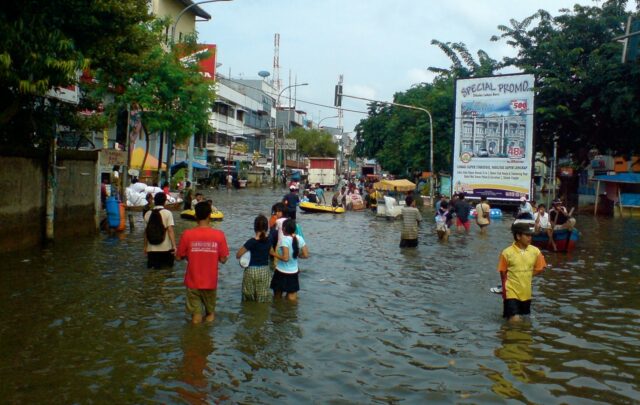
It’s been a hellacious summer. Wildfires and plumes of smoke swept the world under repeated heat domes and long-term droughts. They deeply cut into European agriculture while drying out rivers vital for commerce. Nuclear plants deprived of cooling water shut down in Hungary and Romania. In North America, smoke from record fire seasons in Canada and Oregon choked people to the Atlantic coast. Long-term western U.S. drought drained its two largest dam reservoirs, Lakes Mead and Powell on the Colorado River, to record lows. Flooding spread across many U.S. states, as well as Germany, France, Indonesia and West Africa.
At the close of meteorological summer ending September 1, I’m boiling like the oceans with rage and disgust at how far short our climate efforts have fallen. And I feel like a Nepalese village buried under the muck, overwhelmed by the inundation of bad news. It’s been damned hard digging myself out to get at my writing table. But I’ve had to sit back and reflect on where we stand as a climate movement and a species. And work through my own emotions, which are hitting their own critical threshold. This summer pushed me over the line.
I’ve been in the climate fight for decades. I’ve worked to grow two climate groups into substantial forces. My name is on two books and dozens of papers on climate change solutions. I’ve contributed to several major solutions research efforts and helped organize tables aimed at building consensus on climate policies. I’ve locked myself to a tripod blocking an oil train with its climate-twisting cargo. I’ve been everywhere from governors’s offices to county jail holding tanks. I helped stage the first climate civil disobedience necessity defense in U.S. history for that oil train action, arguing we broke the law to avert a greater harm.
And after all that, after this summer, I recall that Ken Kesey put out a serialized novel called Spit in the Ocean, based on a variety of poker with many wild cards. I wonder if everything I’ve done amounts to spitting in the rising seas while climate chaos holds the winning wild card. I feel a deep sense of failure. Not so much personal failure, or even of the movement in which I have participated since the 1990s. Staring us in the face is the greatest failure in the existence of our species and our ancestors since they walked out onto an African savannah opened by climate drying some 3 to 4 million years ago. University of Washington neurophysiologist William Calvin theorizes that abrupt climate shifts over millennia caused diebacks that sorted out our ancestors. Those with the biggest brains survived. These gave us mastery of tools and fire that enabled genus Homo to eventually dominate the planet. Now, in our greatest irony, our immense powers have set us on the road to yet another abrupt climate disruption, consumed in the fires of a rapidly heating planet.
Some years ago, I was conversing with a major environmental leader who has made phenomenal contributions to the cause of the planet. “You know,” he said, thinking about the long-term human future, “species that overshoot their habitat tend to have their numbers reduced.” I fear we are on that road. In 2025, a group of actuaries from University of Exeter published a risk-based analysis of likely heating impacts. They set out potential worst-case scenarios of 2 billion people facing early death if temperatures rise by 2° C by 2050 and 4 billion with 3°C by 2050. Among causes would be social conflict, billions forced to migrate by unbearable heat and thirst, food production collapse, and triggering of tipping points where heating feeds more heating. That number is gaining a lot of play lately because Extinction Rebellion founder Roger Hallam has started a new group, 4 Billion Dead. But depicting these numbers as predictions has come under some criticism. The report emphasizes they are only scenarios against which to measure risks. Nonetheless, when experts whose profession is to assess risk assign even an outer boundary possibility to such scenarios, it should give us pause.
Humanity’s greatest risk – Triggering climate tipping points
Humanity is increasing climate-heating gases at the fastest rate in the geological record, the whole history of the planet as far as we can understand it. The result is the most rapid heating we can detect. What took centuries now occurs in decades. The growing risk is that we will set off a cascade of tipping points that drive the climate into chaos, potentially realizing something like those Exeter scenarios. This graphic depicts them:

A master tipping point is the AMOC, the Atlantic Meridional Overturning Circulation, the place in the North Atlantic where warm currents coming from the south sink to the depths, weighed down by their salt content. That opens space, drawing the current north. But meltwater from a warming Greenland has been diluting the saltiness and slowing the sinking, with knock-on effects reaching back into the entire oceanic circulation. A study published in April found a 90% probability that the AMOC will slow by 51% by 2100, putting it on a path to eventual shutdown. Impacts could extend to Antarctica and the Pacific. African and Indian monsoons could weaken. This might be happening already, with a slowdown. Shutdown threatens to dry out Amazonia and the African Sahel. It would cool and dry Europe, elevate U.S. East Coast sea levels, and pile up heat in southern latitudes.
“I have personally researched this for 35 years,” says Stefan Rahmstorf, one of the world’s leading scientific experts on the AMOC. “For the first 30 years we considered this a low likelihood event. I would have said a 5 percent chance of occurring. It’s more like 50/50 now. I would even say more likely than not.”
A recent study from Utrecht University offers perhaps the first ray of daylight in the otherwise grim picture. It showed that the AMOC could collapse at as little as 2° C heating. But if the rate of heating is slowed, the current might remain stable even at 5° C heating.
The Utrecht study brings home the most important message of this piece. Everything depends on the rate of change. Given time to adjust, the Atlantic Ocean can potentially fend off AMOC collapse even under extreme heating. This message applies across the range of climate impacts. We must slow the rate of climate heating as much as possible to avert the worst impacts. That is most important project humanity now faces. It is why, contemplating tipping points dangers some years ago, I revised my climate mission to leaving a planet with which our kids can cope.
Unfortunately, the world is still tracking at a higher rate, heating around 0.3°C per decade. We are bumping up against the 1.5°C target set by the 2015 Paris Climate Summit. A new report from the United Nations Environment Program admits we have blown the 1.5°C goal. The best we can expect is to peak at 1.8-2° C. The report holds out hope that humanity can bring temperatures back down with strong action.
“There are no good outcomes if we remain above 1.5°C. Across the globe, extreme heatwaves are already proving that climate impacts will strike faster, hit harder, and last longer, costing more lives and causing deeper disruption,” said Inger Andersen, executive director of UNEP. “Now is the time we must double down on climate action. We can and must get on the right path by cutting greenhouse gas emissions, strengthening resilience and adaptation, and ensuring exceedance of 1.5°C is as small and short as possible.”

But overshooting 1.5° escalates risks of setting off tipping points, as this graphic from the Global Tipping Points 2025 report shows. The range between 1.5-2°C is crucial. Nearing the low end danger signs are already showing. Coral reefs have already tipped over. Glacier loss from West Antarctica is increasing. The North Atlantic subpolar gyre is destabilizing for the same reasons as the AMOC and could collapse faster. Risk to mountain glaciers gained a bold underscore in Nepal. The Amazon rainforest may be tipping from carbon soaker to emitter. Earth is crossing critical thresholds beyond which dangers radically increase. That’s one reason 1.5°C was targeted in the first place.
Science Daily’s report on the Utrecht study offers a caution on overshoot strategies that might well apply to the range of tipping points. “Much of current climate policy, including the Paris Agreement, focuses on limiting the eventual peak in global temperature. Some strategies involve so-called overshoot pathways . . . The new findings suggest that the path taken toward a given temperature may matter alongside the temperature itself. The faster global warming occurs, the less time the Atlantic Ocean has to adjust, potentially increasing the vulnerability of one of the planet’s most important circulation systems.”
I know people who have made seminal contributions to the cause of the climate and the Earth who have looked at this picture and thrown up their hands in despair. But I’m not there yet. I know that every tenth of a degree could spell the difference between worst-case scenarios and more survivable outcomes. I helped bring a child into the world 30 years ago to the day I am writing this. So I have a direct investment in future generations. But even if I didn’t, I could not accept even the remote possibility of billions dying if I could possibly do anything about it.
This piece has been edited for length. Read it in full here.



Comments
We changed commenting systems on September 10, 2026 as part of a site-wide functionality and security upgrade. Your past comments have not disappeared, and you can still log in with your old Disqus account credentials if you wish. Contact us with any questions.