


The contemporary bioregional movement emerged from the 1960s counterculture, anti-war activism, ecological thought, and back-to-the-land experiments, but the impulse behind it is far older. Human societies have historically developed in relationship with particular landscapes, and for most of human history, culture was inseparable from place. Today, such place-based relationships remain especially evident within Indigenous and other Earth-based traditions.
Northern California became one of the movement’s early centers. A network of writers, artists, activists, and organizers sought to renew relationships among humans, the more-than-human world, and the places they inhabited. Many were of European settler descent and were grappling with the ecological and cultural consequences of colonization and industrial society.
Among the most influential figures in early bioregional organizing was the ecological activist Peter Berg. A former member of San Francisco’s “Diggers,” Berg co-founded the Planet Drum Foundation with Judy Goldhaft in 1973. Planet Drum provided important pre-internet communication among communities experimenting with place-based ways of living and continues to support bioregional organizing today.
In 1976, Berg published Amble Towards Continent Congress, an essay that would become foundational to the emerging bioregional movement.[1] Berg envisioned congress as an ongoing process of coming into relationship with the living continent. In Berg’s conception, congress was a verb rather than a noun. He described congressing as a lifelong exploration of renewing our relationships with the places we inhabit and with one another.
Two years later, Berg collaborated with conservation biologist Raymond F. Dasmann to further develop the concept of the bioregion. In their influential 1978 essay Reinhabiting California, they defined a bioregion as both “geographical terrain and a terrain of consciousness—to a place and the ideas that have developed about how to live in that place.”[2] This conception of a bioregion advances an integral understanding of bioregionalism that bridges the ecological and cultural dimensions of human existence. From this perspective, bioregions are defined not only by watersheds, climate, soils, flora, and fauna, but also by the stories, practices, and cultural traditions that emerge through enduring relationships with particular places.
One of the defining features of the first era of contemporary bioregional organizing (early 1970s – 2009) was the bioregional congressing process. In the 1970s, another important center of bioregional organizing was taking shape in the Ozarks. Inspired by many of the same currents influencing organizers in California, David Haenke convened the first Ozark Area Community Congress (OACC, pronounced like an “oak” tree) in 1980. OACC continues to bring together people interested in ecological restoration, local culture, and regional self-reliance. It is the longest-running bioregional congress, celebrating its forty-seventh year in 2026. At the second OACC in 1981, participants adopted a resolution calling for a continental-scale bioregional congress. After several years of organizing, the first North American Bioregional Congress was held in the Ozarks in 1984.
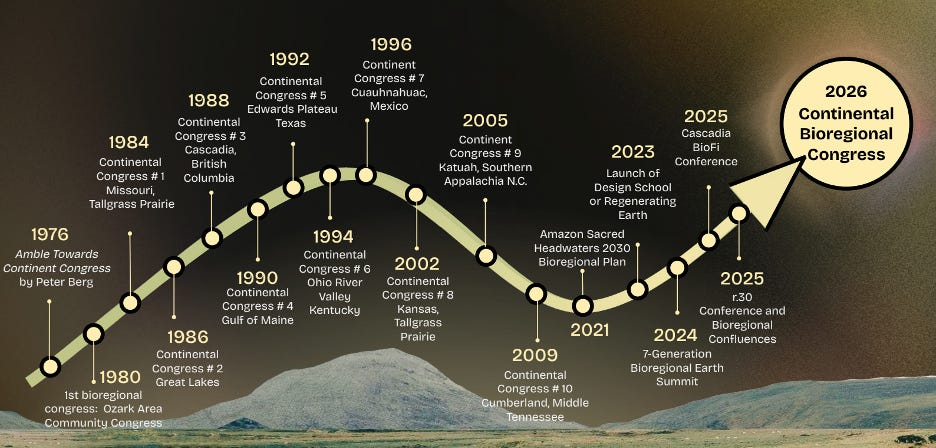
Between 1984 and 2009, ten continental-scale bioregional congresses convened across Turtle Island (North America), with gatherings taking place in the United States, Mexico, and Canada. Congresses brought together several hundred participants at a time to share knowledge, build relationships, celebrate place, and develop collective responses to ecological and cultural challenges. Many sought to honor Indigenous peoples, acknowledge historical injustices, and build relationships grounded in respect and solidarity. Indigenous communities participated in numerous bioregional congresses, helping to shape conversations about place, responsibility, and cultural renewal.
Bioregional congresses were intentionally different from conventional conferences. Rather than featuring a small group of experts speaking to passive audiences, participants collectively shaped the agenda. Workshops, watershed reports, council meetings, ceremonies, performances, and shared meals created opportunities for learning across regions and traditions. The first era of the contemporary bioregional movement provided a valuable foundation that helped the movement cohere its identity and principles through the passing of many resolutions by consensus process.
The congresses created spaces for experimentation in ecological culture and governance. Participants exchanged practical knowledge about Indigenous solidarity, watershed restoration, local economies, renewable energy, food systems, green cities, ecological design, and community organizing. They also sought to cultivate relationships strong enough to support long-term action after returning home. Celebration, cultural sharing, theater, music, and art were also central to the congresses.
Although the continental congressing process paused after 2009, bioregional work never disappeared. Across North America and beyond, watershed councils, Indigenous-led stewardship initiatives, regenerative agriculture projects, local food networks, rights of nature campaigns, and countless community resilience efforts continued to carry the bioregional vision forward, even if not by name.
A renewed interest in bioregional organizing is well underway around the world, marking a second era of the movement. Several factors are contributing to this resurgence. Climate disruption, biodiversity loss, political polarization, and the fragility of global supply and economic systems have prompted many people to look once again to place as a source of resilience and belonging. Bioregional initiatives are now appearing in areas as diverse as finance, law, governance, conservation, education, technology, and cultural renewal. Rather than remaining concentrated primarily on Turtle Island, as during the first era, bioregional organizing has spread globally through a growing network of interconnected initiatives, gatherings, and communities of practice.
The revival of continental congressing through the Eleventh Turtle Island Bioregional Congress (TIBC11) is one expression of this renewed momentum. After a seventeen-year pause in continental-scale congressing, TIBC11 will convene in the Cascadia Bioregion from September 15–19, 2026. Like the congresses that came before it, TIBC11 is intended not as a conventional conference, but as a participatory and co-created process through which participants collectively explore how bioregional approaches might help communities respond to the intertwined ecological and social challenges of our time. TIBC11 will take place during Global Bioregional Month, a broader constellation of events, gatherings, and celebrations occurring across several continents throughout September 2026.
At its heart, bioregionalism remains both practical and hopeful. It begins with a deceptively simple proposition: that human flourishing is mutually dependent upon the flourishing of other beings and the places we call home. The work of bioregionalism, then, is the ongoing effort to become good inhabitants of place.
- [1] Berg, Peter. Amble Towards Continent Congress, 1976.
- [2] Berg, Peter and Raymond F. Dasmann. “Reinhabiting California,” in Reinhabiting a Separate Country, 1978.



Comments
We changed commenting systems on September 10, 2026 as part of a site-wide functionality and security upgrade. Your past comments have not disappeared, and you can still log in with your old Disqus account credentials if you wish. Contact us with any questions.
Thanks for writing this piece, in these dark times it’s good to know that bioregionalism is having a revival of sorts. I attended the 4th Congress in Maine and it was a watershed event that shaped my life ever after – leader-full governance, consensus decision making, plant-based eating just to name a few things. Sadly, I couldn’t make bioregional economics work for me and my bioregion ended up being a small house and garden in a major metropolitan area. It warms an old man’s heart to read about a new bioregional congress, and to see some of the people that will be there. Of particular interest is David Haenke, whose booklet “Ecological Politics and Bioregionalism” was a profound influence on how I viewed the world. I’ve just started re-reading another book, that I would highly recommend to those working on a resurgence of bioregionalism, “Sacred Land, Sacred Sex, Rapture of the Deep” by Dolores LaChapelle.