

What our evolutionary heritage reveals about the world we could build — and the principles that could take us there.
When people look at the cascading pathologies of our civilization — the relentless extraction, the extreme inequality, the systematic degradation of the living world — it’s easy for despair to set in: if this is what humans do, perhaps it’s just what humans are. If we are basically selfish, acquisitive individuals, then maybe neoliberalism is simply the system we deserve.
But a vast array of scientific findings — in fields such as evolutionary biology, cognitive science, and anthropology — offers a fundamentally different analysis. The behaviors that drive our current crisis are not the expression of a fixed human nature. They are the product of a specific historical trajectory, one that began only a few thousand years ago and has been intensifying ever since.
Our ancestors spent roughly ninety-five percent of our species’ history in nomadic hunter-gatherer bands — a very different kind of existence, one where accumulation of wealth was unthinkable and communities kept in check the power of domineering individuals. Beginning sporadically around ten thousand years ago, certain bands started settling in place. Agriculture emerged. With it came private property, and with private property came hierarchies. A farmer who got lucky with his crops accrued extra wealth and power, which allowed him to recruit others to help defend his possessions, with violence if necessary. Aggressive communities conquered more peaceful ones, foisting on them warrior cultures that prized machismo and domination. Over millennia, this dynamic compounded into the civilizational order we have inherited — virtually every major civilization in history constituting some version of a wealth pump, with patriarchal cultures, rigid hierarchies, cruel exploitation by elites, and unsustainable resource extraction.
In my book, Ecocivilization: Making a World that Works for All, I lay out a framework for an ecocivilization that would represent an entirely new phase of human history — one that redefines the possibilities of the collective human experience by applying our evolutionary legacy to a technologically advanced, global society. To understand what that could look like, we first need to understand what that legacy actually is.
What we actually evolved to do
Cast your gaze back to the long stretch of human experience before that rupture, and a strikingly different picture emerges. Across continents and across millennia, Indigenous and traditional communities share a convergent cluster of values and practices: deep reciprocity and gift economies in which accumulated surplus is redistributed rather than hoarded; decisions made collectively, with strong norms against domination by any single individual; an identity constituted through relationship — with each other, with community, with the living world; an ethic of living within limits, taking what is needed and leaving the rest; and a worldview in which humans are embedded in nature, not elevated above it.
We see these values carried forward in living Indigenous traditions today. Ubuntu’s foundational insight — I am because you are — holds that selfhood is relational at its core. The Andean concept of buen vivir speaks of living well in right relationship with community and the living world. And these same currents run through humanity’s great faith and wisdom traditions: Buddhism’s interdependence and imperative of compassion for all sentient beings; Christianity’s love of neighbor and care for the poor; Islam’s emphasis on stewardship of creation and economic justice; Confucianism’s emphasis on social harmony; and Daoism’s invitation to attune with natural flows.
These traditions arose independently, across vastly different cultures and epochs. Their convergence reflects a shared inheritance of what humans fundamentally need and care about.
What this inheritance points to is an affirmation of the primacy of human flourishing — a concept originally clarified by Aristotle. He drew a distinction that remains central to modern psychology: between hedonia — transient pleasures arising from praise, acquisition, status, and material comfort — and eudaimonia, the deeper well-being that arises when a person strives to fulfill their true nature and realize their unique potential. Our dominant consumer system is engineered around hedonia, locking people onto a hedonic treadmill that drives perpetual economic growth. An ecocivilization, by contrast, would be designed to cultivate eudaimonia.
The principles of life
Life itself, as manifested in healthy and resilient ecosystems, offers an essential model for how such flourishing might be organized. Three core design principles emerge from the logic of living systems.
The first is mutually beneficial symbiosis. Life’s great evolutionary leaps — from single cells to complex organisms, from organisms to ecosystems — have been driven not primarily by competition and conquest, but by symbiosis: relationships in which each party offers something the other needs, creating a whole greater than the sum of its parts. An ecocivilization would organize human society around this same principle, not merely minimizing harm to other beings and systems, but actively contributing to their flourishing.
The second is fractal flourishing. Look around the natural world and you will see fractal patterns at every scale — in the branching of trees, the structure of coastlines, the architecture of lungs and neural networks. Ecologies are themselves fractal: cells nested within organisms, organisms within populations, populations within ecosystems, ecosystems within the living Earth. In a healthy fractal system, the well-being of the whole depends on the flourishing of each part. An ecocivilization would embody this principle: creating the conditions in which each person’s flourishing naturally contributes to — rather than diminishes — the well-being of the larger systems in which we are all embedded.
The third is integration, which can be understood as unity with differentiation. A flourishing ecosystem is not homogeneous. It is diverse and differentiated, and precisely because of that diversity, more resilient and generative than any monoculture could be. An ecocivilization would honor and actively support the diverse ways in which cultures and individuals pursue their own forms of wellbeing — weaving that diversity into a richer whole rather than flattening it into a single Western template.
From principles to practice
To understand these principles in context, it helps to contrast them with those underlying our current civilization — the principles that have set us on the disastrous trajectory we’re currently on.
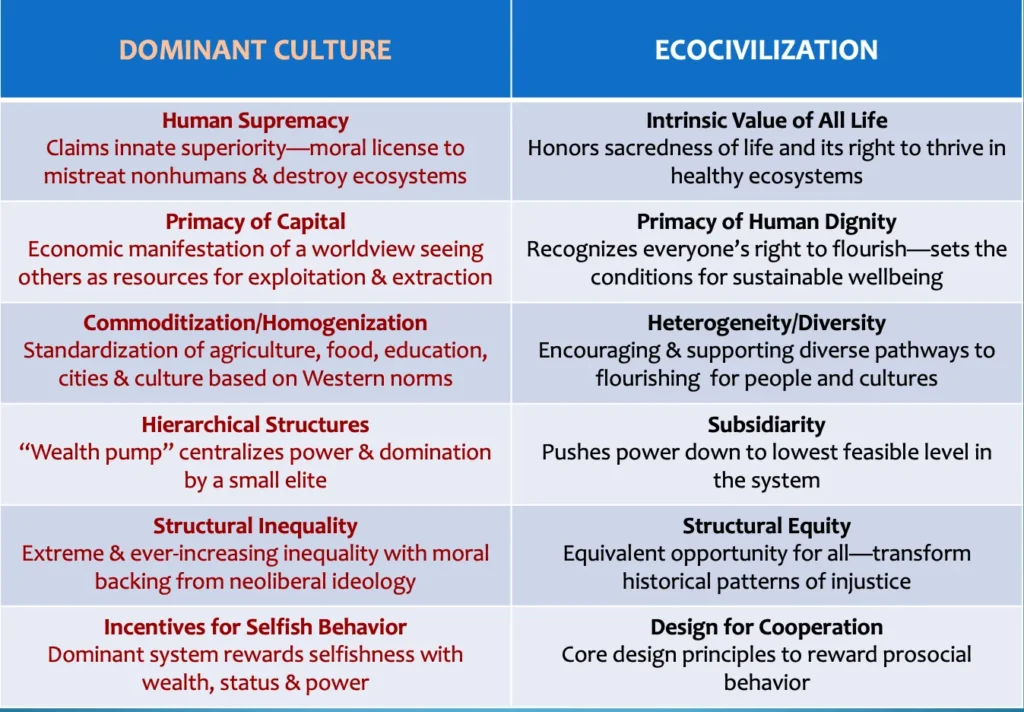
The dominant culture rests on a foundation of human supremacy: an anthropocentric ideology claiming innate superiority over nonhuman nature, giving moral license to mistreat animals and destroy ecosystems. An ecocivilization would eschew anthropocentrism, recognizing the intrinsic value of all life and honoring its right to thrive.
The economic manifestation of a worldview that treats others as resources for exploitation is capitalism — a system that gives dominion to capital, establishing a rulebook that prioritizes its proliferation above any other considerations. An ecocivilization would instead give primacy to the essential dignity of all people and their right to flourish, setting the conditions to optimize eudaimonia.
The relentless pursuit of profits under global capitalism has led to unprecedented commodification and homogenization: monocrop agriculture, destruction of biodiversity, and the standardization of food, education, cities, and culture based on dominant Western models. An ecocivilization, following the principle of integration, would support heterogeneity — honoring the diverse ways in which various cultures and individuals pursue their own paths to flourishing.
Our modern civilization is only the most recent instantiation of the wealth pump, using hierarchical structures to centralize power and preserve domination by a small elite. An ecocivilization would promote the principle of subsidiarity: pushing decision-making power down to the lowest feasible level in the system, trusting communities with the choices that shape their lives.
An inevitable result of the wealth pump is structural inequality — extreme disparities in wealth and power, now reaching grotesque levels with moral backing from neoliberal doctrine. An ecocivilization would emphasize structural equity: aiming to provide each person with an equivalent opportunity to fulfill their own unique potential, which implies a deep commitment to transforming historical patterns of political, cultural, and economic injustice.
Finally, the dominant system motivates selfish behavior from childhood onward, rewarding it systematically with wealth, status, and power. An ecocivilization would be built instead on core design principles for successful cooperation — reward structures that align with the inherent prosocial disposition of human nature as it has evolved over millions of years.
PRINCIPLES OF AN ECOCIVILIZATION
Cohering the weave
A reasonable question might arise from the many inspirational examples the book lays out: could any of these actually succeed within the corrosive context of the dominant system? On a standalone basis, many are already taking root. But they are currently working against a hegemonic tide propelling us in the opposite direction.
What is crucial to hold in mind is how these ideas build on and support each other. The principles of an ecocivilization are not a menu of separate reforms from which we might pick a few favorites. When entwined as a coherent whole, these elements reinforce one another, forming an internally consistent, fully integrated system — more resilient and transformative than any of its components operating alone.
That is the deeper promise of an ecocivilization: rather than a collection of good ideas, it represents a new (and ancient) civilizational operating system — grounded in life’s own design principles, aligned with our deepest evolutionary inheritance, and adequate to the scale of transformation our moment demands.



Comments
We changed commenting systems on September 10, 2026 as part of a site-wide functionality and security upgrade. Your past comments have not disappeared, and you can still log in with your old Disqus account credentials if you wish. Contact us with any questions.
Not all ecosystems reach a climax state but those that do only hold that state until something perturbs it. As early humans moved around, they would have perturbed all ecosystems they moved into. It couldn't be otherwise with a new species moving in and needing to eat. The notion of some stable ecosystem that humans could inhabit seems fanciful. Indeed, no species consciously lives within limits. Otherwise, evolution would have nothing to work on. All species use whatever capabilities they've evolved with to maximise the throughput of resources, sometimes called the maximum power principle.
Negative feedbacks, predation, sickness, injury, can limit the success of species, and where the environment stays stable long enough, the many species within an ecosystem can reach a temporary stable state, until inevitably perturbed. This can be because of environmental changes (climate change, earthquakes, asteroid strikes, etc.), mutations of species, or some species moving in (e.g. a virus or humans). Then it may be able to reach a different stable state.
No species (as a species) will consciously choose to restrict their use of resources, whilst others don't and are more successful (for a while). Species don't live for the future, they live for the now. Humans, collectively, are no different, but have capabilities for the throughput of resources which are much greater than other species. So they create the most damage and can probably never live in climax state ecosystems. That some groups appear to have done for now is an artifact of us not being able to comprehend deep time. All humans lived in what seemed like stable egalitarian groups, living within limits. But we've seen what happened. It was inevitable.
No civilisation that depends on non-renewable resources (as all "advanced" ones must) can be sustainable. Sustainability requires using resources only at, or preferably below, their renewal rates, and not damaging the environment beyond its ability to assimilate that damage. So use of non-renewable resources can never be sustainable (even if a low level of that use can go on for a very long time, as it has).