At the beginning of his second term, President Trump pledged a regime of aggressive deregulation to stimulate economic growth. Unfortunately he has followed through on that promise, claiming 646 deregulatory actions over the past year. These have aided industries ranging from slaughterhouses to automakers no longer bound by emissions standards under the Obama-era Endangerment Finding, which has now been reversed.
The energy sector has been among the foremost beneficiaries. Environmental rollbacks have already unleashed accelerated oil, gas, and mineral development, especially on treasured public lands.
Aside from its reckless imperilment of the natural world, Trump’s deregulation poses alarming risks to human health and safety. Among the most alarming are changes to regulations governing nuclear reactors and their waste.
Rollbacks too radioactive for public notice
In January, with no public notice or involvement, the administration overhauled nuclear safety regulations. The changes, though made in secret, were shared with the companies that stand to benefit from them.
Although its exact scope remains unknown, we know that the overhaul cut over 750 pages of Department of Energy (DOE) nuclear safety regulations. The changes nix requirements that groundwater, wildlife, and plants be protected from harm by radioactive materials. They replace these requirements with vague exhortations that “consideration must be given” to avoiding such harm. They double the allowable limit of accidental radiation exposure for workers before an investigation is triggered. And they cut entire chapters on how and with what physical barriers to secure nuclear material.
Trump issued the changes in a series of orders intended to expedite the construction of a new generation of reactors. Under the terms of a pilot project launched at a meeting with industry last May, at least three of these new so-called small modular reactors (SMRs) should be operational by July 4.
“Small” modular reactors are actually as large as a city block. They generate less than 300 megawatts (MW) of electricity, in contrast to the 1,000 MW generated by conventional large nuclear plants.
The program will be under the direct oversight of the DOE. The Nuclear Regulatory Commission (NRC) is more independent and has overseen the safety of commercial reactors since the 1970s. However, the NRC will only consult on the development of reactors built under the pilot. The program will also be exempt from the National Environmental Policy Act, which requires federal agencies to consider and solicit public comment on the environmental consequences of major projects.
The rollbacks, as far as we know, only apply to reactors built under the pilot. But their impacts could reach much further, according to Edwin Lyman, Nuclear Power Safety Director at the Union of Concerned Scientists.
“They’re pretending that these are test reactors that are not being built to generate commercial power,” said Lyman in an interview for the Herald. But the changes “could propagate across the entire fleet of commercial nuclear facilities, severely degrading nuclear safety throughout the United States.”
Nuclear safety regulations: A history of hard lessons
The rollbacks target regulations that emerged from decades of hard lessons and careful deliberation. After World War II, when the United States demonstrated the terrifying power of the atom in Hiroshima and Nagasaki, governments around the world quickly harnessed that power for commercial use. The U.S. government put a single agency, the Atomic Energy Commission, in charge of both the promotion and the regulation of nuclear power.
The conflict of interest inherent in this dual mandate was soon put to the test. In the 1960s, a Bandwagon Market for new reactors strained the ability of the agency’s small staff to ensure safety. Runaway costs and construction delays took their toll on public sentiment toward nuclear power. So did persistent concerns about radiation leakage from nuclear plants in the case of an accident or during routine operation.
The government established the NRC in 1974 to address public unease and provide independent regulation of the industry.
But NRC oversight was not enough to prevent the worst nuclear accident in U.S. history just five years later. In 1979, a combination of mechanical failures, malfunctioning indicators, and poor employee training at the Three Mile Island nuclear plant in Pennsylvania caused about half the fuel to melt. Although minimal radiation was released, the accident triggered the evacuation of 144,000 people and widespread public alarm.
Other mishaps have plagued the industry. In 1975, a fire broke out at the Browns Ferry Nuclear Plant in Alabama when a worker used a lighted candle to check for proper sealing around cables. In the early 1990s, whistleblowers at the Millstone Power Station in Connecticut reported that they had faced intimidation or dismissal for calling attention to dangerous violations of NRC regulations. And in 2002, an inspection at the Davis-Besse nuclear power station in Ohio revealed significant corrosion of the pressure vessel’s head. The degradation was so severe as to indicate prolonged negligence in maintenance and inspection.
Each of these incidents had a chilling effect on public sentiment toward nuclear power. This effect was magnified by accidents at Chernobyl in 1986 and the Fukushima Daiichi nuclear plant in 2011. The NRC has since implemented significant safety reforms including improved operator training, emergency preparedness, and equipment requirements.
Data centers’ gluttonous energy demand
Given this history, one might think we’d need a pretty good reason to scrap nuclear safety regulations.
No such luck. The current push toward deregulation originates with one industry, and it is one of questionable relevance to human well-being. It is the proliferation of electricity-guzzling AI data centers that is driving the push to gut regulations and build reactors in a hurry.
Data centers, which are increasingly but not exclusively used to power artificial intelligence, accounted for more than four percent of U.S. electricity consumption in 2023-2024. This figure is likely to increase to 17 percent by 2030. Although natural gas will power most AI in the near future, investments by tech billionaires and firms may soon change that.
Meta, Nvidia, and Bill Gates, for example, have invested millions in nuclear startup Terrapower, which the NRC just approved to build a reactor in Wyoming. This was the first commercial reactor approved in the United States in more than a decade. The speed of its approval suggests the NRC may be taking safety shortcuts to grease the wheels of industry growth. Under increasing bipartisan pressure from Congress, the agency’s response has been to streamline permitting and, critics argue, compromise safety.
A perilous deregulation-driven renaissance
In addition to putting safety on the line, hasty permitting can actually increase costs. The story of two reactors recently completed in Georgia displays this unfortunate consequence. In 2009, Georgia Power received NRC approval to build two reactors. These reactors, the first to receive approval in three decades, would join two existing reactors at Plant Vogtle near Augusta. These had themselves come online in 1987, at a cost exceeding their budget twelvefold.
In 2023–24, Vogtle Reactors 3 and 4 were completed—seven years behind schedule and $23 billion over the initial budget of $14 billion.
Despite the industry’s 2003 promise of energy “too cheap to meter,” Georgia utility customers are now paying some of the highest rates in the nation.
Such delays and cost overruns are par for the course for the industry. But contrary to the claims of nuclear proponents, they can seldom be blamed on burdensome regulation. In the case of Vogtle, construction errors, corporate malfeasance, and regulatory laxity were at fault. A study noted that “inadequate Nuclear Regulatory Commission regulation and streamlining procedures meant to encourage investment in new nuclear projects contributed to excessive costs.”
And the dangers of lax regulation are large even for reactors that are small. SMRs contain less radioactive material and produce less heat. But rule changes that eliminate safety features could make them more dangerous, in the case of an accident, than a large reactor with stronger safeguards.
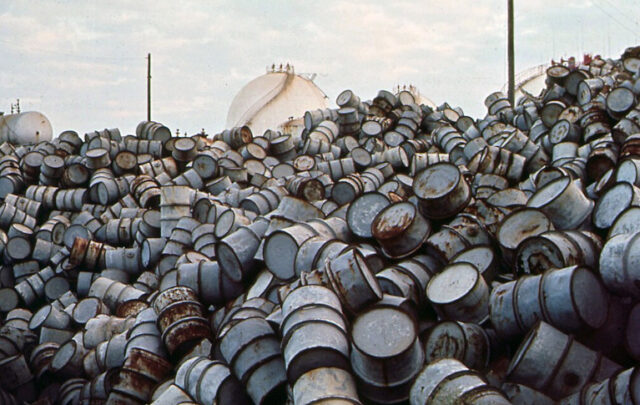
SMRs also do not address the persistent problem of waste. Data centers, industrial facilities, and communities with an SMR will likely have to house nuclear waste on site indefinitely. This prospect is particularly concerning in light of studies predicting greater volumes of waste and more reactive waste from SMRs than from traditional reactors.
Although SMRs have a smaller land footprint than conventional reactors, they produce energy less efficiently. This is in part due to economies of scale. It is also due to increased neutron leakage from their compact cores—leakage that damages the reactor and generates more waste.
Beyond safety and waste concerns, critics argue that SMRs’ potential to meet energy demand has been vastly overstated. Energy expert Vaclav Smil estimates that to contribute 10 percent of its electrical supply, the United States would have to build 1,300 SMRs generating 100 MW each. This does not account for the coming explosion in energy use from AI.
The industry allies who populate the Trump Administration and tech billionaires like Peter Thiel are not the only partisans of today’s bandwagon nuclear market. Nuclear power is also being hailed as a solution to climate change.
Nuclear power may partially answer the question of how to produce less carbon while generating electricity. But it does nothing to solve the much larger and more fundamental problem of ecological overshoot. That is a problem that cannot be solved by simply “transitioning” modern, growth-obsessed techno-industrial society to run on novel energy systems.
It is a problem for which the only real solution is to scale down our population and our economic enterprise, to a smaller steady state that is in balance with Earth’s capacity.
This piece has been edited and condensed for length. You can read the full article here.