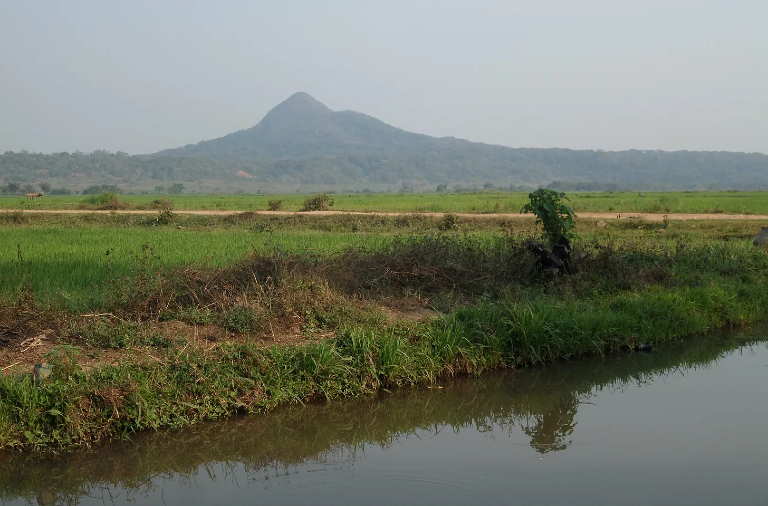
In late September, 2025, I found myself racing along dirt roads in northern Malawi on the back of a motorbike, with two other people packed tightly in front. I was sitting on a grid of metal bars, practically hanging off the back end of the bike, as the wheels churned up the mud and dust beneath our feet. A green sea of rice fields swept by as we weaved our way between busy motorcyclists and mothers carrying children in colourful chitenges. The lonesome Bungulu Mountain bulged out of the landscape, standing tall as we hopped off the bike to carefully cross a rickety footbridge over an irrigation canal. After some forty minutes, we finally arrived at Chombe Village, where we shook hands with the Ama Bwane.
This tiny, tranquil hamlet in Nkhata Bay District was comprised of modest mud-brick homes, straw huts, and small agricultural fields for subsistence farming; very typical for rural Malawian villages – 80% of Malawians live in rural communities, and about the same percentage are employed in agriculture. At the heart of the village stood a thatched straw shelter supported by wooden posts. We were invited to take a seat there while the villagers gathered to sit on the floor – 12 of them in all, mostly women. Sitting to my right, Maxwell began the meeting. Max and his team had been working with the villagers at Chombe for a year, delivering a series of training workshops in the field of agroecology. After a lengthy and enthusiastic discussion, we were taken for a tour of the village by the Ama Bwane – the ‘Mother Boss’.
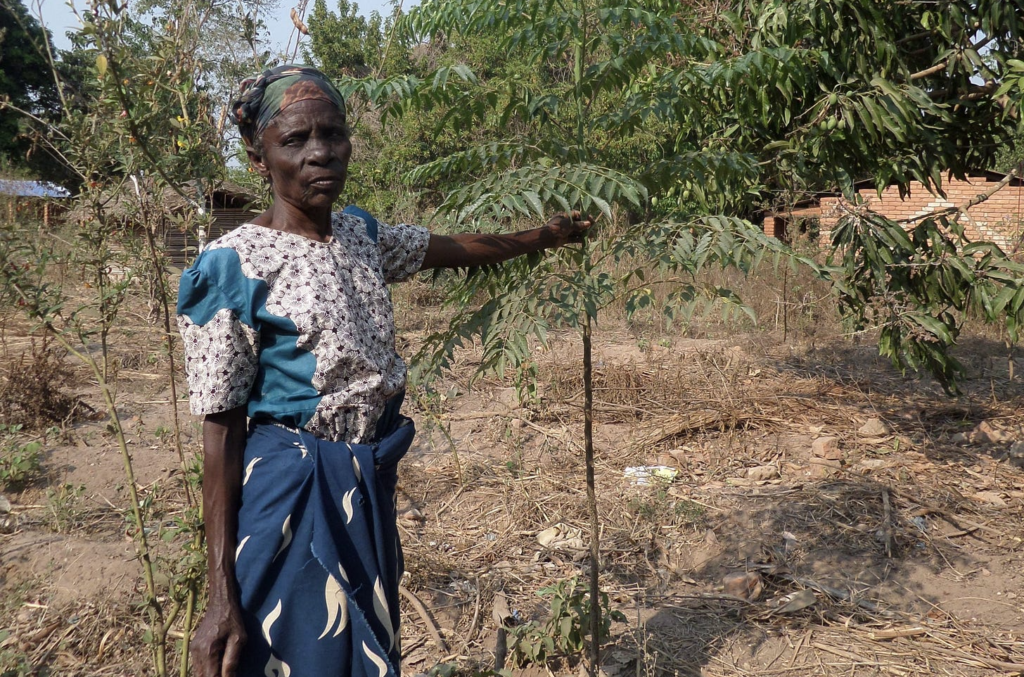
The shelter under which we’d been gathered safeguarded at least 112 fruit tree seedlings, each one spurting out of little heaps of soil and compost wrapped up in tubes of soft plastic. These tree tubes were primarily made of recycled milk packets. The villagers would sell the tree seedlings grown in their agroforestry nursery for 3000 MWK each, earning 336,000 MWK for the village. Also at the shelter were two large sacks of rotting organic material – food waste, green leaves, dry grass, maize stalks, animal manure, urine, and even ash. The result was a rich, dark-brown compost ready to be applied to the fields. Max went to investigate a mound of the stuff, covered with leaves and twigs, with a long stick protruding from the top. Grabbing the stick, he pulled it out and felt the bottom, barely paying attention to the ants crawling over his hands. The stick was warm; this was good. Heat implied that the compost was developing, since the rotting process releases energy. When the stick is cool again, the compost will be ready. We went with Ama Bwane to investigate the fields, where they had dug boxed furrows that capture water and store it in the ground, and had covered them with mulch – leftover organic materials that preserve the soil’s moisture and provide nutrients as they decompose. The villagers incorporated a system of intercropping – growing multiple crops in the same space, whose biophysical traits benefit the growth of all crops. These fields had successfully produced vegetables and herbal trees on soils previously considered dead. Ama Bwane also showed us her urine storage at the edge of the village, which she was very enthusiastic about. There were dozens of reused plastic bottles full of villagers’ urine, which is used to make an organic, affordable fertiliser called Mbeya and is also applied to compost heaps.
After rounding up our visit, Max and I thanked the villagers for their ardent participation and joined our driver, Frank, on the motorbike to cross the rice paddies once again. This time, I sat on the padded seat and Max got the metal grid behind me. Max is a field officer for a small start-up based in the town of Nkhata Bay called EARTH Workshops: Environment, Agroforestry, Restoration, Topsoil, Health. The project is facilitated by Butterfly Space, a not-for-profit eco-lodge centred around sustainable tourism and free community programs in Nkhata Bay. Local professionals from the EARTH team run weekly workshops in several rural villages in the district, offering holistic training towards food and water security, resilience to changing weather patterns, improved nutrition and health, and increased and diversified incomes. I joined the project as a voluntary intern for two months to learn more about the restorative benefits of agroecology: the umbrella term for the sustainable practices advocated by EARTH and many other grassroots organisations in Malawi and the wider continent, including Malawi Schools Permaculture Clubs, Never Ending Food, Ripple Africa, Tyeni, The Commonage, Permaculture Network in Malawi, and Eko Djembe.
Fundamentally, agroecology treats farms as ecosystems. It involves regenerative farming techniques that mimic nature, informed by deep knowledge about nutrient cycling, crops and agrobiodiversity, water and energy, insect and disease ecology, and local natural landscapes, while paying special attention to the social, economic, and political dynamics of agriculture. Agroecology is an ‘alternative paradigm to corporate-led industrial food systems’ that works towards food security through achieving food sovereignty. Food security is defined as access to safe and nutritious food that supports normal growth and development for an active, healthy life. Food sovereignty involves people’s right to nutritious food that is culturally appropriate, ecologically sustainable, and produced in a food system that is defined by and for themselves; the needs of food producers, distributors, and consumers are valued over the demands of markets and corporations. Agroecological food systems are organised from the bottom up, are ‘underpinned by social justice, solidarity, reciprocity and trust’, and value ‘diverse’ or ‘other’ forms of knowledge. Furthermore, in his book Decolonizing African Agriculture: Food Security, Agroecology and the Need for Radical Transformation, William G. Moseley argues that agroecology can dismantle past and present coloniality in the food systems of postcolonial African societies.
In early October, I travelled with another EARTH field officer, Thom, on an e-bike to Singo Village. When we arrived, we were greeted politely by Chief Fred, who shook my hand and welcomed us to his village. We waited a while for the villagers to gather, then Fred took us to inspect their compost heap, which was very large and making good progress. Thom took the temperature stick, which was cold, and revealed the maggots crawling around beneath the foliage. This meant that the heap’s material was ready to be turned around, and the compost would soon be ready. Thom added more water and urine from a watering can, mixed the material again, and re-covered the heap with vegetation. As an experienced agroecologist, Thom expertly reminded the villagers of the necessary steps of compost creation.
Afterwards, one man got to work grinding down pig manure for our demonstration on Mbeya fertiliser. I got involved with a group sieving the manure into a bucket using a mosquito net. Other villagers introduced a bag of chicken manure, followed by maize grain, and they mixed the materials together with a shovel. They then sieved charcoal to produce ash and added it to the mixture. Urine was then added from a watering can, and Thom began to mix it all together. I took over as he explained the reasoning for adding such ingredients: their fermentation process enriches the soil with natural nutrients, enhancing soil structure and, ultimately, crop growth.
Together, the villagers produced a 50L sack of Mbeya fertiliser, along with an equally-sized bag of ‘boosted’ artificial fertiliser which included 10L of water and purchased artificial fertiliser in place of urine. Mbeya reduces villagers’ dependency on these expensive artificial fertilisers since they need less to produce enough food. The goal is to become completely sustained by Mbeya, which is free to make and the ingredients for which can be sourced entirely from within village communities using ecologically sustainable, recycled materials otherwise considered ‘waste.’ This is food sovereignty at work – communities building a sustainable food system that doesn’t rely on expensive external inputs.
This system of regenerative, farmer-first, ecologically sound agriculture is expected to address some of the largest challenges to food security and climate change resilience in Malawi and across the African continent. Research has shown that, including in semi-humid tropical climates like that of Malawi, agroecology has ‘strong implications for improved food security’ through its focus on diversifying crops and diets and increasing farming access and autonomy for the poorest smallholders. In Malawi, diversified cropping systems would incorporate Indigenous cereals such as sorghum and finger millet, as well as a variety of vegetables and leguminous foods, often intercropped to reap the benefits of inter-species interactions. These crops are more resilient to climate shocks like droughts and floods – which are projected to grow in frequency and intensity in Malawi – and provide backup income options when climate disasters strike and common crops like maize fail.