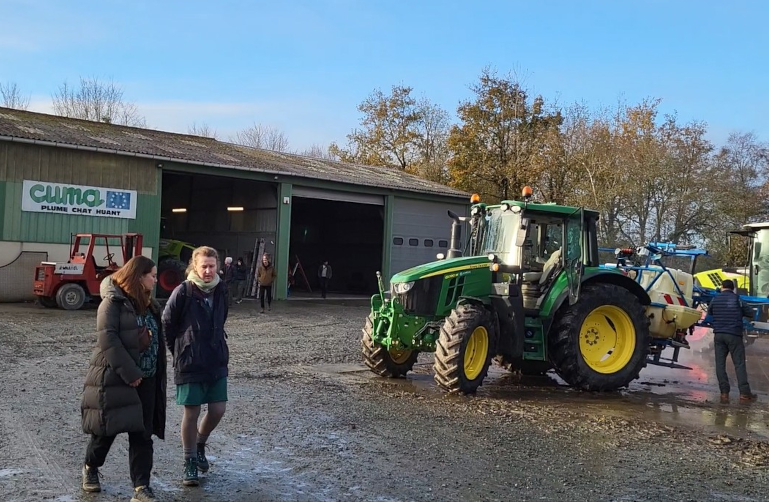
What if, instead of going into debt to invest in their farms, farmers came together to pool equipment? What if, instead of struggling to run a small farm alone, there was extra help at hand? What if new entrants could draw on the experience of more established farmers in their local area? It may sound too good to be true, but this is the reality with France’s network of Agricultural Machinery Cooperatives (CUMA). With more than 10,000 local branches all over France, the CUMA is a space for farmers of all stripes to come together in a neighbourly spirit of mutual aid and solidarity. Pauline Petit reports from Plume Chat Huant, a local CUMA cooperative in north-west France.
“It’s a community of farmers who share equipment. We have to work together to organise ourselves,” says Hervé Mérand, manager of the Plume Chat Huant cooperative. But this local branch of the national CUMA network also plays a role in reducing polarisation, as Hervé explains: “It’s one of the last spaces where we can still discuss together, despite our different practices.”

The coop’s repair workshop. Photo: Adèle Violette
Supporting small farms
Almost 50 farms are members of this CUMA branch, and 80% of those farms are organic. This wasn’t always the case. The growing number of organic grassland systems can be partly explained by the Plessé municipality’s Local Agricultural and Food Policy (PAAC) which for the past six years has supported young farmers who bring diverse and sustainable practices.
Strategically, pooling the purchase of equipment is a win-win for members. It frees them up to invest elsewhere on the farm. Meanwhile, they save some 30% in maintenance and operating costs associated with the equipment.
Members can also avail of the services of three farm workers and an apprentice who are employed by the CUMA. This pooling of labour is another economically viable solution – particularly for small-scale farms that cannot afford to employ someone full-time.
New members take out shares in the cooperative in order to gain access to the various services. There are different categories of membership, for partial or full access, in proportion to the level of engagement.
To cater to everyone’s needs, members decide together on investments in machinery. “A CUMA is all about the people; you have to be prepared to work in a collective and make concessions.” Yes, there are compromises – but these are compensated for, in the forms of cost savings, and the organisational benefits of shared management.

Hervé Mérand (back right), manager of the Plume Chat Huant CUMA branch, explains the workings of the cooperative. Photo: Adèle Violette
Sharing knowledge, nurturing new entrants
Here farmers clearly share more than machinery. Although it’s mostly technical matters that are on the agenda (scheduling, determining investment strategies, etc.), weekly meetings are also a space for members to socialise and learn from each other: harvesting advice, sowing best practices and getting support from neighbours. “We often turn up at the planning meeting with plenty of questions and no answers, and leave with advice on the course of action to take or which tool to use,” explains Hervé Mérand.
All of this is especially helpful for young farmers. As well as offering a pathway into farming that minimises start-up investments (and therefore debt), the CUMA facilitates networking with other farmers, affording new entrants opportunities to ask advice from their peers.
One such new entrant is Alice Colin. Originally from another region, she started farming with her partner in 2022. Not coming from a farming background, for them the CUMA was one of the first places where they could meet and connect with other farmers, socially and professionally. She explains that several new entrants started farming at the same time, which made it easier to build relationships: “We were lucky; when we arrived, other farmers were getting started at the same time. We quickly formed a close-knit group where we help each other out and share a lot.”
As well as this group of peers, Alice and her partner have access to advice from more experienced farmers: “Being part of the CUMA gives us access to people who are more rooted in the local area, who have more than a decade of experience. They have a broader perspective on farming and have a lot to share, both on the technical and the organisational side.”
To encourage this kind of integration, since 2020 the CUMA has organised induction days to provide better support for new members. This is a chance to introduce new members to how the cooperative functions, the methods used and the collective approach, as well as the full range of services – both visible and less visible – that it offers.
Members can then use the repair workshop independently — or with the help of staff. Here they have access to equipment for welding, hydraulics and even tyre repairs. It’s a valuable resource for farmers, especially as such services are rare or virtually non-existent in rural areas. “If it wasn’t for the CUMA, I wouldn’t know how to do certain repairs. These skills have been lost in our countryside,” Mérand points out.

Alice Colin, CUMA member and dairy farm manager. Photo: Adèle Violette
Collective spirit won’t be dampened by funding uncertainties
More than just pooling resources, the CUMA can be understood as a tool for the technical and financial empowerment of farmers. With over 10,300 local branches across France, the CUMA network, deeply rooted in these communities, carries a collective strength.
But this strength is now under threat from political directions and decisions at national and European levels. Specifically, this CUMA branch receives funding from the farm competitiveness programme, under the second pillar of the Common Agricultural Policy (CAP) 2023-2027. However this pillar may disappear under the next CAP, translating to cuts of up to 40% of investment support.
Such a decision would have a direct impact on the capacity of farms to invest. It would also undermine the services that are the strength of the CUMA network: technical support, administrative assistance, community engagement and experience sharing. After all, the CUMA is also collective intelligence. “Thanks to the network, we can find out whether an investment that seems risky to us has already been tried out in other CUMAs. We get figures, feedback… We know where we’re going!” says Mérand.
To take away these supports is to do more than endanger a financial tool: it is to weaken a cooperative model that provides security in decision-making, strengthens farms and fosters agricultural solidarity.
That said, the CUMA model is not simply about public funding. Its primary strength lies in farmers wanting to come together and pool solutions tailored to their needs. It can operate differently, on a different scale. And it is, by its very nature, replicable! “There are no particular constraints on the model’s replicability, once you have the willingness to come together to share a tool or an asset,” emphasises Mérand.
In other words, as long as this collective spirit endures, the CUMA ethos will continue to exist, to evolve and to sustain a farming community based on solidarity and self-reliance.
ARC2020 visited the Plume Chat Huant branch of the CUMA in November 2025, as part of a field trip during our Rural Resilience Gathering.