Show Notes
How do we live through wild times?
Legendary scholar, activist, and systems thinker Joanna Macy named the moment we are living through the Great Unraveling—a time when our ecological, political, economic, and social systems destabilize to the point of no return. And yet, she also insisted that we stand on the threshold of a Great Turning: a profound transition toward a more just and sustainable world.
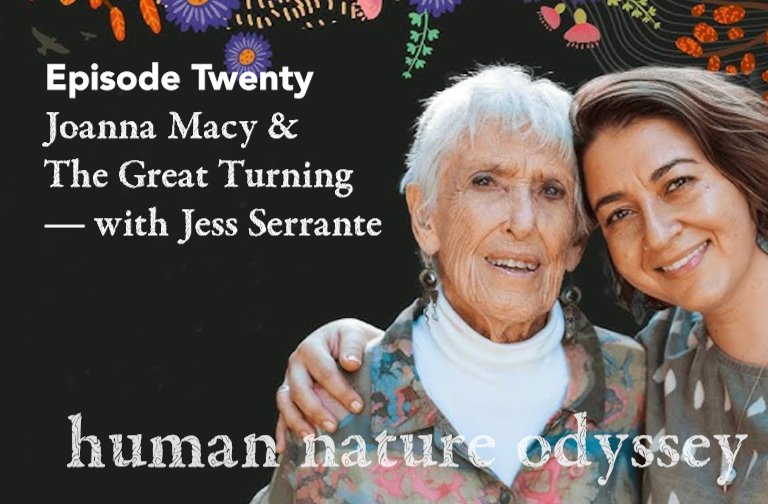
Before Joanna’s death in 2025, climate activist Jess Serrante recorded a series of intimate and insightful conversations with her. In this episode, Alex sits down with Jess, weaving in clips from those recordings to explore the questions Joanna devoted her life to asking: How do we live with meaning as civilization unravels? How do we turn toward the grief of this moment—and transform it into action? And how do intergenerational relationships help us become elders for the future – when wisdom is needed most?
Citations
- We Are The Great Turning [podcast]
If you’d like to support Human Nature Odyssey, please subscribe wherever you enjoy your podcasts, leave us a review, and visit humannatureodyssey.com.
Join us on Patreon and get exclusive access to audio extras, writings, and notes.
Theme Music is “Celestial Soda Pop” (Amazon, iTunes, Spotify) by Ray Lynch, from the album: Deep Breakfast. Courtesy Ray Lynch Productions © Ⓟ 1984/BMI. All rights reserved.
Transcript
You're here too. You're facing just what we're facing. So even though I can't see your face, I'm very moved to think of how much we have in common. I may never hear your name. I see your face. But you suddenly come real. Because you're on the planet with me at this time.

What's it like to live on Earth at this moment?

Do you know how lucky you are? You live in a highly advanced modern civilization. There's comfort, choices and convenience like never before. You can eat an orange from Barcelona in the dead of winter. You want a new sofa? Stay put. It will arrive tomorrow. And go ahead. Reaching your pocket. What's that? Oh, a magical portal that lets you chat with anybody around the entire frickin world.

Well, that's pretty cool. We've got high def satellite images of distant planets and their moons, 3D printing and state of the art hip replacement surgery where you can't afford it. Don't fret. I know some jobs that will get you money. You like money, don't you? Maybe you should invest some. That old stock market is on the up and up.

I mean, have you noticed all the innovation lately? And the great news is, it only gets better over time. Sure. There's been some blips, a few bumps, but all we got to do is trust the system will lead to more prosperity and wonders than you can possibly imagine. Just keep working, keep investing, and watch this baby grow.

That's the story of business as usual. But there's another story. It's called the Great Unraveling. No, don't think about that. Welcome to the gears of Business as usual. How the machine turns landscapes into scraped and scoured and stripped in mined wastelands. The hundreds of millions who live in extreme poverty. The rise of authoritarianism and rising seas. The erosion of the global order.

The fires, floods, famines, mass migrations. Scapegoating, the fraying of social cohesion. It's getting harder and harder for the system to meaningfully respond. Some call it collapse. Activist and author Joanna Macy called it an unraveling. It's not just the planet's ecology unraveling or our political systems or economic systems, but the story of business as usual is unraveling, too. It's making less and less sense.

There was a time where serious seeming people could tell you, with a straight face that this was a good system, a practical system, a system that worked. And some people still will. But it's getting harder and harder to believe them. But we already know this. We've been living with this knowledge for years now. It's become the normal state of things.

The ever present background can be hard to look at. Tempting to shrink away from. But what kind of story would it be if we turned away now, if we let our lives pass by without fully meeting this moment we were born into? But how do we meet it without being so overwhelmed? Action becomes impossible. This is where Joanna Macy comes in.

She's the one who named these two stories. We're living through the stories of business as usual and the Great Unraveling. But she also told of a third story, A Different Path, and she called it the Great Turning.

Welcome to Human Nature Odyssey, a podcast exploring how to be fully alive during ridiculous and terrifying times. And the better world that's still possible. I'm Alexa.

We're in a situation that humanity has never been in before. You know, there've been wars, plagues, huge migrations. But this concerns every one on Earth. And this is not something we know how to even begin to think about.

That's Joanna Macy. Born in 1929, Joanna was a scholar of systems thinking, Buddhism and deep ecology. She was an environmental peace and justice activist and renowned author. She led workshops moving people through their despair and into meaningful action. And if you're like me and sometimes struggle with being overwhelmed by the state of the world, or too numb or distracted to face it, Joanna is here to help.


I want to reach and take hold of that live wire of reality. I want to be here. I want to be. If I can't avoid climate change. Then I want to be here with all my attention, with all my trust in life.

In July 2025, Joanna macy passed away at the age of 96. We're able to hear her voice. Thanks to climate activists Jess Serrante just sat down with Joanna in the final years of her life to reflect on how to live during these wild times. These conversations became the podcast. We are the great turning. In this episode, we'll explore excerpts from that podcast and speak with Jess ourselves.

She'll reflect on her powerful friendship with Joanna macy, the legacy Joanna left behind, and what it means for us to inherit that legacy, to take up the baton and one day pass it on to the next generation. But first, let's listen.

Joanna now lives in Berkeley, California, and she's lived a really extraordinary life. She grew up in New York City in the 30s, began studying Tibetan Buddhism while living in India in the 60s with her husband Fran, who worked for the Peace Corps. And in the 70s, she became an anti-nuclear activist when she was a married mom of three.

In her early 50s, she went back to school to get a PhD studying Buddhism and systems theory. And it was then that she faced an existential crisis, kind of like mine. Almost 50 years ago, a moment that was for me, almost cataclysmic occurred. And a daylong symposium of the Cousteau Society. That's Jacques Cousteau, of course, the scientist and adventurer best known for exploring and protecting the oceans.

It held a full day on three floors of her great coliseum in Boston. On the environmental problems assailing us. Not just the oceans, as Cousteau is connected with, but it was the oil spills, the acid rain, the boy's name, the lakes. It was factory farming. It was just a whole jamboree of all these issues. All of it seemed to be growing.

And that kind of assault on the human body. Oh, no. Another species to. This was back then. It was in 77. Yeah. 50 years ago.

We were destroying our world. We are destroying our world with every aspect of the power that we've accrued. And it brought a tremendous internal avalanche of grief. It was so arresting to me. It was so huge realization that I couldn't speak it. And it silenced me.

It silenced me for 15 months. I couldn't speak of it to my friends, my family, my my husband, my fellow academics in the department. And there's the loneliness of the unheard witness.

Of what's befalling our planet. You've been holding it back because you don't want others to know how bad it is. You don't want others to know how great is the grief. I didn't want my family to know how much pain I was in. I didn't want them to know my own suffering. Because it was enough to drive you mad.

To think that we were heading over the brink as a species.

But Joanna didn't stay silent for long. Keeping her grief to herself wasn't helping her or the people she loved. She realized she needed a space where these feelings could be spoken out loud. And she suspected others might need that too. So in the late 70s, she started gathering people together not just to share information, but to share the feelings that came up fear, grief, anger, gratitude to and the love for a world that was being destroyed by honoring and sharing these feelings.

Joanna believed people were more likely to act. She called these gatherings the work that reconnects. Having people understand it was the greatest joy in the world. That means that it brings a mutual gratitude and respect.

To find a home. It's like you've been homeless for years and years, and suddenly you find a home. A roof over your head. Joanna led these workshops for over four decades for thousands of people around the world. And eventually one of those people was just around. Really grateful to get to meet you. And it's always such a funny thing to listen to someone on a podcast.

You know, I get to talk with evidence of is, you know, I had that moment at the beginning of this where I had your voice in my ears yesterday and I was like, oh, yeah, this guy's voice. And maybe a year it is in real time. Okay. So at what point in your journey did you meet Joanna macy?

So I met Joanna in 2014. I was in my mid 20s. I was several years into my work as a campaigner and organizer. At the time, I was working at Rainforest Action Network. My days were made of just like throwing myself against these mega corporations. And I was. I felt so small. It just felt like I was this, like little annoying fly and like, buzzing in the face of these companies.

And like, that felt generous. Sometimes I, like, got a free ticket to a conference here in Berkeley, and Joanna was a keynote speaker. And the morning of her keynote, we happened to be, I think we were at UC Berkeley, and we were like in one of those, like little bathroom hallways. Like she was coming out of the bathroom.

I was going into it kind of thing. That's a great place to meet your hero. And we were the only ones there. And we walked past each other. And then I, like, turned around and I was like, Joanna macy. And I just, like, came out of my mouth. And then we started talking, and she. She was incredible. Yeah.

We struck up a conversation. She was fascinated in the work that I did. She gave me the green light to come to attend intensive that she was putting on that summer. And that was sort of that was the beginning. All of a sudden, I wasn't just like fighting out of like the pure energy of anger in youth. I was I had grief that I could express that was evidence of my inextricable connection to life.

I understood where that grief was coming from, and it was safe to name it and honor it. In fact, it was like important for the work that I'm doing to to do that. So many parts of this work blew open my mind and my heart. But the the first piece of it that touched me the most deeply was the honoring our pain work.

I just I didn't even know I was allowed to do that. What did you learn from her about how to navigate that? I think it all starts with being honest about what's alive in me. Like trusting the flow of feeling inside myself in the spiral of the work that reconnects. Right? Is this four stage spiral that takes us through this alchemical process, where we begin with gratitude, with the extraordinary gift of being alive.

And it's not quite as linear then as this, but I think this does really like set a light on something that is pretty universal. Through our gratitude, we begin to feel the grief of what is happening to this planet and this life that we love so much. And the people that we love. And then through really touching the depths of that pain, we come into closer connection to our interconnection.

Right? Like we feel how bound we are to one another. And the love that pours forth from that moves us to action to like, give what we can, however, make our imperfect offering. And that spiral which is the it's a model that we use in practicing the work that reconnects. But it also has become a way that I understand the way I move through my days.

But I just can recognize, oh, in this moment I'm mostly present to despair. Or to rage. Right. Like this happened a couple days ago. I'm sitting at my computer, I'm sitting right here and I get the news about this ice murder. And I feel my whole body flood with fear and then rage. And I watched the impulse to like take a deep breath, compartmentalize, keep typing.

Right. And something that I learned from Joanna is that like that's actually not how I move it. I move it by honoring it. Right. So I like flood some rage against the machine into my ears. Right back to my college days. Oh yeah. And like fucking moved it you know. No one does it like them for me in that realm.

I'm with you. I'm with you. So it's just stomping around my room to killing in the name, you know? And it actually didn't take that much time. It's not like I'm, I'm not still incensed by what happened and what is happening, but it was like okay, I like found myself in the spiral and it moved me into okay, I can honor it.

I can then like emerge from that pain after honoring it, have conversations with people, which is one of the things that the work also teaches us to do is to, like, not hold it in. Like even just in this moment, I felt a hesitance in myself to even bring up that story. Right. Which is so interesting.

Like I don't be the one to name something outrageously painful about what's happening in our world. Right. There's millions of examples of who just the one that, you know, as front page of the, of the papers this week, to be completely honest. Like, I don't want to feel the pain at all. Of course, you know, of course I don't, I don't I don't want to live in a fucking world that makes you feel that way either.

I don't want to sit in it. I want to move past it really quickly. And, yeah, I'm almost skimming on this surface level of intellectually understanding things, but, like, not really sitting with. The grief and the fear. I need, like some kind of light at the end of the tunnel. Like, what did they transform to if I sit with that?

So one reason that I was able, in that moment, to watch the impulse to shut it down and then stand up and put on the music and move, is because I have learned over the years, through my own experience and through Joanne's teaching, that when I cut off the feeling, it costs me aliveness. I can carry on.

I could have taken a deep breath, push it out of my mind, gone back to the work that I was doing. But the cost is actually too high because my vitality, my passion, is cut off. Every time I deny the reality of what I'm feeling, I'm not actually protecting myself from feeling it. The feeling was already there. The feeling was the natural response to what's happening in the world.

The thing I'm cutting myself off from is like letting it actually move through me, which is a surrender to the flow of what it is to be alive in this time. Right? That's what I was pointing out earlier. It's like sometimes I'm really present to like the ecstatic joy of the neon sunset happening outside my window. Sometimes life feels like wildly mundane and dull.

Sometimes I'm flooded with outrage, right? Like it's all part of what it is to be alive. When we dull any of it, we dull all of it. One of the main principles in the work that reconnects in all of this being together and speaking the truth of our experience. Telling the truth to another person. Being with them.

Being with them. Yeah. Hearing what it's like for them. Sharing what it's like for you. Honestly sharing and being heard when we're with people who generally see what we are seeing and feeling. There is a huge gift in having the courage to go first. To be the one that says, hey, this thing that's happening in the world right now, I'm really having a hard time.

Can I tell you about how it feels. And it's the same with gratitude to for whatever it's worth, right to be the one to say, you know, your exuberance, your passion, the stuff we do know that you've held back out of fear of what would happen if people saw it. Because it's not cool to care, but to be willing to go first.

I am wildly in love with life, with this planet, with what it is to be alive. Holy shit. All I want is to be around people who also see that and want to remember it. And it's totally vulnerable to be the one that goes first in either direction, honestly, right? The exuberance or the pain. And I have found that a practice of that over the years has made me in my life far less lonely.

And also just because even if I get missed sometimes or I get dropped or it feels too vulnerable or I am being true to myself like I'm offering my gifts, my care, my perspective as honestly as I can. Which really, at the end of the day is often feels like the most I can ask for.

So for decades, Joanna led the Work That Reconnects, helping participants get in touch with their gratitude for the world, honoring their grief at the state of it, and then going forth and acting from that place. And Joanna believed there was this action that helped create a third story different from business as Usual or The Great Unraveling. She eventually called it the Great Turning.

What if out of the Great unraveling, we choose a different path. What happens when more and more of us begin to understand our interconnection with the rest of life? When masses of people see that trying to dominate or control the world only makes it more out of control. When we remember that we're not separate from the earth, but a part of it.

And what would happen if we finally realized there's no master race or master species? That every being on this planet is our literal cousin. And what if the vast majority of people came to believe that our own safety and well-being depends on the safety and well-being of others? What world would come of that? No, really. What do you picture?

What would that world look like? What do you see?

The great turning is in us. It's in our apprehensions of our capacity and our, connectedness with each other. But it's of fundamental shift and what we want.

So we want life to go on. We want to give ourselves to life going on.

I love how Joanna describes these three stories. Business as usual, The Great Unraveling. I feel like the funny thing is, is that business as usual and even The Great Unraveling, I think, are relatively easy stories for people to understand. It's like, okay, yeah, I can I get what that's talking about? It's just like, yeah, the Great turning feels like the most hard for me to comprehend.

Should we understand the great Turning as a future we're working towards, or like a reality that's present? Maybe it's a little bit of both. Like how do you think about this constant story? It's question so much. We talk about the great turning as having three aspects. There's a framework created by Katie Logan and Don Haney from the Buddhist Peace Fellowship that explains this really well.

And the framework is block build, be harmful. The first obvious way that we see the great turning in action is in blocking actions. Resistance against death and destruction. Putting their bodies in front of destructive forces. Putting the bodies in front of trees, in front of other humans. And of course, it's not just protest, right? Like policy work, law work is often blocking mine.

Like, I work with environmental lawyers who have spent decades of their lives using the law to try to block further harm from happening. And that work, as I've learned from my own personal experience and also from largely supporting people who work in that realm. Right. Often when we think of activism, that's the thing that we think about.

That work burns really hot. It takes an immense amount of energy to show up in resistance against these forces. Everyday in your life can be really hard to sustain over time. Takes an immense amount of skill to do that. And that alone, of course, is not going upstream. It's not transforming. Trying to contain its expansion. Yeah. And and making a stand for the individual lives that would otherwise be taken.

Right. So to stop this from happening. Right, we need to build new systems. We need to build new ways of being together. Right. And so this is the ways that we see people building alternative economic models, right. Co-op preschools and grocery stores and permaculture and biodynamic farming and land tending and building new conflict resolution tools. Right. Restorative justice.

We're building new systems. Let's have new ways of healing when conflict and harm is done. That's the second place that we see it. And then these systems, as beautiful and powerful as they are without a larger paradigmatic consciousness shift, also can be upheld. So that's the third. That's the be where we are shifting consciousness. I and I, often I see my work as largely falling into that realm.

Now. And like I help people to see themselves as a part of this transition to a more just and life sustaining world, which just understanding yourself as a part of the Great Turning can be like world changing for us. And so all three of these things blocking harm, building new ways, being and developing an alternative consciousness. Yeah. Different way we understand our relationship to others in the world.

Yeah. Those are the the three faces of the Great Turning. I want the beautiful, unjust world you're talking about with the great turning. And like you're describing the place, you see it. And it's a wonderful list, Jess, of all the places you can find it. But I got an even bigger list of all the places where you can find what's being smashed into pieces.

Yeah. How do you think about that? Has your thoughts on that evolved? I could easily, off the top of my head, make a very long list of all the ways that everything's fucked and wrong and everything that's being destroyed. I can take us back to a moment pretty early on in my relationship with Joanna, when I met Joanna.

I went to her and I was like, listen, I get this thing that you're saying about the great turning. Like, I get that. I see these three stories, but I'm not really believing in it. Like, I don't really and I'm not really buying it. And the thing that she said to me was just, we know that the great turning is real because we're a part of it.

I had been holding it like to believe in the Great Turning. It was like team business as usual versus team great turning. And which one was going to win. My team was the underdog. Oh yeah. But the question of who's winning was entirely the wrong question. And that's what Joanna was pointing out to me over time. Right. So instead of sitting in the stands looking at the game and saying, which team is more likely to win?

Offering ourselves and being a part of the Great Turning is about getting off of the stands and into the game. It's about giving ourselves to the outcome that we want, right? Saying I don't care how outnumbered we are or what the scoreboard says. I choose to devote my life to the possibilities that I believe in with everything that I've got.

And that is the great turning. It can be confusing and it can be disheartening because this isn't a like fork in the road. Like will we as a society choose the Great turning, or will we choose the Great unraveling early to zero, right? It's that we choose the great Turning. Wow. Business as usual is raging in the way that it is, and the great unraveling is unfolding.

Can we move the mic just a little closer to you? Where you a little closer to the mic. Yeah. Then I can sit here with my arm on the. How's this. That's perfect. You look like a real pundit or something. Leaning into your. Yeah, I. I had a video camera on here and tell me what's happening in the world.

Okay, I think I think we're good. At what point did you feel like. Oh, wow. This is a friend of mine. I mean, I think she was pretty immediately offering me friendship, and it took me a little while to receive it, if I'm being honest. Wow. After the ten days, she called me and she asked me to drive her.

She wasn't driving at the time to another retreat that she was facilitating for like a day. So I had to, like, spend the night on this land up in Mendocino. So we had like a two and a half, three hour car ride together that I was very nervous about going into. But it was like it was a road trip.

You know, we, like, stopped for ice cream and, like, she took a nap and we, like, talked about a million different things and learned about each other's life stories. And it was just very sweet and familiar, like from that moment. That was when it really started to feel like a friendship. And I think it just took a little while for me to, like, believe it, that that was what she was inviting, because she was this legend.

And I was just I was a baby. I was like 25, you know? Like, I don't know anything. So at what point did you two decide to sit down and record your conversations together? Yeah, we got a lot tighter through the pandemic, actually. We both had more time and we both needed each other more. And so we would talk for hours and hours.

We had toyed many times with the idea of collaborating with each other, and we had a week where we were on the phone every day because there was some stuff that I was moving through, and she was like, call me tomorrow, give me the status update tomorrow. And we would talk. We were talking constantly. Wow. That week. That's so sweet.

Yeah. And it was through the conversations that came out of that that we decided that we wanted to create the podcast. And so I moved back here. I was sort of like on the wind at the time. And I moved back to Berkeley to be near her to work on this and that. We bring on a team of professional editors and people to, like, really help us make it something beautiful.

Something that you talk about as you're recording is just knowing that Joanna was viewing. This is maybe one of the last things that she was going to work on. And I guess I also just say aloud that I almost feel like it's I don't want to ask you about this because I don't know, you that well, I don't to put you on the spot about serious emotional things in your personal life, because I know your relationship with Joanna is very real and very personal.

And also you shared it with all of us. So I want to ask you about what it was like to have the moment of Joanna's death really happened, knowing that that was going to happen. And now that you have this gift of conversations that you did together, how? Yeah. How do you feel about. Experiencing that and then having being on the other side of that anticipation?

Yeah. I'm glad you asked. Okay. Thank you for. Yeah. I like thinking with you. And I know that it's not over, but it's like in order for us to move the project towards completion, I have to go do some thinking on my own and go through the material and then come back because you are creating material that will be a lot of the people to whom it's introduced.

I'll be gone.

Yeah, and I think that's a part of what scares me to if I'm being totally honest. Like, well, that's why I'm just a sensei. And, well, I and so and like looking at this, I am facing my kindness to come up.

And I'm used to being me. I know I like being me. And that being me. As if disappear under my feet and I will disappear. And what won't be left? What? The words. I don't want to say them, but I will be left. Is my love.

That's what my love for the world feels like. It's something that I have to, Yeah, but how can it be given if I'm not here? Well, I will be here. And we're making.

And what you're. You have. With incredible courage, stepped in to say, I'll have this to be there when you're gone.

But thanks for saying it, because I didn't have the guts to say, Yeah, but it's a work of incredible caring. I love it. I just so love your spunk. Your the your strength to look right into.

My mortality, our mortality, that mortality and this moment and say, all right, I'm up for this. It makes sense to do this.

I have this memory. It's in the first episode of Where the Great Turning. You hear us sitting on her couch, and she says, you're preparing for something that will be my gift when I'm gone. And your gift?

But you know what? When the, emptiness comes and you look to where I sit on this couch, and I'm not here. You all know you. You've been with me. Gone already? You've been with me. With me gone. And we are giggling about this. This, like, time travel thing that we're doing in this conversation. Yeah. And hours after she died, I walked into her house and I sat on that couch.

And I remember that moment. Wow. And I thought, Holy shit, here it is. I'm here. And her body is in the other room. I'm about to go see her dead body for the first time. Wow. She is the most alive, dead person I've ever known.

She is so present for me. And it is. I expected it to be this way for a while. It's been six months since he died. And I still can't talk about this without lots of tears flowing. It's so hard to be without her. I miss her so much. Yes. And there's so many gifts for me in remembering.

I mean, I can't it's like impossible to put words to how lucky I feel not only to have loved and be loved by her, but to have had a recorder on the table for dozens of hours, to have spent a year of my life poring over, reliving dozens of conversations, and pulling like I would. I wouldn't have remembered so many of the things that she said to me.

Have we just had the conversations? But I had to listen to them again and again and cut them into the episodes and write around it and try to figure out how to translate what she was, what she was giving me to everybody else who I wanted to give you the vicarious experience of sitting at the table with her.

You did. Thank you. Yeah. I, I mean, the way that that, like, seeded her so deep in me is just like a gift that continues to reveal itself to me. Yeah. It's so extraordinary. I mean, it's an incredibly generous act to share an intimate relationship like that with others. And so, as a listener, I feel like I was really invited into it.

And I, you know, never got to meet Joanna. And now she's someone that I got to have spent time with in this way. Yeah. Because you you let me into that and, and I benefited, you know, and so from those conversations and that's, I feel like the intergenerational aspect of life is really that's the whole thing. That's the whole thing.

Part of the the reason why we're in this global mess in the first place is because we're trying to extend our own personal lives as much as possible, and that's how we think we're going to have immortality. So our fear of death is what's causing us to try to control everything. And make the world, ironically, so much less hospitable for us.

Yes. Where is the real meaning of life on this earth? If you ask me, is my husband wanting to know you for me? Is that we receive from the generations that came before us and we hold. Yeah. What we've received from them, we nurture. Do we tend to it? And then we. We pass it on. Yes. And that kind of like handing of the baton.

It's amazing that you got to really spend that time, like receiving the baton from Joanna. And how do you think about the podcast now that you're on the other side, and that the elder that was in your life is now, like you said, like an ancestor? And how do you think about the future generations, the younger people that are alive right now and like our role in their lives?

Yeah. There's there's a moment that's coming to mind. It is in the midst of making the podcast, I was sitting in her kitchen with her, and I don't remember. Oh, it was when the the wildfires in Australia were happening. Oh, yeah. And we're sitting at her kitchen table and there's the newspapers on the table, and we're looking at these fiery images.

And there's so much that you're going to have to face that I won't, I suppose. Yeah. And I feel.

Only joy at you avoiding any. Suffering that might come across all of us in the years to come. Well, now I've now I do feel sadder. That's the grief for me. What is.

Then I won't be there with you and help when it's really awful. I breathe no sigh of relief that I'll be gone.

What comes up for me so strong now, as you're aware? Is that what's true for me? Is this. Heartbreaking. Open with love for what we're doing. And there are many of us who are preparing themselves and the rest of us to carry forward as humans on this planet when it becomes so unfriendly to our life form, to our fragility.

There'll be cold winters and hotter summers. Then this kind of body I can handle well.

And, you know, it just occurs to me that we are feeling so guilty toward the future. Once.

We must also realize that what we're doing at so much that we're doing out of compassion that we are putting ourselves in the heart, minds and bodies of those who are living, toward the end of this very century. What things will be like? Yeah. 80 years from now, and what things will be like in a year.

And we're crying. I can't believe this is happening. The loss, the devastation. And I look up at Joanna with teary eyes. And I say, Joanna, the world needs what you've given us more than ever. And she just looked at me and she said, honey, that's the part that you were born for. But what I really see and felt in that moment is that intergenerational baton pass thing.

Like I done my part, babe. I got me all the way here. And now I'm 94 and it's, it's almost time for me to check out of this life. So yeah the work continues. But that's your part. You get to pick it up from here and carry it where it needs to go for as long as you can, and then you'll pass it on.

Also, you know, and it's just I see this like line of us through history. So I see my responsibility. And this has been a hard part of losing her, is like being willing to grow up in a way like which is, I think, a part for all of us in losing our, our elders. Like as we lose them, their responsibility to carry what they've given us falls heavier on our shoulders.

And I have definitely felt that in a very strong way since she's been gone. Like, okay, if I really mean what I said to her about how much I care about these teachings and how much I believe they are some of the most essential medicine for the world in the time they were in. And it's up to me to figure out how I'm going to do that.

And I can't just sit at her feet and, like, ask her to make me feel better about things anymore. As I feel her from the realm of the ancestors pushing me forward now in a different way. Right. It seems like the fact that we have so many religions form around charismatic elders goes to show that there's this like tendency in our nature, this desire to want to immortalize someone and keep them always as the person that we're looking up to.

Like, as you're saying, like to always kind of stay at their feet. And that's the strategy. Not here to judge that strategy. But the other option is to, as you're saying, to grow up and to recognize, like, okay, we have to be in that position. All the things that we admired about our elders and our ancestors that really the ones who rose to the occasion, we have to try to become that ourselves and to become elders, looking at ourselves in old age and hope that we could have lived in a way that we looked up to them as well.

Yes. So there's something in this that I think is really important, and it's come up a lot, especially in the last six months, where I'm remembering Joanna with people very often. I mean, she was a fucking spiritual giant. She was in many ways, like extraordinarily special human being. Yeah. And her memory deserves all of the celebration and the recognition of that of the extraordinary spirit that she was and is.

And I think that something that comes up for me often in these conversations is like watching the tendency for us to pedestal our teachers, our elders, especially our dead, that there's like a both and like she deserves that celebration. She was extraordinary. Yeah. And I don't think she would want us to separate her out from the rest of us as some special human being that had something right, like there's something actually really disempowering that we do to ourselves when we put our teachers in that way, we weave this story that they are some they were something other than the in pain, suffering, passionate, deep feeling human beings that we are to and like.

We have the capacity to each step into our own version of that giant ness. Totally. It's we do this all the time. You know, it's so tempting to be like, oh, that person is just amazing. I can never do what they do. And on one hand, it's showing them respect. But also, just like you're saying, it's a really sneaky way of just it's a cop out.

I feel like ultimately that's exactly the words that were coming in my mind. It's like, oh, I could never. I won't even try, actually. I'm not the kind of person that could do that. You know, and I think what such a powerful part of your relationship with Joanna is something that's so rare and how our society is currently structured that we are so siloed from the other generations around us.

And I think there's a real loss in that because the crisis that our world is facing, the great unraveling. I think it's really fascinating to remember that this is an intergenerational experience. Yeah. As my friend recently put it, that I really loved. He said there's there's not going to be one moment when it's apocalypse o'clock. The great unraveling is unraveling, and it's unfolding over decades and generations, and it kind of puts us each in this position of those of us who care and feel the pain of this moment.

You know, look to the next generation and I certainly feel this with my friends, kids who I'm close with. I find myself wanting to to protect them from this, the very young. They're learning about some very heavy things at a at a young age, but so did I. And I recognize that as the world continues to unravel, they're going to live in a world that is increasingly more not hospitable to human life.

And that's really heartbreaking. But also inspiring to say, okay, well, we got to do something now and then also to hold the possibility that they might also experience some beautiful things in the world that we never got to see. Yeah. As well too. Yes. The desire to protect I mean, I feel that so strongly to every day as I center myself at the beginning of my work day and I do a little prayer and meditation, I reach out to the future generations as a source.

Like I reach back to my ancestors, and I call on the ones that came before me to like, be at my back. And I thank them for bringing me here. And then I also reach forward. Imagining that I can have contact with the ones who are going to inherit this planet from us. And I get so much strength.

I get filled with so much love. I feel it in this moment because, yeah, it's a it's so natural, right, that the, the depth of our desire to protect them from it. But I also think that like what I found over time is that given that like the we are in the circumstance stances that we're in, I can't protect them from the reality of the world.

But what I can do is model the most beautiful in integrity ways that I can muster to be a human being, in the vulnerability of being alive and being alive in this time.

Yeah. Yeah. I, I felt I felt a wave of feeling hearing you say that. Yeah, I see it. I'm not usually having podcast conversations in that mode. You know, in my head much more. And that's my job.

Well, so now you lead your own workshops and create space for people like Joanna did. How do you see your role in this? What's your place in The Great Turning? I would say that I am taking everything that Joanna gave me. I am mixing it together with my many years of experience organizing and helping people find their place and find their ground and act strategically and orient to the way that they want to be in the work and sort of swirling all those things together.

That's how I understand my job, is to bring together people who are heartbroken at what's happening, who are wildly in love with the world, and who need the resources to carry on, to keep on living with their hearts intact, in service of a world that is just and life sustaining. Having these conversations and holding these spaces, that's what makes me most come alive.

We are living through, as I see it, the crumbling of these death systems, business as usual for shorthand. They are tearing themselves apart. And the great turning is the voice of those of us who refuse to let these systems have the last word about who we are as human beings on planet Earth. And like how we get there.

Right. There's a million. It doesn't ascribe any specific picture of what the future is supposed to look like. Right. By turning our attention toward the great turning, we are allowing every one of us to dream into that together and trusting in that dream, knowing that of course, there going to be divergences in the ways that every one of us pictures it.

And also the way that things ultimately go will not be the way that any one of us specifically imagines it. This is the reason that Joanna says that the Great Turning is the Great adventure of our time, just like any of our favorite epic adventure stories. The stakes are very high. The possibilities are numerous. The protagonists are flawed and the outcome is entirely uncertain.

And that is just the nature of the adventure. And I'll say just one more thing on this, which is that like, I can't think of a better way to live when I choose to orient my life this way. My life is so much more interesting and beautiful, and the connections that I get to make and the conversations that I get to make and the ways that I get to be in relationship with the earth and with my neighbors and with people who have never been with in person like you.

Right. Like the stuff that gets to emerge is just infinitely more beautiful than letting my despair run the show. And this doesn't mean that I don't have the despair, right? I'm like working with it every single day. It's just that this is far more interesting and compelling to me. And so it's the choice that I make. We are creatures that can choose to, no matter how bleak things look, no matter how cornered we sometimes feel, we always steer.

We always have choice. Maybe it's not a choice of where are you stuck? Where you be? Is that choice necessarily about money in the bank? But the choice is always there for you as to how you respond and what you choose to see.

Thanks for listening. Until next time, I hope you'll consider the legacy you want to leave for future generations or the younger people in your life. How can you feel more present with what it means to be alive to you right now? Where are the others in your life? You can share that with one place. Define community is the Human Nature Odyssey Patreon.

There you'll find kindred spirits from around the world. Bonus episodes writings. And you can listen to the extended conversation with Jess Serrante. There's so much we covered that couldn't fit into one episode, but a week after this episode comes out, you'll be able to hear it all on the Human Nature Odyssey Patreon. Thank you so much to everyone supporting the podcast, sharing it with a friend, and leaving a friendly review.

And thank you so much to Jess Serrante for joining us today. You can listen to her podcast with Joanna. We are the Great Turning. That sounds true or wherever you enjoy your podcasts. This series was made in association with the Post Carbon Institute. You can learn more at Resilience.org. And as always, our theme music is Celestial Soda Pop by Ray Lynch.

You can find a link in our show notes. Talk with you soon.