I recently attended a talk about the benefits of long-term data collection that used Wytham Woods, a university-managed woodland just outside of Oxford, as its frame of reference. In this lecture the speaker described the woodland as a cultural landscape, one where human interaction with natural systems has, over a long period, formed a distinctive terrain. Learning about our historic usage and manipulation of the woods, of how areas had become farmland and were later replanted with trees chosen for their commercial value, made me realise how much of the landscape around us is manufactured.
We often think about natural spaces as undisturbed green areas, but we have been manipulating the world for a lot longer than we have viewed it as something separate from us. Acknowledging this means that what a space is suddenly becomes a lot less important than what we perceive it to be. When comparing Wytham to a woodland that has less human management, can we call one space more natural than the other? Where does an overgrown quarry fit in the mix? The ground is there beneath our feet either way. When so many landscapes could be considered ‘cultural’, what does it mean to work towards environmental restoration?
The idea that nature is something that needs to be protected or restored suggests to me that the ecological processes currently occurring are somehow less authentic because of the influence of humans. If the natural world is something distinct to us, then what are our aims and priorities in its preservation? Shifting baseline syndrome is the idea that ecological harm goes unnoticed due to the finite experiences of individuals. It is often used in conversations about the climate crisis, and the case made for long-term data collection in the lecture I attended was mainly to stretch our knowledge of a place beyond that of a lifespan. The concept implies that our understanding of the natural world is one that is being lost or diminished, but do squirrels consider what the world looked like before they were born? Given that no matter how far back our data spans, we have no way of knowing what form a world without humans would take, why is a half-remembered space more legitimately natural than the one we are currently moving towards? Unavoidably, we can only work to conserve an environment which we have already shaped.
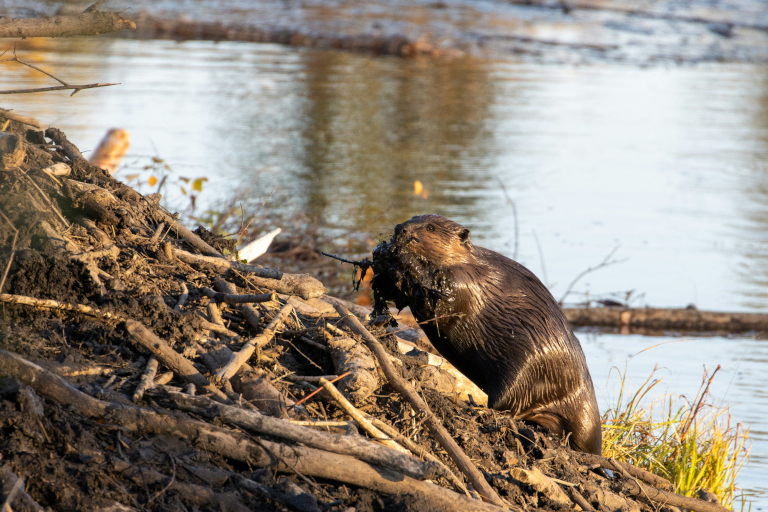
Moreover, there are species who are more environmentally suited to the current climate shifts and a new equilibrium will eventually be found, so why do we say we have a responsibility to preserve a historic one? Beavers change their ecosystems by building dams; what makes our manipulation unnatural compared to theirs? People often argue that it’s our comprehension of the harm it causes others that makes it an ethical issue. But when we see patterns of exploitation and of mutualism on every scale, why would this understanding be unique to humans, with all other beings acting on impulse alone? We have no knowledge of the intent behind the beavers’ creation of wetland, whether they have balanced the lives harmed against the benefits of introducing the habitat.
The assumption that only humans have the capacity to consider their impact on the environment seems to reinforce an exceptionalist viewpoint that is often used to defend the ecological harm our species is causing. Arguing that a distinction from other creatures is what drives the moral responsibility to prevent further climate change implicitly devalues the work that such action involves. If environmental justice matters because we feel a need to protect something outside of ourselves, then how do we decide what that is and what our priorities should be? By choosing some ideal of how nature ought to exist, we assume we can control it, removing both agency and value. The environment becomes once again led by our own experiences, and I struggle to see how this world is any less human-interest driven than one in which we are fully exploitative. Yet if nature is indeed a separate entity, this decision is unavoidable: if we do not define what it is meant to be then there is no concrete argument for preventing it from progressing in its current manner.
By moving from seeing nature as something we – a distinct group causing harm – need to protect, to understanding it as a system we are actively involved in, battling climate change becomes less a concept of preservation and more a question of how we can help to shape a world that allows many beings to thrive. In many ways this reframing strengthens the ethical arguments behind climate justice, allowing future decisions to be informed beyond somewhat arbitrary beliefs of how things used to be: the conversation shifts towards an evaluation of how to best serve all the needs that form this complex system. While this still may not give clear answers to every question of prioritisation, it allows the pressing need for action to sit alongside factors such as human interests and the long-term persistence of nature, without one negating the other. By remembering that we, like beavers, are an active part of the ecosystem, the goal is no longer to preserve nature, but to ensure that our participation in its ongoing evolution considers the interests of many.