Try guessing the common glue that connects the following topics often covered on this blog in recent years:
- The Sixth Mass Extinction is a scary prospect
- Space colonization is a fantasy
- Agriculture and subsequent inventions spell bad news
- Meat-brains are not all that impressive
- Dualism drives a sense of separateness
A clue to the glue is that one word will do. And it’s not in the title, exactly. Have I spoiled the challenge with too many hints? Well, in any case, the word is: ecology.
Obviously, the first item is an ecological concern. The second is borne of total ecological ignorance. The third marks a turning point in our ecological relationships—from embedded participants to would-be masters. Our most consequential mental shortcoming is believing we can invent replacements for ecology that have long-term sustainable potential. And the last gets at the philosophical (metaphysical) underpinning that accompanies our ecological estrangement.
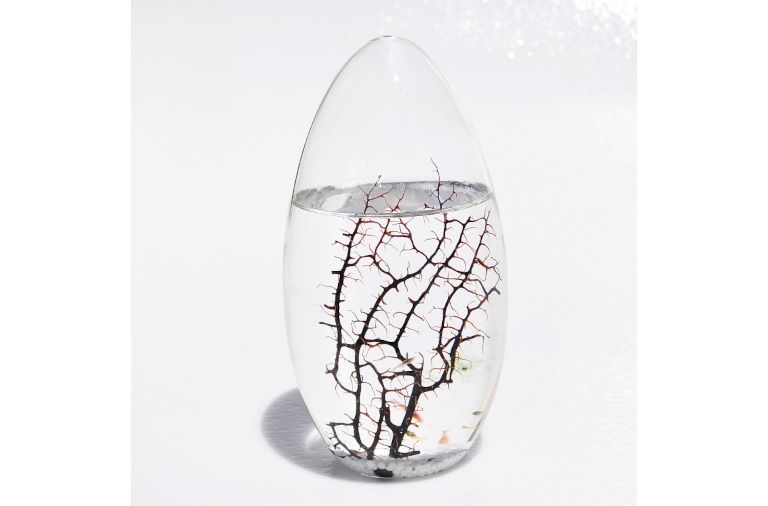
This post highlights yet another failure on the ecology front that has overlap bearing on these themes. That failure is the EcoSphere aquaria. An EcoSphere is a desktop curio containing a small, sealed community of life meant to sustain itself for long periods. And it does, sort-of: for a whole hundred-thousandth of timescales relevant to ecology and evolution. Yay? Only 99.999% more to go! You’re almost there!
What Are EcoSpheres?
Commercial EcoSphere units centered on an exceptionally-resilient species of shrimp, combined with algae and bacteria in a roughly-balanced symbiotic triangle. Snails were part of the mix in earlier units to keep the glass clean, but were later dropped. Admittedly, the idea is cool, attractive, and not a total flop. Except the business folded in 2022. And the “products” all die in relatively short-order.
From the Wikipedia page:
The main conceptual interest of these objects lay in the fact that they were materially closed ecological systems which were self-sustaining over a period of years. At room temperature, and with only low inputs of light, the algae produced oxygen which supported the shrimp and bacteria. Bacteria broke down the shrimps’ wastes. The breakdown products provided nutrients to the algae and bacteria upon which the shrimp fed. The manufacturer stated that shrimp lived in the EcoSphere for an average of 2 to 3 years but were known to live over 12 years.
The page goes on to clarify:
Closed jar systems like the Ecosphere degrade with time. They are “self-sustaining” only in comparison to systems which degrade much more quickly.
Yeah: impressive only when compared to even more ridiculous attempts to create artificial living communities. Although reproduction of the shrimp can happen within the EcoSphere, it is apparently rare. Members of the chosen shrimp species are long-lived: up to 20 years when safe from predation. So, the lifetime of the experiment is mostly down to individual survival, not generational cycles. In fact, if the average viability of EcoSphere is 2–3 years for critters that can live up to 20, the impoverished environment constitutes an early-life death sentence: quite opposite a miracle of sustainability!
The same page also mentions freshwater–mud analogs originally teeming with diverse life of the tiny variety. After an early mass extinction (in which all multi-cellular life is eliminated—gulp), what remains can live for whole decades. Wow. Is that a lot?
Get Real!
No attempt in the history of human meddling has resulted in a “closed” ecology capable of lasting even a century—usually well short of a decade. The famous Biosphere 2 project that included humans had to break the seal after just 16 months. I put “closed” in quotes above because the sun (sold separately) is a ponderous but critical component, easily dominating the mass of the entire experiment.
But think about the failure, here. Not even a very hardy variety of shrimp (cockroaches of the sea?) has been accommodated in a small, closed environment for a small fraction of a human lifetime—even with all the resources and biodiversity on Earth within easy reach, and enjoying benign ambient conditions (comfortable temperatures and low radiation levels).
Now tell me: how exactly is it that sane individuals can believe that humans—far higher-maintenance than cockroaches/shrimp—could possibly be supported for human lifetimes (let alone multiple generations) on an alien, hostile, (effectively) lifeless planet? It’s beyond crazy. What’s more, this mother-of-all-challenges isn’t even a significant focus of the clueless enthusiasts, who obsess instead over the form of conveyance. Talk about putting the cart before the horse! They’re so far out of their depth as to invite pity, and will unquestionably fail to realize their juvenile dreams (though may not live long enough to be convinced of its failure). Too bad we can’t simply distract them with ice cream.
Here’s another stark framing. Actual (land) cockroaches are unpopular for EcoSphere-like experiments, as few people would want to show off a cockroach on their desk. Miniature shrimp are at least cute—or in any case do not suffer the same negative cultural associations as cockroaches. It seems safe to assume that enclosing cockroaches into a small, sealed “ecology” would fail as fast or faster than the ones using shrimp. We thus find that the artificial ecosphere designed by humans is more deadly to cockroaches than it is commonly assumed nuclear Armageddon would be. Think about that! An artificial colony on Mars—where the outcome is almost certainly total extinction—is more deadly to Earth life than nuclear war!
The Wise Folk
Now consider this thought experiment. Imagine showing pictures of the Martian or lunar surface to a person who has lived their whole life as a traditional hunter-gatherer embedded in an ecological community. Then offer the proposition: “Just say the word and we’ll send you to live there free of charge.” How would they respond?
Presumably, they’d look at you like you’re totally nuts. They might say “That place has no life: no ecology into which I might tuck in. It’s certain death. A barren rock like that has nothing for me to be a part of—no stories to guide and support me.”
On the flip side, it isn’t hard to conceive of a non-hunter-gatherer (modernite; agriculturalist) saying “Yeah, I could work with that.” The mentality here is that (ecologically detached/ignorant) humans exert control over nature: shape it to our needs. Members of modernity exalt the moxie inherent in rising to such challenges. Our culture defines itself by this god-power “over” nature.
The point is that the hunter-gatherer (presumably) puts ecology first, looking for ways to fit into a Community of Life, as an unquestionable part of it. The (dualist) modernite perceives themselves to be transcendent; apart; separate; able to innovate anything they need out of limitless brains—so the mythology goes.
The hunter-gatherer knows instinctively in their bones that separating oneself from ancient ecology is bonkers. Listen to them.
This framing more closely associates the modern agriculturally-based mentality with unhinged space fantasy than with a sense of ecological rootedness that accompanies the only human cultures demonstrating true longevity on the planet over ecologically-relevant timescales. Once humans started wholesale manipulation of environments (plowing, eradicating), the mentality changed significantly: separation sequence initiated. The millennial countdown commenced 10,000 years ago: ten, nine, eight…
Thanks to my friend, Craig, for pointing me in the direction of these failed shrimp baubles.