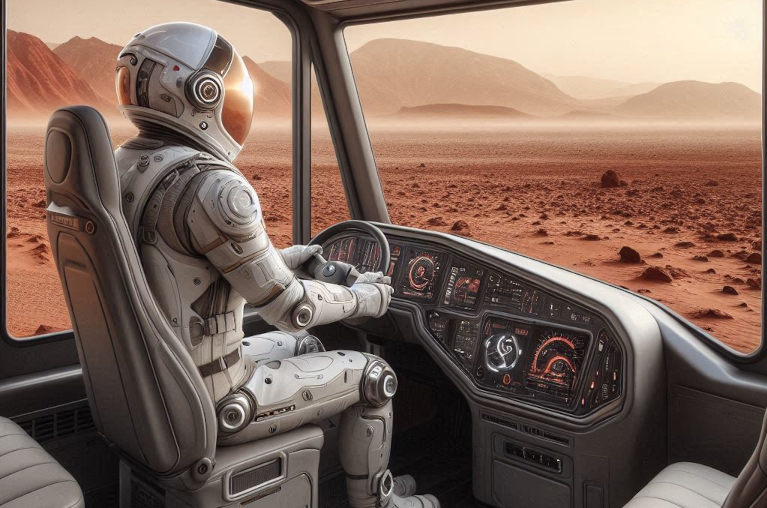
I was recently on a medium-haul bus ride, sitting within earshot of the driver—but not the closest passenger to him. I’d encountered him a few times before: a somewhat chatty middle-aged fellow given to telling the occasional joke into the microphone for the whole bus. He is, on the whole, a friendly and likable guy, who does his job well.
The passenger sitting in front of me obviously had talked with him before, because at one point he asked the driver for an update on his ion drive. It took three tries to have his question heard correctly: “eye-on drive?” But once clear, ho boy did the conversation take off!
This post is partly for entertainment value, but also serves to highlight delusions about space. Granted, some people might judge this character to be a little “out there,” but to my ears all space talk is at a similar level of crazy.
Game Changer!
The floodgates were open for the driver to talk about his game-changing idea. According to him, NASA knows a little bit about ion drive but they’re not apparently aware of the benefit of repulsive ion drive: pushing against the ejected charge electromagnetically (not just its chump inertia). Do that, and you’re really cooking! Acceleration becomes exponential, the driver claimed.
Apparently, he was really close to being done with the prototype. He had finally figured out how to keep the coils cool enough to prevent melting the plastic on which they were wrapped. Seems important. Or maybe try a different material? Anyway, it basically works now, but he still needs to solve the control issue. He said he was making progress on driving the coil by stepping up the voltage from an electronic speed controller of the sort one would use for a drone’s rotor motor.
“So, yup: I’ll be taking a trip to California soon.” This was the first of several hints as to his target audience. “After all, he’s the richest man on Earth and seems to be open to radical new innovations.” An additional reference in praise of Tesla cars eliminated any further ambiguity as to who he intended to wow with his technology—even though never called by name.
“I simply refuse to sell it to China. I don’t care how much they’d offer. At least if I sell it to my guy, it’ll take a while before anyone uses it for weapons.” He explained that a rocket with no heat signature would be ideal for stealth attacks that would render defense systems useless. “No one will see them coming.”
His goal is to have his ion drive be implemented for space travel first, “so that I’ll have a way off this rock before they make it glow in the dark.” He’s only slightly concerned about this fate, because, as he gibed: “Oh heck, at least I’ll be rich. Nuke ’em all—I’ve got caviar!”
At this point, he switched gears to express enthusiasm for a zero-combustion engine—explaining how a rail gun uses electromagnetism to accelerate a projectile to high speeds. Well, you can also contrive to move something back and forth—like a piston, in fact. So, imagine a car engine whose pistons are moved not by little combustion explosions, but by an electromagnet sheathing around each cylinder. One question: why bother retrofitting a combustion engine architecture and have to mess with pistons (and crankshaft and transmission) if you can reconfigure the geometry to just move the damn wheel directly with, you know, a rotary motor like an electric car already does? I must be missing something rather big. Anyway, no carbon, no oxygen. It won’t require cleaning like a solar panel would. Set one up on Mars and you’d have safe, reliable power. “Just something I came up with in the bathtub,” he noted—joking that “I may not be an actual genius, but I can play one on TV.” He focuses on “making something that would change the world, sometimes coming up with a good one, and other times not so much”—modestly. It almost made me believe his good ideas must actually be good, if he is discerning enough to tell the difference…
Back to the ion drive, it would apparently also solve the thorny problem of landing on Mars without a thick atmosphere to slow down the lander, and without wasting billions of dollars on the sky-crane approach, in which the rocket workhorse destroys itself after lowering its cargo. It’s a technology of many talents.
Let’s jump back to the zero-combustion engine (the driver kept bouncing, so you’re getting the same experience, here). He thinks maybe the smart move is to draw that up first to float in front of the big guy to pique his interest. Then he can ice the cake with an ion-core performance (groan). Apparently, this electromagnetic engine will never go dead, as long as it stays running. Did I hear that right? The next part was unambiguous and eye-popping: it takes less power to operate than it can produce. My thought is that as long as Mars is equipped with power outlets and a power plant somewhere that can be ignored in the calculation, he might be right.
An Exception?
I don’t think this guy is really that unusual in both his assuredness of a space future, and a confidence that he can do something big as an unappreciated underdog. That’s how it works in the movies, so our culture is saturated with this notion of the lone underestimated genius who changes the world with insight and grit—doubted by elite jerks like me at every turn. Our culture irresponsibly manufactures loads of folks like this all the time. Then failure eventually makes them bitter and they vote their anger so that our culture reaps what it sows.
Now, the more serious and technically experienced space enthusiasts would doubtless roll their eyes at this guy—while others like me roll eyes at them—and they roll eyes back at me (mutually-assured eye fatigue). Just as our bus driver lacks some basic awareness of conservation laws and other physics, the space enthusiasts are wholly ignorant in ecological terms. What’s more, they don’t see what that has to do with anything. And even if it was important, how hard can it be, compared to rocket science and robot sidekicks? Ecology is more of a “soft” science, after all, right? Nothing “hard” about it? Ecology, in this sense, is similar to a Prime Directive that can be drafted by any teenager or LLM: an easy detail requiring little actual work.
The Cost of Ignorance
I think of it in terms of this analogy. Let’s say you approached a 25-year-old average Joe and said: “We are holding open a position for you at the prestigious Mayo Clinic as Chief Neurosurgeon. The job starts in ten years. Your mission is to get yourself ready by then, and if you can do so, the high-paying job is yours for life.” How does Joe react?
“Hot damn! Okay. Let’s roll up our sleeves and get started. The first thing I need to focus on is what sweet ride I’ll use to commute to work. No ordinary car will do: I have to design something from the ground up. I’m thinking either ion drive or zero-combustion electromagnetic pistons. Hey: maybe I can finally put my 3-D printer to some actual use! This will take a while, but I think in ten years’ time I’ll be prepared for the commute.”
What is our guy missing? Medical training, perhaps? You know: preparing for actually doing the job?
If someone wants to live on Mars, don’t skip over the word “live.” What is it to live? What is Life? Life is ecology. Life does not exist in a vacuum—as individually-wrapped separable units—but in a contextually-rich, interlocking web with a loooong evolutionary heritage that has proven itself over deep time. Trying to live on Mars without the first clue about how Life lives is very much like aiming to be chief neurosurgeon without the first clue about the actual job: instead focused only on how we might get there.
To live outside of one’s ecological context—and in fact where no ecology of any relevance exists—would require somehow creating a suitable ecology, or borrowing a sufficiently-complete subset of an existing one that can tolerate a completely novel setting for which the beings are not adapted. We have zero idea how to do either (upcoming post), and much less to show in terms of demonstration.
My guess is that if I had piped up on the bus to point out conservation of energy or charge (what are the ions to repel against?), the driver wouldn’t say: “Oh, I was not aware and will need to go back to the drawing board—maybe I’m totally on the wrong track.” Likewise, space enthusiasts confronted with warnings of ecological deal-breakers are not likely to accept that they have any critical-failure-relevance to their dreams. Something in their brains will shut down the threat before it can destroy anything precious and even challenge their core identity. It won’t matter too much in the end, though, as these fantasy enthusiasts won’t get any closer to Mars than the bus driver will get to “the big guy.” It’s just a little sad, is all.