We are back with Shane Casey in The Burren, Ireland, where lambing season is in full swing.
Shane has been busy with the next generation on and off the farm too, visiting schools with a herd of Old Irish Goats. Once a common sight in the Irish countryside, this rare native breed is helping to revive a cultural heritage that has lessons to teach us today, on biodiversity, wildfire management, and the transmission of knowledge from one generation to the next.
Over to Shane in the lambing shed.
The gentle bleating of the ewe, as she tends to her newborn lamb, is a welcome respite from the noise coming through the news channels of late. I place the bottle of iodine back up on the wall after giving the lamb’s navel a spray, and then grab a fist of hay to wipe my hands clean, as I stand there and watch them for a moment or two. It’s a fine ram lamb, a pedigree Suffolk, shaking his head in response to his mother licking around his ears, bleating as she goes, forming those all-important connections.
It’s a stark contrast to last year, when she was just a hogget having her first lamb. The wiggling creature on the ground had her cowering into the furthest corner of the pen, and it took a few minutes for her maternal instincts to kick in. Thankfully, there are no such issues this time around. I go to fetch her a bucket of water, a sop of hay, and a fist of meal, and when I return, the lamb is already making an attempt to stand, but he nose-dives instead into the fresh straw!
When I throw an eye on them an hour later though, he’s up and under the ewe. There’s a little movement in the top of his tail as he tries to shake it. It’ll be going like the hammers from herein. These are the moments that farming was made for!
I started writing this letter last September, but for reasons I’ll outline below, I’m just getting around to finishing it now.

The “poor man’s cow”: Goats in the Caher Valley in September
Kidding around
It was a blustery sort of day, and we had been out herding sheep in the Caher Valley, with the two children in tow (seven and three years old).
We were weaning the last few lambs, which had been stragglers at the end of the lambing season, too young to go to the mart, and easier to manage by simply leaving them on the ewes, but now was the time to separate them, and give the ewes a chance to recover before letting the ram back out.
On the way home, we spotted a herd of goats on the hill, not far from the road, so we parked the car to try to get a little closer on foot, skirting around in a wide berth to get above them. Somehow, they didn’t run off, probably deciding that the singing three-year-old on my shoulders posed no threat to them!
Among the bunch were a few Old Irish Goats, a rare native breed. The breed, and goats in general, were a lot more common on the Burren when I was younger, with many neighbours having their own animals (a poor man’s cow as they were known).
In fact, farmers locally used to receive headage payments for goats, so they were worth keeping around, and what a visitor to the Burren might consider a “wild” goat, was often far from it.

Getting smothered with love in the 1980s
At home, there were a handful of female goats that we considered as pets, when I was growing up. They’d arrive down from the mountain at this time of year to kid, usually bringing a few dozen pucks (males) with them.
My brothers, who are a few years older than me, used to sell the kids to neighbours at Easter time, a local tradition rather than an Easter lamb, for a five-pound note each (the Irish currency before the euro) – it used to go a lot further back then, than a five-euro note would go today!
Evidence of the tradition can also be found in the archaeology on the farm, including a small stone-wall pen, around five foot (1.5m) high, called a “kid crós”. The kids would have been kept in them, ensuring their mothers wouldn’t go too far away, and could be milked on their return.

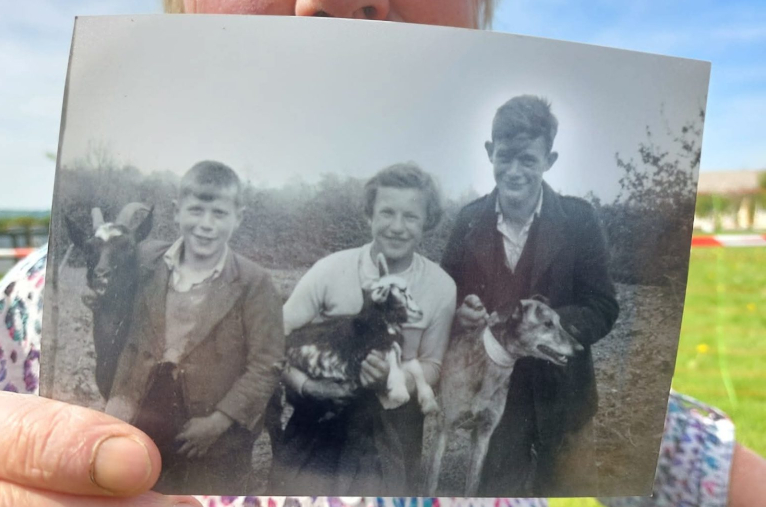
Nellie Connolly, from Carlow, brings a photo of herself and her brother holding goat kids from many moons ago

A new niche for the Old Irish Goat
I’ve heard a lot of stories about goats over the last year, as I had organised, with the support of the Old Irish Goat Society, to bring a small herd around to different towns and villages in Co. Carlow (south-east of Ireland), as part of a public engagement project for managing urban green spaces for pollinators and our wider biodiversity – nearly 4,000 people, from young to old, came to see them, and it was the older generation that had plenty of stories.
I heard about the goat that reared a horse foal, after its mother didn’t make it and a replacement mare couldn’t be found, lifted up on a barrel so the foal could suckle. I heard about the goat that would lead a herd of dairy cows from the field to the parlour and back again, twice a day, every day, without fail. In a different house, the goat itself was milked, as some of the children had asthma. I heard about the goat that saved a flock of sheep from stray dogs, and many other stories.
It turns out, goats played a huge cultural role in Irish farming in the past, but through no fault of their own, they have fallen out of favour. Thankfully, the Old Irish Goat has found a new niche, in conservation grazing to control upland wildfires and managing historical sites. It’s a reminder however, that nothing in farming is permanent.

Lessons for young farmers
Unfortunately, after that excursion, our household succumbed to the annual September coughs and colds, and it was late October that I remembered the letter. I was sitting in the mart, watching weanlings go through, and thinking back to something else from when I was younger – a game of sorts.
We’d be sitting on the concrete steps overlooking the ring, shivering a little as the cold went up through us, trying to guess the price of the weanling, before the auctioneer dropped his hammer. It’s an important lesson for any farmer to know the value of their livestock, to know if the price on offer is the best you can expect, or to hold out for more. We’d judge it on the breed, the weight, the quality of the animal, and the price of similar weanlings that had gone through already. Of course, the skill of the auctioneer, the buyers around the ring, and the farmer selling, also influence the final price. Needless to say, the prices being paid this year were very different to the prices back then!
There was the purchase of a new tractor, between that and Christmas, which pushed the letter to the back of my mind. It’s something I’ll come back to in another letter, as the gradual increase in the size of machinery has led to the loss of cultural heritage, and particularly field names and stories in many areas.
Then there was the New Year, which as always, was a busy time with the onset of lambing – a very welcome distraction! So that brings us up to date.

The Old Irish Goats have a bit of fun with the team from Carlow Fire and Rescue Services, during their visit to the county
Policy Notes: County Carlow’s Green Infrastructure Strategy
Shane’s tour with the herd of Old Irish Goats was part of a public engagement project for managing urban green spaces for pollinators and our wider biodiversity. In his role as Environmental Awareness Officer for Carlow County Council, Shane explains a pilot programme it is rolling out: a pollinator foraging map.
In April 2023, Carlow County Council adopted their County Carlow Green Infrastructure Strategy, which contained a novel approach to managing urban pollinator foraging networks. The approach is based on the policy that:
“No pollinator in County Carlow’s towns and villages will have to travel more than 200 metres in order to find a food source (green space of a minimum size, that is managed for biodiversity).”
The approach resulted in the production of a pollinator foraging map (trialled in Carlow Town initially, with a view to replicating in all other towns and villages). We will expand on how this was produced, and how it can be used further below, however, there are two other key elements of the policy to be aware of:
The ‘200 metres’ distance was derived from the All-Ireland Pollinator Plan’s “How Far Do Pollinators Travel” Blog, which outlines that solitary bees (the vast majority of our bee species), and many bumblebees, forage within a very short distance of their nest. It would be hoped that future iterations of the policy will reduce this distance further.
The ‘green space of a minimum size, that is managed for biodiversity’ is derived from the Carlow County Development Plan 2022 – 2028. This Plan is the parent document of the Green Infrastructure Strategy, and states that in order to qualify as Green infrastructure, ‘the ecosystem and associated environmental features must be of high quality and capable of delivering more than just green spaces (i.e. regularly mown grassed areas)’. The Plan also provides a county-wide priority hierarchy of Green Infrastructure Resources, from protected biodiversity sites at the top (e.g. Special Areas of Conservation), down to street trees and civic spaces.
Using this hierarchy, publicly managed Green Infrastructure Resources (e.g. Carlow County Council managed areas), within Carlow Town were identified as outlined below. It is anticipated that the next iteration of this list will include community managed spaces, and privately managed spaces.
In each case, a 200-metre pollinator commuting zone was included. This is better visualised on Figure 1 below – essentially, the more the commuting zones overlap, the better the connectivity.

Figure 1: Carlow Town Green Infrastructure Network
In Figure 2 below, we have zoned in of one particular area in Carlow Town to demonstrate the benefits of mapping a Pollinator Foraging Network. The commuting zones in this area form a “C” shape. Within the centre of this shape, there is a gap, despite clear green spaces on the base map. However, these areas are playing pitches, which do not qualify as priority Green Infrastructure Resources.
Mapping allows us to see the true extent of connectivity, while also allowing us to prioritise investing resources into filling the gaps, and improving connectivity, rather than expanding ‘islands’ of biodiversity.

Figure 2: The Benefits of Mapping a Pollinator Foraging Network
Finally, to accompany the map, the following operational policies will apply to these areas, along with All-Ireland Pollinator Plan recommendations as applicable:
- Implement a pesticide reduction strategy in these areas, except in the case of Invasive Species control, with the aim of eliminating their use in the medium-term.
- Wherever possible, ‘No Mow’ will be the preferential management approach.
- In any area greater than 5M2, all planting must include a minimum of two canopy layers, i.e. wildflower planting can only take place when accompanied by shrub or tree planting.
- All tree planting will follow the “right tree, right place” approach, taking account of both their underground and mature canopy space requirements.