As a temperature check on where the alternative agri-food movement is in Britain, the Oxford Real Farming Conference is a good barometer. Oliver Moore reports from Oxford.
Listening to the land
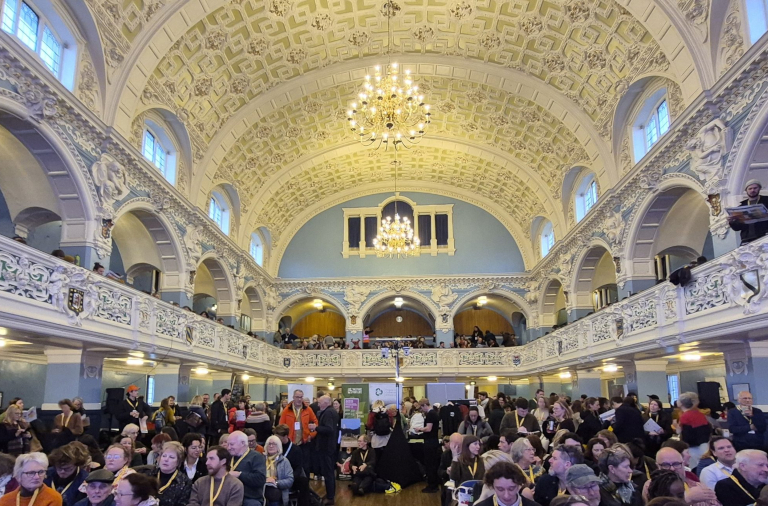
The Oxford Real Farming Conference started 17 years ago as a tiny fringe event offering an alternative to the industry-focussed Oxford Farming Conference. This year’s ORFC, held in the first week of January, was attended by 4,800 people online and in person.
In a surprising and enlivening programme, much space was held for wider, more nuanced and outsider approaches to all aspects of farming and the land.
It wasn’t just the topics; it was the range of activities—workshops, book readings and author interviews, creative writing classes, morning meditation with Satish Kumar, speed dating, storytelling, film screenings and more.
There was much on using intuition in our relations with plants and animals, on reanimating indigenous foodways, on being more present in our surroundings, and on reexamining English, Welsh, Scottish and Irish roots, rites and rituals from pre-capitalist and pre-colonial times.
Listening to the Land was one of five main strands of the programme. It carried the momentum of a pre-conference event held the day before in the stunning Wesley Memorial Church: Listening to the Land Day 2026. Here, a couple of hundred people gathered, from Britain and further afield, from Aotearoa (New Zealand) to Turtle Island (North America), seeking to build a more receptive, reciprocal, sometimes even ceremonial space and place in the land, and in our farming ways.
Conscious farmers
ORFC’s opening ceremony was memorable for many things: for dung beetles as inspiration, for the enforced absence of Palestinian farmers due to attend—who were nonetheless cheered for in solidarity—and for the powerful drummers of the Shumei Taiko Ensemble, who are also farmers with a very specific way of growing food.
Part of the Shumei movement, these drummer-farmers focus on nurturing life force in seed, soil, and plants. Indeed for Shumei, the consciousness of the farmer plays a role too.
Tomi from the Shumei farm in Yatesbury spoke with me. Not only is it no dig and no biocides, it’s also no fertilisers, no compost, and soon no crop rotations at all. “The most important thing is the love and gratitude for the vegetables, nature and everything.” So it’s about sending love –and also “saving seed and continuous cropping” for these practitioners. Even the seeds are grown out in pots of soil, not of compost; as Tomi puts it, “the soil can manage everything.”

The Shumei Taiko Ensemble opening the Listening to the Land Day. Photo: Oliver Moore
Justice and joint struggle
The Justice strand too, felt very strong and present. This strand brought together those from marginalised perspectives—landless and minorities such as black, queer and neurodiverse.
Many of the Justice strand’s events were in the Story Museum, a gorgeous, magical, welcoming place that felt strikingly different to the main venue of the conference: the majestic but forebodingly imperial Oxford Town Hall, with its muskets in glass frames and intricate perfectly plastered enormity.
Another strand was dedicated to the wider peasant movement working together on the global and local levels under the banner of La Via Campesina and its UK member Land Workers Alliance: from dismantling global trade injustices to “joint struggle” with Palestinian farmers, as Professor Mazin Qumsiyeh, zooming in from Bethlehem, put it, and fighting the far right in farming.
Some participants came with a critical lens. There were grumblings about how the agroecology movement needs to get its own house in order. While it may have, in La Via Campesina, a movement that is expressly of the global south and its people, one that fights racism and colonial-capitalism, interjectionists pointed out that in western Europe it’s a very white “sector” (the word used specifically), especially in the owning classes, and has some questionable tendencies towards essentialism, and notions of purity, on its edges.
“It’s not the plough, it’s the how”
There was a strand on food and farming policy. Yet it gave surprisingly little attention to how a post-CAP, post-Brexit farm policy is developing and diverging in each of the United Kingdom’s countries (each of which have their own individual ag policies). Instead, glyphosate, Mercosur, technology (e.g. AI, corporate capture) featured strongly.
That said, the occasional sessions with policy makers from government departments were busy with lots of questions from growers and farmers.
The phrase “it’s not the plough, it’s the how” is Patrick Holden’s, an organic farmer in Wales, who is also with the Sustainable Food Trust. It encapsulates well the case for care-full organic farming, while flagging in contrast the use of herbicides in regenerative agriculture –the movement that coined the phrase “it’s not the cow, it’s the how”.
I came to ORFC seeking deeper explanations—to better understand why hurt people hurt people, and cycles of destruction and extractivism keep happening as we try to feed ourselves. It was a balm to host a post film screening conversation—with an intro in Irish—with Professor Rupa Marya, deftly chaired by Anna Lappé. Our session Farming is Medicine: From Turtle Island to Éire really seemed to move people. There were tears, and long conversations after.
As Rupa put it: “I was inspired to see so many people actively connecting the dots between the genocide in Palestine, the control of our food system and land access, the technofascist expansion of AI and the catastrophe for the environment and civil liberties that brings, and the use of paramilitary in the US to kidnap and murder dissidents. Connecting these dots allows us to come up with comprehensive strategies—across borders and biomes—to build a resistance approach through food, land and care.”
Conclusion
There is in academia the idea that organic farming and food will eventually become just like mainstream farming and food, through a process known as conventionalisation. This means that over time, the inputs, the processes, the routes to market and so on all copy the mainstream. You can see this play out in places like Germany’s Biofach organic trade fair.
Another view is that the alternative agri-food movement replenishes itself—so while these processes of conventionalisation are happening, a deeper, wider, more diverse and horizontal tendency emerges to replenish the movement too.
Among other things, the Oxford Real Farming Conference shows that there’s more to the movement than mere conventionalisation.
The movement is doubling down—it’s attempting to deepen its understanding of the world. And there’s no time like the present for that.