


Just days after Martin Luther King, Jr. was assassinated in April 1968, members of Congress sympathetic to the civil rights hero proposed a federal holiday in his honor. It would take another 15 years and a failed floor vote, however, for Congress to pass the legislation that finally codified a day to commemorate King’s legacy. President Reagan signed the bill into law in 1983 and the first nation-wide MLK Day was celebrated in 1986.
Every third Monday in January since then gives us reason to revisit the life, deeds, and words of Dr. King. As a millennial growing up in the Northeast, I learned about the civil rights champion—and, by proxy, the civil rights movement as a whole—via his speech at the March on Washington in 1963. The famous “I have a dream” refrain served as a staple of my grade school education. But it wasn’t until much later that I learned about the King whose politics extended far beyond the image of the man in popular imagination. In years past, I’ve used MLK Day to re-read his “Letter from a Birmingham Jail”—where he takes to task the “white moderate who is more devoted to order than to justice”—as well as his final book, Where Do We Go From Here?, where he reckoned with the achievements and the limits of the movement he led. In 2018, as I was helping to launch the Sunrise Movement, I published an article about King’s commitment to economic justice and his sympathies to democratic socialism.
But one thing that is so valuable about MLK Day is that it provides an opportunity to reflect not only on the legacy of King himself, but also to hold up other heroes of the civil rights movement. There are countless leaders in the movement who helped bend the moral arc of the universe a bit closer towards justice, and this holiday is theirs, too. Here at the Whirlwind Institute, Mark and I have each written about movement leaders who, though less widely known as King, are icons in their own right. Two that we would like to shine light on today are Ella Baker and Fannie Lou Hamer.
* * * * *
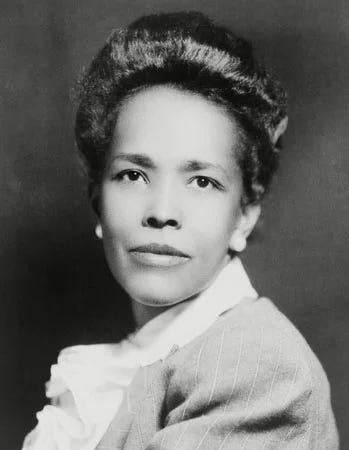
Ella Baker, circa 1944. Wikimedia Commons.
In 2020, Mark wrote a piece for The Nation arguing, “It’s Time We Celebrate Ella Baker Day.” As a woman in a chauvinistic society and as a leader who preferred two-way conversations to soaring speeches, Baker was a remarkable figure in the civil rights movement. As Mark writes, “While King is justly remembered as a powerful preacher and rousing orator, a political strategist and practitioner of nonviolent direct action, Baker calls attention to a more specific role: that of the organizer.”
Mark noted:
“[T]he sociologist Charles Payne has argued that the civil rights movement of the 1950s and ’60s actually contained two distinct traditions. One he labels ‘the community-mobilizing tradition,’ which was ‘focused on large-scale, relatively short-term public events.’ Payne sees this lineage as ‘best symbolized by the work of Martin Luther King,’ and he includes in it such well-remembered events as the March on Washington and the famous campaigns in Birmingham and Selma, Alabama. The second is a tradition of community organizing. This is a lineage, Payne writes, ‘with a different sense of what freedom means and therefore a greater emphasis on the long-term development of leadership in ordinary men and women,’ and it is a tradition best epitomized ‘by the teaching and example of Ella Baker.’”
Baker was indeed a major proponent of what she called the “spadework” of social change, the unglamorous but vital labor an organizer commits to in order to build the leadership of a community. As Mark writes,
“Her organizing was about building relationships—about forming deep ties with people who had not necessarily considered themselves part of a political movement before. She instilled in people a belief in their self-worth and ability to lead, and she cultivated their capacities for independent action.”
As a field secretary for the NAACP, Mark writes, Baker hosted training conferences for dozens of young activists throughout the South. One of Baker’s trainees, an Alabamian named Rosa Parks, ended up igniting a key skirmish of the civil rights movement when she refused to cede her seat on a bus to a white man in 1955, an act that became the impetus for an intricately organized community-wide bus boycott. When another protest movement emerged in 1960—this time, among black students sitting in at lunch counters across the South—Baker invited the leaders to a conference at her alma mater, Shaw University. The meeting led to the birth of the storied Student Nonviolent Coordinating Committee (SNCC).
While Baker can be seen as a great practitioner of the relationship building and leadership development that are the hallmarks of structure-based community organizing, Mark argues that she also had a keen appreciation for mass mobilization as a tool for social change. It is this flexibility that makes Baker a stellar example of an organizer with a sophisticated understanding of what we might today call social movement ecology.
Mark describes a methodological divide that threatened to derail SNCC early on in its existence and the role that Baker played in keeping the movement united:
“Over the course of its first year, SNCC members debated whether to continue to focus on nonviolent direct action or move toward long-term community organizing, and the group threatened to split over the issue. Baker counseled against the divide, and SNCC came to embody both traditions. Its young organizers contributed to confrontational mobilizations such as the 1961 Freedom Rides—in which interracial groups boarded buses to challenge segregation in interstate travel—and the appearance of the Mississippi Freedom Democratic Party at the 1964 Democratic Party Convention in Atlantic City, where the group challenged the legitimacy of its state’s all-white official delegation. At the same time, many of SNCC’s organizers moved to small towns in the South to engage in base-building efforts and found participatory Freedom Schools that would foster local activism for years to come.”
“Today, Baker’s example challenges us, as [biographer Barbara] Ransby puts it, ‘to strike the balance between mass mobilizing and organization-building; between inclusivity and accountability; and between strategic actions and spontaneous ones.’”
It is no easy feat to navigate the pros and cons of different strategies at different inflection points, and Baker’s ability to do so made her an irreplaceable leader in the civil right movement. But just as importantly, she trained others in the same strategic judgment. It is this twin commitment to movement strategy and to leadership development that makes her a legendary organizer.
* * * * *
In 2017, I wrote for Dissent about another of the civil rights movement’s most iconic leaders: Mississippi’s Fannie Lou Hamer. Known within the movement for her generosity of spirit, her love of song, and her common sense witticisms—“I’m sick and tired of being sick and tired” is etched on her gravestone in Ruleville, Mississippi—she introduced herself to the nation at the Democratic National Convention in 1964 with a story of the violence she faced when she tried to register to vote. As I wrote in 2017, on the 100th anniversary of her birth:
“The youngest of twenty children, Hamer began picking cotton on a sharecropper plantation at the age of six. In 1961, she was involuntarily sterilized when a white doctor surgically excised her uterus. The next year, when the civil rights movement came to Mississippi, Hamer was personally recruited by the Student Nonviolent Coordinating Committee’s field secretary, Bob Moses, to build a mass base of autonomous local organizers that would become the Mississippi Freedom Democratic Party [MFDP]. While returning from a voter registration workshop in 1963, she was arrested in a bus station, thrown in jail, and cudgeled, leaving her with permanent kidney damage. And [at the national convention] in Atlantic City—out of the Delta, out of prison, out of poverty—Hamer led a delegation of poor, rural African-Americans to the DNC to realign America’s political parties.”
That summer, Hamer had come all the way from the Mississippi Delta to New Jersey as a delegate of the Freedom Democratic Party, an alternate slate of civil rights delegates that challenged the legitimacy of the white supremacist Southern Democrats who ruled Mississippi through racial terror. Hamer detailed this terror in front of television cameras at the DNC: “Is this America?” she asked to the committee of Democratic officials who were tasked with adjudicating the challenge, “the land of the free and the home of the brave, where we have to sleep with our telephones off the hooks because our lives be threatened daily, because we want to live as decent human beings, in America?”
President Lyndon B. Johnson was so unnerved by the power of her testimony and what it meant for the Democratic Party’s national coalition that he called an impromptu press conference to knock Hamer off the air. The move backfired. Instead of being broadcast live, replays of Hamer’s speech appeared on television sets across the nation during primetime.
I love the story of Hamer and the Mississippi Freedom Democratic Party because of its power as an example of a movement group forcing a key target—in this case, the president of the United States—into a “decision dilemma.” As I wrote:
“The MFDP forced the question: If white supremacists could not be counted upon to support their party’s nominee, what were they doing in the party in the first place?
The Democratic National Convention was the perfect stage to gouge open this rift in the party. ‘If you seat those black buggers,’ Texas governor John Connally warned President Johnson, ‘the whole South will walk out.’ That was, of course, the point.”
Hamer’s response to the compromise that the president offered at the convention—two seats for the MFDP, reserved for a white minister and a middle-class businessmen—was clear and resolute: “We didn’t come all this way for no two seats!”
The outcome of the convention fight was a complex moment for civil rights activists. To this day, various participants and historians debate whether the MFDP should have accepted a brokered deal or did better by sticking with their uncompromising defiance. In the long run, the impact of the delegation’s challenge in Atlantic City is clear: Never again would an all-white Dixiecrat bloc from the South be seated as legitimate representatives of the party. At the time, civil rights organizers were torn about whether they had won enough. Bob Moses, the architect of SNCC’s organizing efforts in Mississippi, later explained to an interviewer that many of the activists, while disgusted with Democratic officialdom, were proud of the statement they had made: “The delegation didn’t feel defeated…how could they? They didn’t get the seats but they ran out the white delegation.”
Last year, I followed up my 2017 article on Hamer with a master’s thesis that explored, in part, the civil rights movement’s quest to realign the Democratic Party by expelling white southern racists. While completing my research, I encountered a story about Hamer that spoke to her straight-talking character. A few months before Atlantic City, the movement in Mississippi was organizing a Freedom Summer to register the state’s poor black population to vote. One of the major questions the organizers debated was whether or not to allow white activists from outside the South to join them. I wrote:
“Inviting white students down to the Delta at all was a controversial decision. The state SNCC chapter refused to integrate its staff in 1962 when urged by the national headquarters. Hanging around white people made them look suspicious, field workers argued. The whites who found their way into the movement in Mississippi were few. Some, like Michael Schwerner and his wife Rita, came in 1963 through different organizations like the Congress for Racial Equality [rather than SNCC itself]. When a SNCC straw poll went against bringing in a flood of white volunteers to support Freedom Summer, it revealed a split within the movement: most of SNCC’s field staff [made up largely of black college students from out of state, many of whom had been active in the sit-ins] opposed bringing on white Northerners, while the local Mississippians welcomed any help they could get. The locals won the argument on the strength of Hamer’s moral clarity: ‘If we’re trying to break the barrier of segregation, we can’t segregate ourselves.’”
Celebrations on MLK Day have a tendency to cast the past in a triumphant light, with each step of the movement leading the country closer to justice. But history shows that those taking action at the time had to deal with difficult—often, life or death—choices. Organizers second guessed their decisions, politicians worked behind the scenes to frustrate the movement’s aims, the leaders themselves frequently felt they were coming up short. Popular history tends to forget the agonizing moments of strategic dispute that threatened to divide the movement: Should SNCC split into different organizations based on theory of change? Should the Mississippi movement welcome white students? Which compromises are worthwhile and which are too much to stomach?
Ella Baker and Fannie Lou Hamer were each present at many such critical moments of strategic decision-making, and their stances influenced the outcome of the movement as a whole. But as important as the specific decisions they made is the example that they set for how to engage in respectful debate, reject the idea of self-isolation in the service of purity, and remain committed to the struggle to win. The standards they demanded of others were ones they held themselves to, with the belief that all could make a worthwhile contribution—not merely those nominated to speak from the podium. As Baker put it, “people have to be made to understand that they cannot look for salvation anywhere but themselves.”


















_circa_1944.png)