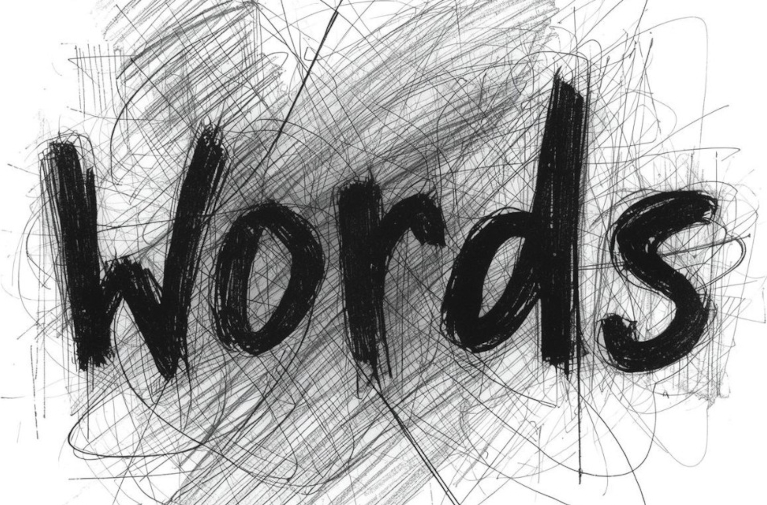
Consider the word ‘electric’. Unexamined, the term undoubtedly carries positive associations. At some point, we preferred light bulbs to the fire hazard of candles, and we opted for electric heating instead of coal-burning chimneys.
Now, ponder a meme featuring an urban sticker that reads: “Ditch electric vehicles / Build trains”. Or notice a related slogan put forward by an urban planner: “EVs are here to save the car industry, not the planet.”
Power them as we wish, the two phrases mock the fact that an electric vehicle jam is still a car jam. And the contrast begs the question regarding the role language has in helping us (or confusing us) as we aim for a thriving future.
As a recovering engineer who once conceived of life as a linear journey along an industrial treadmill, join me nonetheless in exploring the power of words.
Beyond the Limits of (the Limits) of Our Language
Consider three additional examples of how the words we use influence our perceptions, and often our behaviors.
First, a ‘value chain’, whereby the economic activities that ultimately (and entirely) depend on the living world are supposedly bound by an inert object, often used for imprisonment. Second, ‘cash crop’, squashing the cultural, biological, and ecological complexities of agriculture to fit the dictates of a ‘commodity’-producing, profit-maximizing machinery. And third, ‘individual’, a term that, according to the Oxford English Dictionary, first appears in 1425, then 1580, and then 1620, at the turn of the modern age — the very epoch that began to fracture and erode people-in-communities into the smallest possible ‘indivisible’ units.
The first term is mechanistic; the second, economistic; the third, atomistic. And as such, recalling the Cambridge philosopher of language Ludwig Wittgenstein, the words raise the question of the extent to which they either impair or enable us as we seek to live in good relationship with all else that is not us.
“The limits of my language define the limits of my world”, remarked Wittgenstein accordingly. And in his later Philosophical Investigations, he added: “A picture held us captive. And we could not get outside it, for it lay in our language and language seemed to repeat it to us inexorably.”
To what extent are we captive by the words we use? Conversely, can language begin to liberate us?
Revisiting the Discourse around Sustainability
Here, it’s worth examining at least four other terms specific to the sustainability community, exploring their effects on the cause we seek to advance.
– ‘Sustainable development’ — As Jeremy Caradonna has noted in Sustainability: A History, reconciling sustainability with development is an oxymoron—as long as development looks like how we conceive it today, bound to a growth curve that is exponential. Caradonna thus suggests we’re better served by speaking about development towards sustainability. Put another way, as much as we need air to breathe, it would be mad to think that we live to breathe.
– ‘Green’ energy — Solar power requires large quantities of cement, steel, and glass, not least rare-earth metals. In addition, these materials are all fossil-fuel-intensive, and their extraction and production are far from ‘green’. (Forms of ‘green’ energy come from small-scale hydro, tidal, or biomass—and, sometimes, not even those are ‘green’.) Regardless, less popular is the discussion around reconfiguring our cities and our lifestyles to reduce energy dependence in the first place, and to decouple wellbeing from consumption.
– ‘Mindscapes’ — In contrast to ‘framework’ (another inert term), and moving beyond ‘paradigm’ (as in ‘exemplar’ or ‘model’), the word ‘mindscape’ emerged in the 1930s, referring to the discourses or storylines that shape our reality. The term is meaningful for our purposes in that it grounds the imagination in the elemental priority of the geological and the biophysical.
– Fibershed — Honoring its name, the UK-based initiative Fibershed educates on slow fashion while fostering ‘soil-to-soil’ regenerative textile systems. Its whole ethos is premised on carbon farming and on creating fully compostable, bioregional garments that honor people and the integrity of their biophysical localities. These companies remind us about the adagio that from dust we come and to dust we shall return.
We could surely dismiss our choice of words as irrelevant philosophical concepts. But was not a term such as ‘the invisible hand’ the very same thing — initially a ‘bookish’, imaginary proposal put forward back in time by Adam Smith, himself a professor of moral philosophy at Glasgow and Edinburgh? Words that stem from a conversation, or a page, can end up shaping (or mis-shaping) the planet.
Reclaiming New Language, for Good
Another common term that we often take for granted is ‘environment’. It comes from the French environ (meaning, ‘around’ or ‘surrounding’). But notice how it bounds us to the (artificial) human/non-human divide that so often betrays us, as if we could survive for more than 10 minutes without breathing or for more than a few days without water. ‘Environment’ makes us believe that everything ‘else’ that is not us is ‘out there’ somehow.
But, no. We are nested, embedded, grounded, rooted in this planet—our one and only ‘Common Home’, to borrow the phrase from the inspiring encyclical Laudato Si’. Are we not far more than consumers or mere citizens?
‘Employees’ must be replaced, too. The word is instrumental. It entails ‘using’ or ‘employing’ a tool for such and such a task. But, again, we’re no means to an end, as Jewish philosopher Martin Buber reminded us in calling for ‘I-Thou’ relationships that leave behind the ethos of ‘I-it’. We’re creative agents. We’re talented beings.
I keep returning to the sense of being ‘urban earthkeepers’. Of course, there are still hunter-gathering tribes that escape these urban delineations. But ‘urban earthkeepers’ is a language that better honors our nature (and our calling) as village and city-building earthlings that ought to live in harmony with Earth.
* * * * *
And you, fellow reader, what other words would you delete or add to sustain this conversation — and more importantly, the very cause for which it stands?