Day one of our tree distribution and planting exercise in Kwali District turned out to be far more challenging than expected. Our logistics team had made every necessary arrangement to ensure a smooth operation — or so we thought. The plan was for the driver to arrive at our nursery by 7:00 a.m. to convey hundreds of tree seedlings to the designated planting sites. Unfortunately, he arrived three hours late, at exactly 10:00 a.m.
Loading the trees took another two hours, and by the time we left the nursery, it was already noon. The day’s heat had intensified, and the farmers waiting at the planting site had been expecting us since 9:00 a.m. To make matters worse, the vehicle broke down three different times on the road.
At 1:30 p.m., after visiting two roadside mechanics, we discovered that the driver had been operating the truck without functional brakes. It was a risky situation — one that could have led to tragedy. We insisted that he replace the faulty brakes before proceeding, but the mechanic explained that it would take more than three hours to purchase the parts from a nearby town.

By that time, farmers from the community were calling repeatedly, expressing concern over our delay. We encouraged the driver to find an alternative truck, but he insisted on “managing” the same vehicle — something I could never allow with my team onboard.
At 4:00 p.m., just as we thought we were close to the community, the truck broke down again — the fourth time. At that point, our field officer decided to take a commercial motorcycle to the community to explain the situation and seek help in finding another means of transport for the trees.
That was when hope appeared in the most unexpected form.
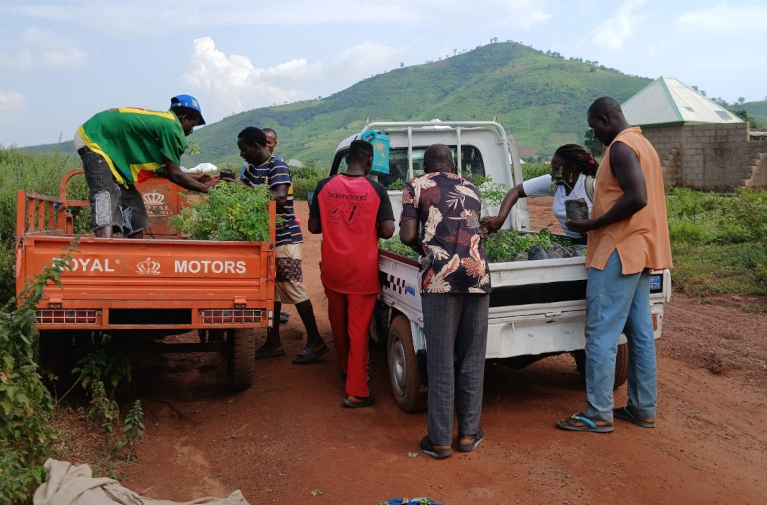
A young man named Mejeh, one of the beneficiaries of RUWAI’s youth empowerment and sustainable farming program three years ago, heard about our situation. Without hesitation, he mobilized a few other youths and came to our aid with a tricycle — the same one he had purchased from the profits of his farming enterprise.
When he arrived, he smiled and said,
Oga, na that your previous support and investment in my farming business helped me buy this small truck. I thank you and your NGO for helping me.”
Those words hit deeply.
Just a few years ago, RUWAI trained and supported Mejeh with the tools and knowledge to start a sustainable farming business. Today, he runs a small but impactful agro-transport service that helps local farmers move their produce from farms to markets, reducing post-harvest losses and improving rural livelihoods. On that day, the same young man we once empowered became the one empowering others — stepping in to help us continue a mission that benefits his entire community.
His story reminds us why we do what we do. It reminds us that when we invest in young people, we are not just changing individual lives — we are building a chain of hope and self-reliance that strengthens entire communities.
In Nigeria today, youth unemployment remains alarmingly high, with the National Bureau of Statistics (NBS) reporting that over 53% of young people aged 15–24 are either unemployed or underemployed. Many of them are eager to work, to learn, to contribute — but lack the opportunities and support systems to thrive.

At Rural Watch Africa Initiative (RUWAI), we believe that empowering one young person can ignite transformation across generations. From training youth in sustainable agriculture and agroforestry to providing the tools for environmentally friendly livelihoods, we are cultivating a new generation of changemakers — people like Mejeh who prove that the seeds of support we plant today can blossom into lasting impact tomorrow.
Our work continues — and so does our hope. You too can make a difference by sponsoring a community or supporting another young person like Mejeh. Together, we can turn more challenges into stories of resilience, empowerment, and growth.
Join us in restoring lives and landscapes — one tree, one youth, one community at a time.