

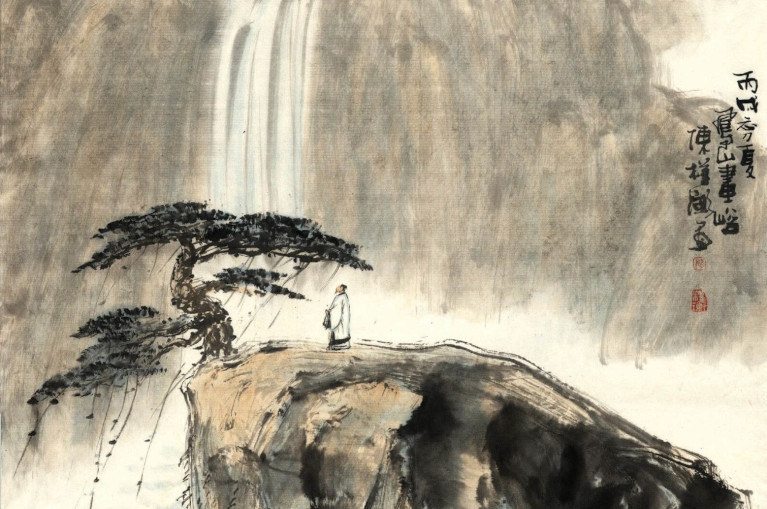
While rummaging through a bookstore in Iowa City decades ago I happened upon a slim volume with the intriguing title, Tao Teh King by Lao Tzu: Nature and Intelligence, translated by philosopher Archie Bahm. As a 20-year-old, I was in a state of full rebellion against my Christian upbringing, the consumerist culture around me, and the pointless violence of the Vietnam War. I was looking for alternative ways of understanding the world, and was taking classes at the University of Iowa on existentialist philosophy and early Buddhist texts. Lao Tzu’s very first sentence hooked me: “Nature can never be completely described, for such a description of Nature would have to duplicate Nature.” The book advised a modest way of life emulating nature’s way. For years afterward, Lao Tzu would be my constant companion, and I still occasionally read that tattered copy.
There are many other translations of Tao Te Ching (this is the English spelling that appears most frequently; a fairly accurate phonetic rendering is Daodejing). Indeed, it’s one of the most frequently translated books. Bahm’s version, which dates from the 1950s, is today not regarded as being scrupulously true to the Chinese text, but it’s clear, coherent, and sensible.
In 1973, ancient Taoist manuscripts were found in southern China, including the earliest then-known text of Tao Te Ching, dating from the second century BC. This discovery greatly improved scholars’ understanding of the book and its origins. Twenty years later, an even older version, similar to the one found in 1973, was discovered in a tomb near the town of Guodian in the province of Hubei. This manuscript was dated to the fourth century BC.
Recent translations of Tao Te Ching put its chapters in the order found in these recently discovered versions, and also reveal new meanings in many passages. Experts now believe that the book began as a set of orally transmitted sayings, and that some of the text consists of additions and revisions introduced by the scribes who put it in writing. Nothing reliable is known of the supposed author Lao Tzu (a name that simply means “Old Master”); the book may be a compilation of ideas that originated with a scattered group of wandering sages rather than a single author.
None of this diminishes the usefulness of the insights in the text. Don’t be dazzled by appearances, the Old Master tells us. Don’t go to extremes. Live simply, and closely observe natural phenomena like forests and streams. From the Stephen Mitchell translation:
Knowing others is intelligence;
Knowing yourself is true wisdom.
Mastering others is strength;
Mastering yourself is true power.
If you realize that you have enough,
You are truly rich.
If you stay in the center
and embrace death with your whole heart,
you will live forever.
Understanding any ancient text requires some knowledge of its historical context. Early Chinese history is unfamiliar to most Westerners, so here’s the briefest of overviews. The Shang dynasty, which flourished in the second millennium BC, is the first dynasty of traditional Chinese history for which there is clear archaeological evidence. In 1045 BC, King Wu of Zhou overthrew the Shang dynasty, but his descendants slowly lost power. The former Shang lands were divided into hereditary fiefs, over which the king had dwindling control. At the same time, raids by nomadic tribes from the north intensified toward the end of what historians call the Western Zhou period. The subsequent Eastern Zhou period is divided into the Spring and Autumn period (770-481 BC) and the Warring States period (475-221 BC), and it’s these latter two periods that form the backdrop for the composition of Tao Te Ching. A powerful kingdom (the Shang dynasty and its remnant in the early Western Zhou period) was disintegrating through civil wars and invasions by neighboring tribes, requiring people at all social levels to rethink their relationships to one another, to government, and to nature.
Confucius (Kong Qiu) lived from about 550 to 480 BC, during the Spring and Autumn period. His profoundly influential philosophy centered on personal and governmental morality, justice, kindness, and veneration of ancestors; it also emphasized rulers’ duty to their subjects. Proclaiming himself a transmitter of earlier values, Confucius promoted a bureaucratic, hierarchical, and legalistic vision of the ideal society. Tao Te Ching may have been composed orally during Confucius’s lifetime and written down somewhat later, during the Warring States period. Taoism seems to have been, in part, a reaction to Confucianism—a response that emphasized spontaneity over etiquette, genuineness over duty, and the superiority of nature over humanly-imposed social and technological order.
In the Afterword to his translation of Tao Te Ching, sinologist Victor H. Mair makes a strong case that early Taoism was influenced by the Yogic tradition of southern Asia. Mair points out that both Yogic and Taoist spiritual practices centered on breathing exercises, postures, and meditation, which were claimed to yield superhuman abilities. Both Tao Te Ching and the Bhagavadgita (a key early Indic sacred text) taught that enlightenment could be achieved through non-attachment. Mair also shows significant linguistic parallels between these two texts and argues that it is much more likely that the earlier-documented Yogic tradition influenced China, rather than that Taoism traveled to India.
However, Taoism has its own unique flavor that differentiates it from Yoga. Taoism’s naturalistic trail of thought became most visible and tangible in its subsequent expressions in Japanese Zen gardening and architecture (Zen was Japan’s offshoot of the Chinese Chan Buddhist tradition, which was deeply influenced by Taoist teachings).
Beyond its interest for historians, Tao Te Ching has special significance for anyone trying to find a sane path in today’s world. We are in the very last stages of the greatest empire that ever has been, or likely ever will be. Fossil-fueled technology has driven humanity farther than ever from nature’s way. This did not happen because humans are inherently evil; we are expressions of nature. We are simply victims of our own success: social evolution led some societies to develop capitalism, which then made it possible for them to access and use fossil fuels (as I’ve explained at much greater length here). We’ve temporarily exceeded nature’s limits, in terms of our population size, our overall rates of energy and materials usage, and the amount of pollution we’re spewing. As a result, the impressive social, economic, and technological structures we’ve built in the past couple of centuries are set to come tumbling down. When they do, we may enter our own Warring States period.
Inevitably, the survivors will try to make sense of what has happened. In the wake of collapse, there may be neo-Confucianists who promise to Make Civilization Great Again through obedience to authority and worship of the past. And there may be wandering sages who teach their followers to learn from nature and embrace simplicity.
It’s worth noting that a philosophical bifurcation in the wake of imperial decline may have occurred in another important historical instance. Authors James Valliant and Warren Fahy argue in Creating Christ: How Roman Emperors Invented Christianity that Christianity began as a Roman imperial project to co-opt Jewish messianic, monotheistic radicalism while maintaining the organizational and ideological essence of the Empire—even as the Empire itself disintegrated. That project succeeded brilliantly, but alternative philosophies nevertheless survived or cropped up later. The Franciscans, who offered a nature- and peace-loving counter-philosophy, were co-opted back into the Catholic fold. Pagans and witches were persecuted or burned, while Indigenous peoples were converted, enslaved, or slaughtered. There is every reason to suppose that, as our current global industrial civilization crumbles, there will be similar splits between a dominant narrative (techno-civilization was great, but it was sabotaged and must be restored) and humbler alternatives (techno-civilization was a mistake; it’s nature that’s great).
I’ll leave the last words to the Old Master, this time from the Bahm translation:
Whenever someone sets out to remold the world,
experience teaches that he is bound to fail.
For Nature is already as good as it can be.
It cannot be improved upon.
He who tries to redesign it, spoils it.
He who tries to redirect it, misleads it.




Comments
We changed commenting systems on September 10, 2026 as part of a site-wide functionality and security upgrade. Your past comments have not disappeared, and you can still log in with your old Disqus account credentials if you wish. Contact us with any questions.
It seems as if Lysenko was not wholly wrong, e.g. epigenetics.
Some tails do grow back.
Resilient systems still seek (tend to) equilibrium.
Thanks Bart.
Epigenetics doesn’t support anything Lyseko claimed. It merely makes “species” a bit more nebulous than it already was.
My favorite example of that however remains the California Newt, which can’t live in the Central Valley because it’s too hot but does live in the mountains all around it, and along the coast.
Individuals from Marin mated with those from San Francisco don’t produce viable offspring.
As I understand the issue, Lysenko argued that the environment could affect heritable characteristics. That seems to be true in a few cases.
Non-Mendelian inheritance is an established fact. My favorite example of that is sinistral vs. dextral coiling in sea snails:
https://link.springer.com/article/10.1007/s00114-05-0045-2
But that’s nothing like Lamarckism, which Lyseko promoted. You can lift weights all you want, but don’t count on your kids having big biceps as a result.
Fair point, but still there is a good reason why scientists and scholars are wary of new “revolutionary” theories: most of them are wrong. For each Darwin, there are dozens of Lysenkos.
There were many Darwins. Charles was the first one to find a publisher.
But it does resemble Evangelists picking Bible verses from patriarchal pastoral bronze age myth to support their right wing agenda. Still I agree devotional activities and household shrines (I have/do some.) can be calming and comforting.
That’s quite a conceptual leap you’ve made there! Especially since it’s a stretch to even call Taoism a “religion.”
Any philosophy can weaponize words. You are not so naive to expect mouthpieces to seek enlightenment in the actual texts.
I recall teaching Illich and Buckminster Fuller as part of organic gardening (like trying to understand why we even try), and I had quite a few disappointments in students repeating catch phrases without context. One guy majoring in dance accused me of being too esoteric when I asked him to explain some quips.
I was already a fan of Gregory Bateson before watching his daughter, Nora’s, film about her dad today. Now I’m wanting to put a photographic portrait of Gregory up on my wall. Basically, Bateson is the most devout advocate for relational ontology which existed at the time he was working. Relational ontology makes relationship primary, rather than the notion of “entities” as independently existing. He was thus a great critic of scrubbing everything of context and setting in order to “understand” it.
We relational ontologists are, sadly and ironically, accused of excessive “abstraction”. But our real effort is to dis-abstract.
A careful and thorough reading of the Tao Te Ching is worth all of the effort, but it takes a lot of effort to do the proper hermeneutics. The opening words are key. It goes roughly “The Tao which can be named is not the eternal Tao.” This is, in my view, a basically perspectivist epistemology, but not necessary an anti-realist perspectivist epistemology such as that found in Nietzsche. It is more likely a naturalist/realist perspectivist epistemology such a as that found in James R. Martin, the relational-perspectivist realist with a metaphilosophy of aptness. Of course, the conceptual and linguistic structure of these two are slightly different, but only slightly once the hermeneutics reveals what Taoism is ultimately about.
I have one damaged foot from shoe store fluoroscopes.
Atoms for peace in action.
Dr. Baetjer (Johns Hopkins pioneer) lost some fingers and one eye
We’re living a re-run of the ugly version.
Our Duopoly consists of two fascist party franchises.
Genocide creeps back home just like isotopes from Fukushima.
(And tritium from every nuclear reactor drain and vent)
Investigation and testing gets harder when the populace has been driven insane.
Darwin himself was extremely trepidatious about publishing his writing about biological evolution through natural selection, and held off for many years. Then he received a letter from Alfred Russel Wallace, in which Wallace explained his own theory of the same. At that point, Darwin was worried that some young upstart would “scoop” his theory, winning the prize. (Was it a prize or a threat of exile and ostracism?) So the two of them became friends and went public with their mutual theory together, risking everything.
Have you seen Nora Bateson’s truly excellent documentary film about her dad, (Gregory Bateson) and her relationship with her dad? It’s on Vimeo ($4.99 US for single viewing, $9.99 to own by downloading). For me watching this today was a “religious experience,” though I’m not a theist. Truly profound and radically deep.
Yep, I “scene” it, but her view of Gregory is somewhat different than that of her sister Mary Katherine.
I know my view is skewed in favor of Bateson the ethnographer (documentarian) against Bateson the theorist
I do not believe a hermeneutically adequate reading of classical Taoism supports the view that classical Taoism was on a slippery slope to some kind of asocial, dis-associated, quietistic isolation from the cultural and social world. But it is not impossible that I am wrong in my assessment here.
Steps to an Ecology of Mind
Very well written thanks and greatings from
My cross country skiing week in the deep frech jura.. without snow
(Only 20 years ago we were use to find easily 1 m of Snow and a nature paradis
While escaping for a few days from my
Physicist money giving cern life)
Greetings micha
Taoism is not a religion – it is The Way a philosophy. It is The Truth. It is action through in action unless action is necessary. It is Beautiful and beauty personified. It was the first understanding of mind body spirit. Christianity has bastardized everything. It took responsibility and placed it on a fictional character. A human is born innocent it is man that teaches evil. Life is water without it everything dies. We are here to learn our karmic lessons. How many times do our worlds need to be destroyed before this happens? Religion is a perversion of aristocratic power grabs. We have the capability to house treat and feed all and yet 1% controls all and spends most of it on a military machine and yachts. Humans are pathetic selfish creatures but we are not born this way. We just choose it. Very sad.
All the mainstream religions are little more than petrified politics. Taoism is a step up from that, but ultimate truth? I’ll take Darwin any day.