

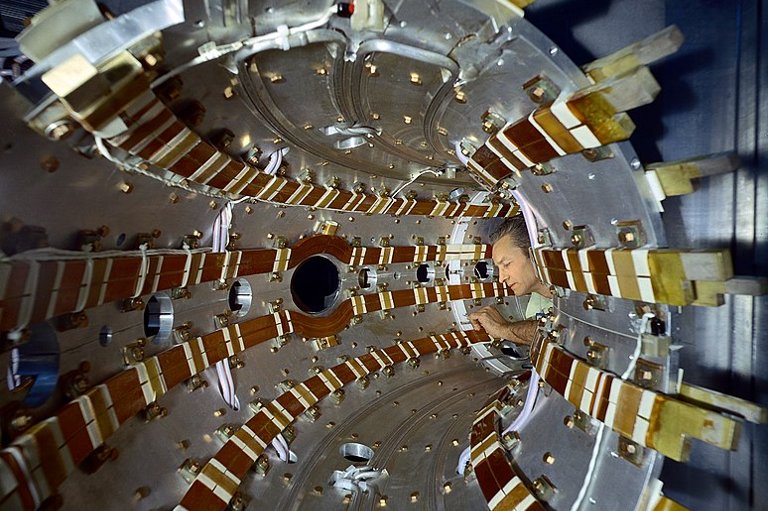
The United States will propose a new emphasis on fusion energy at the UN climate summit known as COP 28. The summit began on November 30 and runs through December 12. Fusion is what powers the Sun and fuses hydrogen atoms to make helium plus a lot of energy. So, it seems like a perfect solution to power human societies without creating the dangerous radioactive waste products from fission reactors nor the carbon emissions from fossil fuel plants.
The reality of fusion―at least the way we humans are pursuing it—is much more complicated and messy than most people realize. The path we are on now suggests lots of radioactive waste will still have to be disposed of on a regular basis and that commercial fusion power is still decades away if it ever becomes feasible.
So, it turns out that fusion is part of the fantasy of a painless energy transition to a society powered by clean, renewable fuels that not only replace the energy currently generated by fossil fuels, but also grow continuously to feed our growing economy.
Doubling down on fusion suggests that things are not going well elsewhere in the energy transition. A look at the world’s energy mix in 2022 confirms this. (Quite often people who are touting the progress of the energy transition speak only of electricity and leave out liquid fuels for transportation and fossil fuels for industrial process heat and space heating of buildings of all types. This gives a hugely distorted picture of our real situation.) The following figures are percentages of TOTAL world energy consumption in 2022 by source:
Biofuels: 0.71%
Other renewables including geothermal and biomass: 1.44%
Solar: 2.06%
Wind: 3.27%
Hydroelectric: 6.73%
It’s worth emphasizing that the largest source for renewable energy remains hydro power—much of which has been installed for decades and to which very little is currently being added. A lot of the best hydro sites have already been dammed in the past century.
Some might say that I should include nuclear power as well since it is not based on fossil fuels. Okay, nuclear power generated about 4 percent of total world energy in 2022. And, it’s going nowhere. Nuclear power has bounced between 6,200 Terawatt/hours (TWh) and 7,600 TWh from 1993 through 2022 when 6,700 TWh were generated.
If we add up the renewables, we get 14.21 percent. If we subtract hydro from this number, we get 7.48 percent. And, we should emphasize the latter percentage since it represents the sources that are growing quickly and touted as our energy saviors.
I’m for the deployment of renewable energy. But I am also convinced that the only path toward a sustainable technological society is through a dramatic reduction in throughput of resources including energy resources. I am persuaded that that dramatic reduction will occur whether we plan for it or not.
Given the rate at which we are depleting fossil fuels and the rate at which climate change is proceeding, I do not think fusion energy can be mastered and deployed soon enough to make much difference. The reckoning for all of us humans will come before that. Right now I’m leaning toward a persistent and ultimately large reduction in economic activity that is unplanned in the coming decades.




Comments
We changed commenting systems on September 10, 2026 as part of a site-wide functionality and security upgrade. Your past comments have not disappeared, and you can still log in with your old Disqus account credentials if you wish. Contact us with any questions.
I agree that a nonvoluntary, unplanned reduction in per capita energy and materials use, at least for the richest half of humanity, is pretty clearly in the cards. But I suspect there is a move getting under way to quietly arrange a bifurcation, so that the richest of the rich–the global 1% can continue to have access to a high-energy lifestyle, even as the rest of us abandon cities and struggle to support ourselves on gardens worked by hand, and find uses for millions of stranded vehicles–chicken coops? Rainproof storage?
Old-tech fission is indeed going nowhere. And practical, economically-feasible fusion might be many decades off (if ever). But missing from this analysis is how soon we might have advanced forms of fission.
Yes fusion may not be of any use and yes humans will wait until the system fails. Growing food makes good use of the solar energy available and Human strength is still quite useful in growing food. The pursuit of money has no future when hunger takes over. Those who jump ship to grow their own food, learn to work together, and live a more relaxed life may find a lifestyle that is quite rewarding .Infact growing old is easier with horses to feed, farm work to be done and wonderful veggies and crops to look forward to.
You don’t back up any assertions. The first 4th gen nuclear reactor has just come online. SMRs are attracting more investment and competition. And nuclear fusion has many potential paths to success, not necessarily decades away.
This is just more doom-mongering from non-technical people. Enjoy yourselves, I guess.
Fusion: It’s the energy of the future and it always will be! I’d as lief fund a pipeline to the sun.