

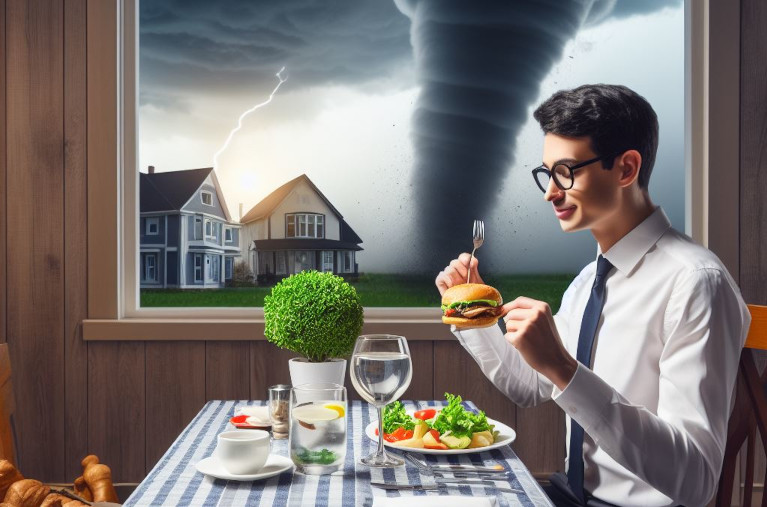
Everybody has beliefs. Many are so deeply ingrained that we do not even recognize them as such. The most staunch scientist—who spurns belief in Santa Claus or God—still operates on a metaphysical foundation of beliefs about how the world works: e.g., that the scientific method is the only valid path to truth, and that unproven conjectures have little worth—and unprovable ones even less—even if quite possibly correct (and important). For instance, science can probably never tell us if animals experience emotions the way humans do, but isn’t it obvious by non-scientific interactions? Maybe some animals experience a sense of awe for natural phenomena, or notice the stars and wonder, or are more aware of their own mortality than we could ever know. Plants “scream” when attacked; will science ever deliver an understanding of what it is like to be a tree? How could it?
But I digress, already. This post is not about the narrow, literalist, and almost certainly incomplete metaphysics of science, but about the stubbornness of brains. People have a very hard time getting rid of some notions, or accepting something that runs counter to their assumptions. One might even suspect some “hard” wiring at play! Hey wait—people’s predispositions, personalities, and beliefs must indeed map to real neural connections in their brains (where else: we don’t use cloud storage!). Changing minds means down-weighting or destroying some connections and making new ones: not easy. Incomplete attempts often “repair” themselves back to something close to the original state, as beliefs are woven into so many offshoots as to be difficult to eradicate fully.
But neither is this a post about brain functions. Come on, Murphy, get it together! What this post is about is how intransigent people are, in general. After a few familiar examples, we’ll turn an important case: people have a very hard time seeing how unusual and temporary this moment is, it having lasted all their lives and more. The claim that most humans don’t appreciate the obvious temporary nature of modernity might seem as dismissive as the claim that animals don’t appreciate their own mortality. Yet some can, and that’s very important.
Everyone is the Hero of their Own Story
Few people behave knowingly as villains. Based on who they are, their set of experiences, what they know, and what they believe, they are acting in internal good faith toward what they think is best. Even people acting outwardly in bad faith (and there are plenty of these) often do so in an honest attempt to achieve something they think to be justified. In some cases, they may be aware that many disagree with them, and surely find this to be frustrating. If convinced they are pursuing the best course, they can only think that most others would either do the same in their shoes, or otherwise don’t have their heads screwed on straight. In either case, the problems of others should not compromise their principles and actions. The right people know they’re a hero.
Convincing someone who has already committed to a certain attitude or path that they are wrong is exceedingly difficult, as it may involve a somewhat public admission of their error. Doubling down becomes attractive, perhaps as a matter of pride. Psychological mechanisms kick in to convince them they are right. I imagine that even history’s most notorious villains had themselves convinced that what they did was in service of a noble vision, and that their picture would be on money for years to come.
Adolescents Know it All
I am assuming that most people reading this blog have passed the adolescent stage in life, and can appreciate perspectives from either side of the divide. Adolescents blossom into independent, reasoning adults, and the process can be rather heady. They begin to recognize that adults don’t always have the answers, and are not infallible. The tendency is to take this too far: adults therefore know nothing and never get anything right. Enough daily evidence piles up to reinforce the conviction. Parents are the worst!
Adults are exasperated in their dealings with adolescents, as there’s no winning. They know that they themselves tuned out clever attempts at advice by adults starting with things like: “I know you think you know everything, and I was the same way. But take it from me: I was wrong and I wish I understood the following thing when I was your age and hadn’t tossed it aside.” Nice try, old bag. Don’t you have a PTA meeting or something?
Whippersnappers Can’t Tell Me What to Do!
A similar phenomenon happens in older people. Some elderly parents endure constant nagging from their younger loved ones. You shouldn’t do that or you might fall. What are you thinking, driving at night? Call when you need help: don’t try to do stuff alone. We need to move you to a “home” because you left the stove on once and could burn down the house. We’re only trying to do what’s best for you.
I can imagine that these senior sentinels of society look on their middle-aged naggers in much the way adults look on adolescents. They think they know everything. Wait until they get to be my age, then maybe they’ll understand. This is no doubt true, as the nagging middle-agers will almost certainly follow similar tendencies and resist nagging by their juniors in the same way.
I’m Not Crazy!
For a more extreme case, how would you convince someone that they are not “all there” mentally? It’s often impossible. Whatever cognitive squirrels they might have running around, those squirrels insist that they see everything accurately (and maybe that everyone else is off their rocker).
The point here, and with all the cases above, is that the “customer” is always right. Or: brains in almost any state are self-assured that they have the story basically correct. The only reality they know is the one in their own heads—how could it be otherwise? And in case you are wondering: yes, I am aware that the notion applies to me as well, and I constantly evaluate whether my minority opinion is a sign that I’ve got it all wrong. It would be the easiest way out, and I have often wished for such relief—but not at the expense of what I perceive to be a better understanding a complex reality.
This Time is Far from Normal
Now we get to the main event. The same thing that gives me the most hope for the future is one of our biggest impediments at the moment. That is, human brains do not come pre-loaded with an operating system, and thus can adapt to a completely new set of circumstances, accepting the world of their youth as they find it. A child born 1,000 years from now will know nothing of modernity, will not lament its loss, and will carry on playing, laughing, learning, and simply getting on with life in the world they encounter.
On the flip side of that coin, people of modernity have experienced nothing else, and take it as normal. This is the height of (tragic) comedy, in a sense. The present era could hardly be any more different than the vast stretch of time that came before, and the vast stretch yet to come—the two of which I believe will have much in common. It’s likely to follow an A–B–A pattern. Or, really more like an AAAAAAAAAAA–B–AAAAAAAAAAA pattern, except 10,000 years of B would need to be preceded by a few hundred As to properly convey the temporal landscape of human experience. Alternatively, a single B representing a few centuries of the height of modernity would follow 10,000 As. Look at those silly B people, thinking they’ve got it figured out and are the normal ones! Classic!
But, how on Earth do you convince a B person (basically everyone you run into) that their time period—lasting many human generations—is the oddball? Most will readily acknowledge that B is strikingly different from A, and likely believe it to be superior in almost every regard. But they imagine the present to be the beginning of a new normal. Sure, many will acknowledge that the future could be markedly different than the present, but most typically in an extrapolative fantasy that evolves in the direction of Star Trek. Let’s explore a few of the possible patterns.
The New Normal
Probably a common default assumption is: AAAAAAAAAAA–BBBBBBBBBBB. We have figured out how to live on the planet, and will carry modernity forward in basically recognizable form from here on out, improving along the way. This one requires the least imagination, and may seem the safest bet, given that we’ve been in mode B for generations, and it seems pretty solid. This is not to say that it’s static, but that the basic way of living (houses, grocery stores, electronic gadgets, global travel, jobs, economy, government) is here to stay, and will be recognizable thousands of years hence. Although perhaps common, this vision—if one can call it that—is perhaps the result of putting very little thought into the matter. The butterfly emerges from the chrysalis, and then flaps happily ever after. I suspect these folks have trouble staring down their own inevitable deaths, as well.
March of Progress
The next-most-common assumption might be: AAAAAAAAAAA–B–C–D–E–F… We keep reinventing ourselves and changing modes. Each is almost unrecognizable to the one before, an a steady march toward perfection. The fact that humans stayed in mode A for millions of years is the anomaly. Normalcy is the progressive march, now that we have ignited the flame. The butterfly emerges from the chrysalis, and then morphs into something better, and something better, and something better…
Buzz Lightyear
As a (meaningless) variant on the previous, the real dreamer is not content with the predictable sequence above, and prefers the flashier acceleration AAAAAAAAAAA–B–D–H–P–Z–θ–∞ (and beyond). These are just meaningless labels, so this one and the previous do not differ in substance. All the same, I’ll bet we’d find preferences between the two. The butterfly becomes a bird, a plane, a starship, a galaxy, the universe, the Marvel multiverse (took longer than expected to get from “plane” to Superman and his ilk, huh?).
Modernity Lite
The somewhat more realistic among us might be aware that mode B is hopelessly destructive, and cannot continue in present form. But a number of shrewd tweaks to the present might bring things in line: renewable energy, pollution control, recycling, circular economy, equality and justice—a well-designed modern machine that is built to last. This sequence might be labeled AAAAAAAAAAA–B–bbbbbbbbbbb. Mode b would be essentially familiar to us, just perhaps more subdued. We’d still have access to global transportation, hospitals, cities, agriculture, computers, and smart phones—but somehow no more of the bad stuff that presently allows those things to exist: the elusive single-sided coin. Perhaps this is the butterfly suffering itself to be a moth?
In general structure, this mode has much in common with AAAAAAAAAAA–B–AAAAAAAAAAA, just swapping the latter run of AAA to bbb, while importantly highlighting the current mode (B) as unsustainable and therefore temporary. I differentiate the two because Modernity Lite is qualitatively different from mode A, which is integrated with the rhythms of nature—living primarily by the rules of the community of life rather than being dominated by the overlay of ecologically-blind cultural rules.
Most Likely Sequence?
While I see mode b (modernity lite) as another form of unsustainable fantasy, I won’t defend mode A as the only or even most likely next phase, as I doubt we are looking at a complete reversion to hunter-gatherer mode. We are unlikely to shake the etch-a-sketch and start from scratch, carrying nothing forward. Yet, I would venture that what comes after, for the long duration that lies ahead, is closer to A than to b. Acknowledging similarities and differences, perhaps an appropriate labeling would look like AAAAAAAAAAA–B–ααααααααααα. Mode α (alpha) might preserve some of the really cool things we learned in mode B, but operate on a solid ecological footing akin to mode A—humbling ourselves as a small piece of the larger and more important community of life. I’m out of butterfly comparisons: real butterflies execute a cyclic pattern, hatching new caterpillars to one day become the next generation of butterflies. The long-lived α pattern might itself integrate cycles, but never revisiting the B-mode butterfly.
Whatever replaces the unsustainable—and thus short-lived—period of modernity (B) will almost have to be sustainable and long-lived, as it is practically impossible to build an unsustainable existence of any duration on top of a reeling ruin. If the biosphere is not given space and time to recover, then following mode B with another unsustainable mode would risk ending it all for us. I guess one could argue for an unsustainable mode C following B, but then by definition precluding continuance of C and probably mode D, etc. In fact, trying to follow B with C either terminates the human experiment or at best makes full reversion to mode A more likely than finding our way to α.
The Tough Sell
Back to the main thread of the post. To my mind, the current mode is utterly disastrous to the community of life and therefore to our own eventual well-being. This not only rules out continuance of mode B, but also the extrapolative elaborations that double down on the same assumptions of human greatness and transcendence form natural law.
The nearly impossible task, then, is to convince people that this time is not normal: it cannot persist, nor could its direct derivatives. It’s very similar to telling someone they’re the villian, an adolescent that they don’t know what they’re talking about, an elder that they don’t know what’s good for them, or a mentally impaired person that they are nuts. How does that usually work out? After all this time, we still haven’t figured out how to do these things—not in one shot, certainly.
It’s one thing to convince someone that their notions about the pangolin are entirely wrong. Most people have little knowledge or personal stake in the ways of the pangolin. But people immersed in modernity are going to have strong opinions, feeling that they know a thing or two about it. In addition, it is the only thing they’ve ever known. Saying that modernity is a temporary fireworks show is like saying: all you have ever known is an illusion—not as “real” or permanent as you have come to believe. Yet, modernity is what we see out the window. It’s very real and tangible—not easily argued away.
I can only reflect on the fact that some people manage it. How does it come about? I recognize that I am atypical, as a well-trained physics professor who is perhaps atypically contextual even within my unusual cohort. Using the analytic, abstract tools of science, I have come to recognize the limitations of that very approach. Growth was the first to fall to these tools, then energy, then resources, and finally biodiversity. Subsequently, I was exposed to new (and sometimes very old) ways of thinking, a new appreciation of our temporal context, and have enjoyed the freedom to explore such things. I now see the basic approach I utilized to get here as being narrow-minded and incomplete—yet still capable of showing me the fault lines and leading me to the door.
Only now that I am out of the prison can I see the bars that I never appreciated were there (a metaphor I owe to Daniel Quinn, in Ishmael). I want others to break free, too. I don’t know how to to be effective, other than writing—perhaps in vain—to help others see the path out. We need to break the spell. Throw a bucket of cold water. Convince people that this is not normal. Modernity cannot go on, and will be the death of us if we don’t wake up to that reality. A crash hasn’t happened yet, but numerous indicators convince me that it won’t likely be avoided by happy accident and ignorance. Let’s start detaching our happiness from modernity’s success, and perhaps get excited about imagining other ways to live.




Comments
We changed commenting systems on September 10, 2026 as part of a site-wide functionality and security upgrade. Your past comments have not disappeared, and you can still log in with your old Disqus account credentials if you wish. Contact us with any questions.
This is a major problem… basically people adopt a religion. In farming i find this very prevalent…there are some who use cover crops, others who do not till, others who use horses, and on it goes. I decided to be self sufficient.. and that is another religion and I’m sure clouds my mind to new ideas, But above all of this is how to get a community around me and that also comes with problems of the christian movements…. so do I belong to the Quaker church for the fellowship and just do not mention GOD!
In some ways plants do not deceive and spending time each day to observe is a good religion.
well, I guess it only makes sense (to certain types …at least) to change if it makes … difference? If we are as destined to forced life under our own despotism for untold millenia .. then why bother trying to change anything?
I still hope that, well, some research/experimentation into how much anarchism (of wide variety, beyond human-only stuff) can be integrated and inspired and supported in ~today humans. May be someone even will give birth to true theory of society’s behaviour! (while it might be not as big game changer as I once hoped – deniers gonna deny 🙁 ).
I am not happy with narrative of great past – even if resource scarity will put a ceiling on global, concentrated destruction – wars and mismanagement of both society and environment surely happened before discovery of fossil fuels. So, just crashing will not save many humans and non-humans alike …
I even tend to follow earlier authors and voice my fear of returning slave-based societies as “new normal”. With some petty but still ruinous wars, on top of dangerous remnants of modernity (radioactive materials, microplastics, changed forever becteria so simple antibiotics will not work anymore …) ensuring too few will have “excess” of time to act out of such vicious cycle …
So …. it still makes some sense to me for thinking about better than seemingle default trajectory.
Tom,
First, thank you for your continuing work. I have enjoyed (if such can be the case, given the subject) reading Do The Math since first encountering it in the post that included the image of a shell of energy harvesters entirely encompassing the sun.
The Intransigence of Now includes the following line: ” I suspect these folks have trouble staring down their own inevitable deaths, as well,” which brought to mind a thought that has often accompanied my reading of your work.
Have you encountered the work of Ernest Becker? His best known work (which is not all that well known) is “The Denial of Death,” which received a Pulitzer back somewhere in the 70s. In it, Becker suggests that sometime in our early experience (3? 4? 7 years?) we come to appreciate that things that are living, including ourselves, will ultimately die; that this realization produces much anxiety; that we thereafter develop a ‘world view’ that includes reasons why our inevitable (physical) death does not mean that we truly cease to exist, that some part of ourselves will continue despite us having no personal corporeal form. He calls this an “immortality project.” Becker argues that, if (when) we encounter circumstances that challenge our world view, we will do our utmost to deny them, because to admit the validity of those circumstances we will have to admit that our immortality project will not succeed, that we will have to truly face the inevitability of our own termination.
Of course, Becker provides much argument for his proposition, from Kierkegaard to Freud, Jung and beyond. He ends, with a note of some sadness, that he does not see a way around this problem, only a hope that people can, somehow, be convinced to adopt an immortality project that does not lead, inevitably, to the end of all immortality projects.
My own view is that the vast majority of humans are not capable of confronting reality in any meaningful sense. First of all, people would have to take the time to read (which excludes, perhaps 50% of the world’s population), then they would have to read things which are difficult (which excludes 50% of those who have the time). Then they would have to understand (lose another 50%), and be willing to take action (50% again, perhaps generously). I am sure you can see where this is going.
I am not arguing against optimism. I say “If you’ve got it, flaunt it.” But, I am, rather, with Guy McPherson: “At the edge of extinction, only love remains.”
Very good, but there’s one sequence you have omitted to mention which is AAAAA-BBBBB-AAAAA-CCCCC-AAAAA-DDDDD-AAAAA-EEEEE-AAAAA and so on: civilisations rising and falling but with a fallow period or “dark age” of a few hundred years separating them. So, in the example above, the first AAAA would be the Stone Age (pre-metal tools), BBBBB would be the Sumerian / Akkadian Empire, CCCCC would be the Bronze Age / Aegean civilisation, DDDDD would be the ancient Palestinian / Greek / Roman civilisations and EEEEE would be ourselves.
In some ways this is one of the more depressing predictions. Our civilisation doesn’t end in a fabulous fiery apocalypse, nor do we achieve a peaceful steady state existence in harmony with the natural world. Instead, we are condemned to repeat the same sequence, and the same mistakes, over and over, like a perpetual Groundhog Day but in 1,000 year cycles. But it’s happened several times already, and past performance is the best indicator of future performance…