

The World Meteorological Organization said Monday that preliminary data shows last week was the hottest on record, a finding that was widely expected after global temperature records shattered in four consecutive days amid scorching heatwaves.
Christopher Hewitt, the WMO’s director of climate services, said in a statement that
“we are in uncharted territory and we can expect more records to fall as El Niño develops further.”
“These impacts will extend into 2024,” he added. “This is worrying news for the planet.”
The unprecedented heat to start the month of July came after what was far and away the hottest June on record, grave milestones that drew further attention to world leaders’ failure to curb the fossil fuel emissions responsible for warming the planet.
U.S. Sen. Sheldon Whitehouse (D-R.I.) lamented Monday that there was “way too little attention in D.C. on the four hottest days in recorded history occurring consecutively all in one week” despite the heatwave’s impacts on tens of millions of Americans.
The advocacy organization Greenpeace International suggested naming heatwaves “the way we name tropical storms.”
“What names should we use? Easy: the names of politicians whose inaction is allowing the destruction of nature,” the group wrote on Twitter.
Large swaths of the planet are currently facing dangerous heatwaves or catastrophic extreme weather—or both, in the case of India and other nations. At least 22 people were killed in northern India over the weekend as torrential rainfall triggered flooding and landslides.
Floods, heatwaves, global instability: the devastating effects of the #ClimateCrisis are here and this will only get worse if we don’t act now.
India is experiencing some of its worst monsoon rainfall in decades and people are dying. ?pic.twitter.com/garisHfCRu
— Climate Justice Alliance (CJA) ? (@CJAOurPower) July 11, 2023
The U.S. Northeast is also experiencing heavy rainfall and flooding; residents of central Vermont were warned late Monday to stay off the roads as emergency workers carried out evacuations and rescues in several cities.
Brian Soden, professor of atmospheric sciences at the University of Miami, told the Associated Press on Monday that as storms “form in warmer environments that have more moisture in them, the rainfall increases.”
“As the climate gets warmer we expect intense rain events to become more common, it’s a very robust prediction of climate models,” Soden noted. “It’s not surprising to see these events happening, it’s what models have been predicting ever since day one.”
Meanwhile, what The Guardian described as the United States’ “summer of weather misery” is set to get even worse in the coming days, with the National Weather Service (NWS) warning of an “expansion of anomalously hot summer heat for the southern tier of the country.”
“Numerous heat-related advisories/watches/warnings are in effect from Florida to Texas to California. Starting in Florida, highs in the mid-90s are not significantly above average but relatively anomalous, with near record-tying/breaking temperatures for some locations,” the NWS said Tuesday. “When combined with the humidity, heat indices will range between 105-110 degrees.”
The unprecedented weather extremes have sparked fresh calls for bold action from world leaders who have thus far taken little coordinated action to halt the production of fossil fuels, allowing oil giants to rush ahead with expansion plans that threaten to dash any hopes of stopping runaway planetary warming.
“We have to go full forward into not only eliminating our absolute addiction and reliance on fossil fuels as a country, which fossil fuel executives and their bought politicians are continuing to have us on, but also foster solutions that are good for people,”
John Paul Mejia, a national spokesperson for the U.S. Sunrise Movement, toldSupercreator.
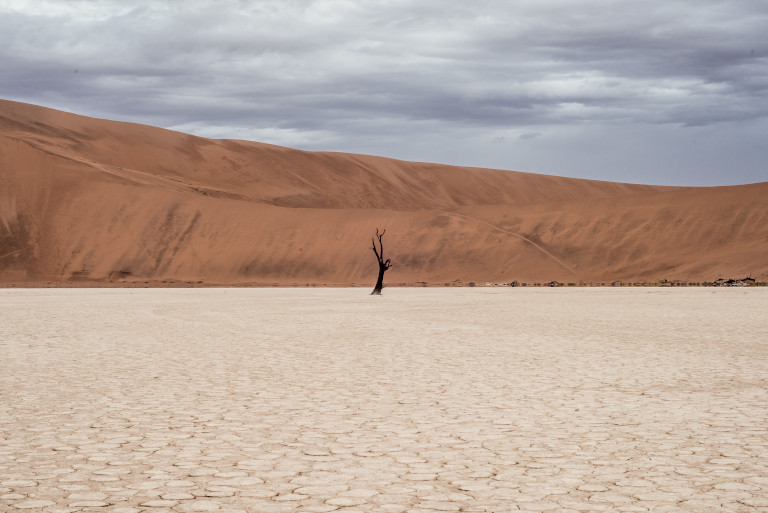
Photo by Ivars Krutainis on Unsplash




Comments
We changed commenting systems on September 10, 2026 as part of a site-wide functionality and security upgrade. Your past comments have not disappeared, and you can still log in with your old Disqus account credentials if you wish. Contact us with any questions.
Thank you for this…l learned even more…if you do not mind…I would like to share this on my fb page … I do not get many people responding, except the choir ..but….I do it to bring as much info to those…who still do not understand.
USAF level II Chemical Physicist here… By now we’re well-into the “great change” of our planet from the earth we’ve known into “some very different, unfriendly planet“… The last months have been 2-sigma to 4-sigma outliers, hot. The entire last year has been 2-sigma hot. So we’ll likely reach 1.5C by only ~2030, inasmuch as climate models notoriously under-predict the rate of Climate Breakdown (Holocene Breakdown).
http://yavapaiweathertracks.org/cfsr_world_t2_day.png
The only way to mitigate that is allowed by well-understood physical laws is to halt capitalist/economic consumption by the wealthiest 30% of humans (the primary carbon sources) within the next few years. No other way is physically or thermodynamically possible (i.e., BECCS, direct-air capture, carbon drawdown, CCS, aerosol injection, mirrors, etc.). The climate only cares about carbon.
For my personal part, I’ve been able to downsize my grid usage to less than half that of the average American household. It can be done, but the high-carbon-footprint toys which Capitalism sells us must be eschewed. Start now because it’s wicked hard and takes about 1 – 2 years under the best of conditions; also to include no flying, little travel, only buy a used high-MPG car, heat/warm only family room, etc.) It’s going to be 101F here this weekend – so a white roof also really helps (and lasts much longer). Sadly, there’s little to nothing we can do about road/pothole issues that may limit the movement of key goods.
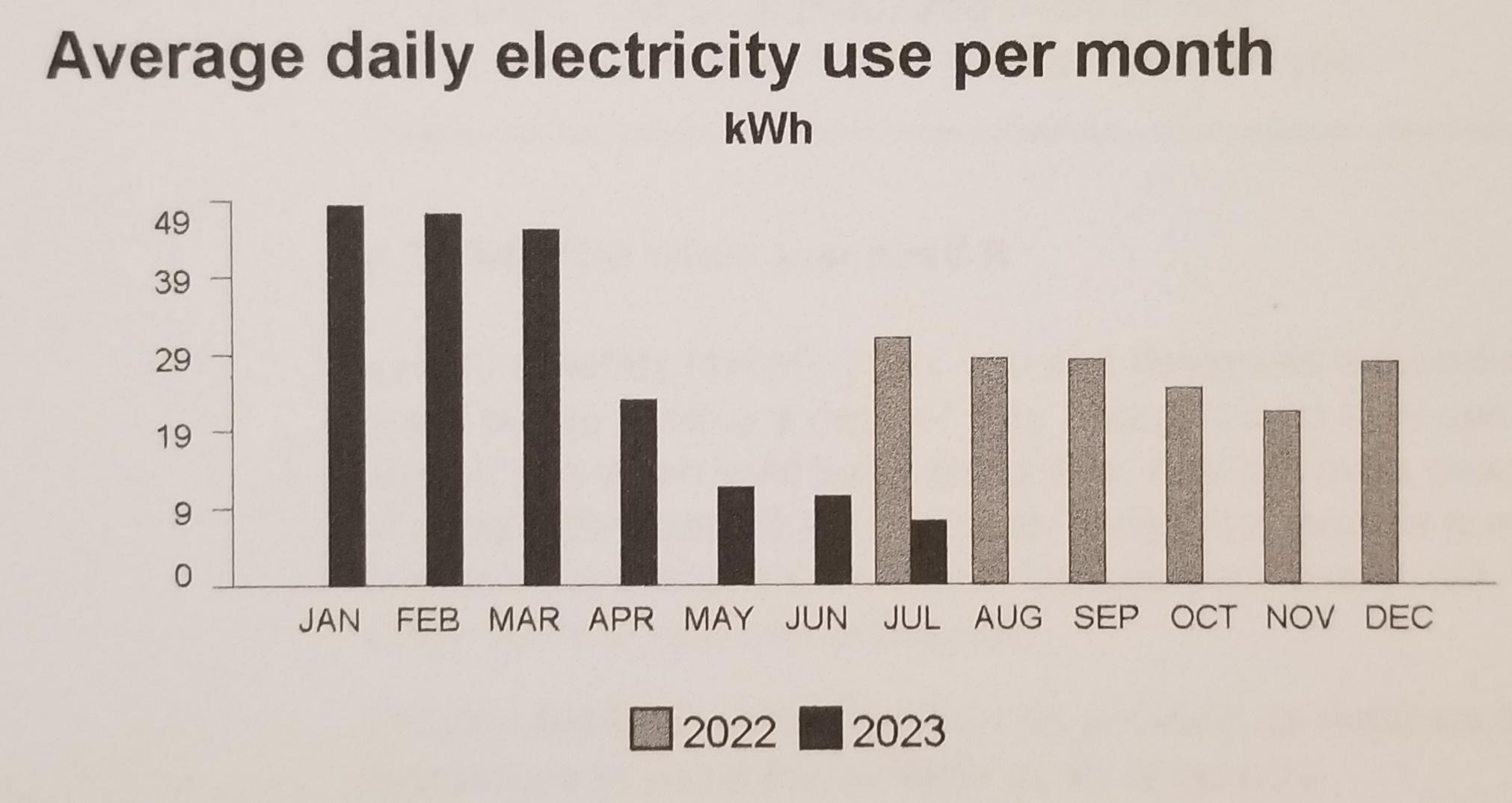
(electric grid draw only)
As expected, the Arctic ice, which drives the Westerlies and Jets, is just rotten this year.
http://yavapaiweathertracks.org/Ice_2023Jul12.png
Range from 90% iced to fully-iced.
This providing confidence in the NASA model:
http://yavapaiweathertracks.org/PIOMAS_ModelE_08-2021.png
https://orcid.org/0000-0002-6722-3677