

We humans now face an era of climate that is uncharted for the size and complexity of the human community. Our roads, rails, ports, buildings, electric grid, water systems and food systems are not designed for this new climate. For example, we continue to build infrastructure based on data for rainfall that does not reflect the dramatic changes that are taking place in rainfall patterns and amounts.
In fact, practically all the standards for building our infrastructure to withstand rain, snow, wind, flood and heat are out of date. In addition, termites that weren’t a huge problem for buildings in some climates are now causing greater damage as more destructive species spread to new areas.
Our maladapted infrastructure problem is becoming even more obvious now as a combination of climate change and the warm phase of the periodic fluctuation of warm and cool waters in the tropical Pacific Ocean known as the El Niño-Southern Oscillation (ENSO) is bringing record worldwide temperatures. A temperature higher on average across the globe than any previously recorded since instrument readings began in the 1850s was measured on July 3. That record was broken again on July 4, and then again on July 5.
Even during the cool phase of ENSO known as La Niña in 2020 the world recorded an average temperature that was “effectively tied” with the warmest year ever in 2016.
This is part of what scientists mean when they say we humans are in uncharted territory regarding climate. In fact, it is likely that Earth’s average temperature is now higher than at any time in the last 125,000 years based on tree ring and ice core data. Modern humans, homo sapiens, arose about 300,000 years ago. However, early humans were, of course, not reliant on a complex energy and resource infrastructure that includes global trade flows. And, their numbers were exceedingly small compared to ours: Estimates run between 10,000 and 30,000.
Public health infrastructure and practices will also have to change as tropical diseases creep further from the equator and toward the poles. In fact, a resurgence of malaria in Texas and Florida was in the news just last week. These are the first locally acquired cases, that is, not contracted on a trip outside the United States, since 2003. Malaria is making a comeback worldwide after concerted public health efforts across the world resulted in a decline from 2010 through 2018.
Even if we decided to make dramatic reductions immediately in our burning of fossil fuels, our destruction of forests, and our emissions of other greenhouse gases such as methane, we could still expect new temperature records for the next 25 to 50 years. That’s because much of the excess heat the Earth has absorbed has been stored in the oceans and will only be released to the atmosphere slowly over that time. And, of course, even with our most earnest efforts, it would take decades to reduce our greenhouse gas emissions to a level that would no longer raise global temperatures. So, that would further lengthen a timeline filled with new temperature records.
Those who have called for a focus on adaptation to climate change—either because they don’t believe climate change is human-caused or because they now see the futility of getting humans to address the causes of climate change—will have their hands full in the decades ahead. They will be working in a new environment in which the Earth breaks records not just for temperature but for other measures such as rainfall and drought in various locations depending on how climate change is affecting those locations. And, they will also have to contend with heavy impacts on food crops and the spread of tropical disease-carrying insects into areas in which they were previously rare or unknown.
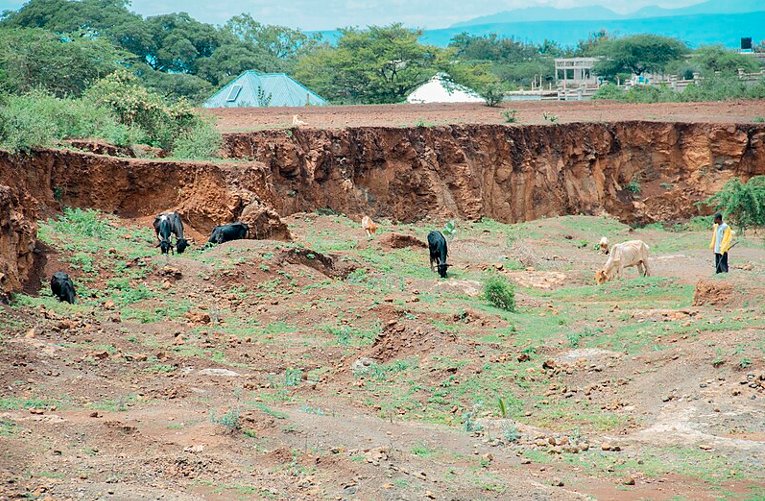
Photo: Human activity and soil erosion in Arusha, Tanzania (2023) Author: Idd ninga. Via Wikimedia Commons https://commons.wikimedia.org/wiki/File:Climate_change_and_human.jpg




Comments
We changed commenting systems on September 10, 2026 as part of a site-wide functionality and security upgrade. Your past comments have not disappeared, and you can still log in with your old Disqus account credentials if you wish. Contact us with any questions.
The problem with communication and organization is that they are hallmarks of complexity.
Did you ever read Tainter? The problem is that even taking over from the elite, the problem is still there; they are a symptom, not a cause.
I sometimes find this writer just filling in space – this is one of those.
I read Tainter but disagreed with his conclusion about diminishing marginal returns. Seemed to me each of his examples showed a pattern where a ruling class aggregated more and more wealth and power to themselves, and less responsibility, and as ecological problems built up, they were able to insulate themselves from the consequences of their decisions, with the poor and middle class if any bearing the brunt–until came the collapse even the elite couldn’t escape. Maybe the root of the problem is prehuman–pecking orders. The human innovation is to take the pecking order to another level, where it’s not just individuals who fit themselves into a pecking order but groups, with inherited ranks.