

Decades of industrial agriculture have caused environmental and social damage across the globe. Soils have deteriorated and plant and animal species are disappearing. Landscapes are degraded and small-scale farmers are struggling. It’s little wonder we’re looking for more sustainable and just ways of growing food and fibre.
Regenerative agriculture is one alternative creating a lot of buzz, especially in rich, industrially developed countries.
The term “regenerative agriculture” was coined in the 1970s. It’s generally understood to mean farming that improves, rather than degrades, landscape and ecological processes such as water, nutrient and carbon cycles.
Today, regenerative agriculture is promoted strongly by multinational food companies, advocacy groups and some parts of the farming community. And the Netflix documentary Kiss the Ground features celebrity activists promoting the regenerative agriculture movement.
But as our new research shows, regenerative agriculture may not be the transformation our global food system needs.
Farming must change
About 20-40% of the global land area is degraded. Agriculture caused 80% of global deforestation in recent decades and comprises 70% of freshwater use. It is the biggest driver of biodiversity loss on land and contributes significantly to greenhouse gas emissions.
Global corporations such as Nestlé, PepsiCo, Cargill and Bayer dominate the food system. Some 70% of the global agrochemicals market is owned by just four companies and 90% of global grain trade is dominated by four businesses. This gives these corporations immense power.
Many small-scale farmers struggle to compete in global markets – especially those in poorer, less developed countries in Asia, Africa and Latin America. In an effort to keep up, these farmers also often go into debt to buy chemicals and expensive machinery to boost production.
What’s regenerative agriculture?
Regenerative agriculture is proposed as a more sustainable alternative to industrial agriculture. It can include practices such as:
- integrating livestock into cropping systems to replenish soil and reduce the cost of animal feed and fertiliser
- leaving soil undisturbed and covered with plants to retain carbon, moisture and nutrients and reduce erosion
- regularly moving livestock between paddocks to give pasture a chance to recover
- using less synthetic chemicals in farming.
But can regenerative agriculture transform the global food system? Our research examined this question.
Our research findings
We explored the origins and current status of regenerative agriculture. We then compared this to other sustainable farming approaches: organic agriculture, conservation agriculture, sustainable intensification, and agroecology.
We found regenerative agriculture shares many similarities with the first three movements listed above. Most importantly, it originated in the rich, industrially developed Global North, primarily North America, Australia, New Zealand and the United Kingdom.
This means the movement often fails to credit Indigenous practices it draws from. It also tends to overlook the needs of farmers in the Global South and broader power inequality in the food system.
Like some other movements, regenerative agriculture is increasingly being embraced by corporations. Nestlé, for instance, aims to source 50% of its key ingredients through regenerative agriculture by 2030.
There are concerns companies may be using regenerative agriculture to “greenwash” their image. For example, experts warn corporations could be using the term to repackage existing commitments, rather than substantially improving their systems.
Regenerative agriculture helps improve the health of crops and plants! By 2030, 50% of our key ingredients will be sourced more sustainably through regenerative agriculture ?? Read more: https://t.co/Xn3lGkt8k6 #EUGreenDeal #EUFarmtoFork pic.twitter.com/S0NjX3R4L6
— Nestlé Europe (@NestleEU) February 11, 2021
Agroecology: a different path
We also found that regenerative agriculture is threatening to marginalise another promising sustainable farming movement: agroecology.
Agroecology combines agronomy (agricultural science) and ecology, and also seeks to address injustice and inequity in food systems.
The movement is associated with the world’s largest smallholder farmer organisation, La Via Campesina, and has been endorsed by the United Nations.
Agroecology advocates for Indigenous knowledge and land rights, and support for small-scale farmers. It seeks to challenge neoliberalism, corporate dominance, and globalisation of food systems.
Some researchers question if agroecology alone can produce enough food for a growing global population. But 80% of the world’s food, in value terms, is produced by small family farms. And globally, we already grow enough food to feed ten billion people. The problem is how that food is distributed and wasted, and how much is made into ultra-processed foods and other products such as bio-fuels.
Agroecology brings many benefits to farmers and communities. An agroecology project in Chololo village in Tanzania, for example, saw the number of households eating three meals per day rise from 29% to 62%. Average household income increased by 18%. The average period of food shortage shortened by 62% and agricultural yields increased by up to 70%.
But the origins of the agroecology movement in the Global South, and its resistance to corporatisation, mean it is often marginalised. At events such as the UN Food Systems Summit, for example, corporate stakeholders guide policy decisions while vulnerable farmers can feel sidelined.
Transforming our food systems
Despite regenerative agriculture’s popularity and its focus on sustainable food production, it fails to tackle systemic social and political issues. As a result, the movement may perpetuate business-as-usual in the food system, rather than transform it.
But our food system includes many landscapes and cultures. That means regenerative agriculture could still support more sustainable farming in some settings – though it’s not a catch-all solution.
And voices in regenerative agriculture have called for a shift in the movement’s agenda, putting more emphasis on equity, justice and diversity. So there is hope yet that the movement may help turn the tide against industrial agriculture.
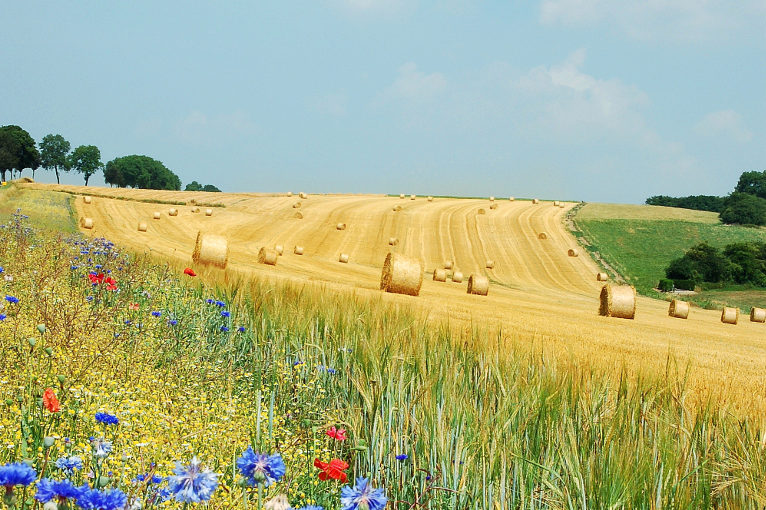
Teaser photo credit: Field in Hamois, Belgium. By I, Luc Viatour, CC BY-SA 3.0, https://commons.wikimedia.org/w/index.php?curid=998412



Comments
We changed commenting systems on September 10, 2026 as part of a site-wide functionality and security upgrade. Your past comments have not disappeared, and you can still log in with your old Disqus account credentials if you wish. Contact us with any questions.
I think it is a matter of scale with regards to any sustainable production system. We have centralized power with centralized money, the governing factor, which creates a centralized system, centralizing populations as it centralizes production and distribution all for control. Yes, “80% of the world’s food, in value terms, is produced by small family farms” and we need to make it 100% while decentralizing population and reversing the money from being created as private debt to being created as a permanently circulating public asset distributed into the bottom of the economy, where everything is produced, not the top which produces nothing.
In general I agree with this analysis …….
But agro-ecology should also be scrutinized with a similar critical eye. There is quite a lot of hot air in the agro-ecology movement and the social component sometimes comes with a attitude of “everything goes” as long as it is done by a peasant/indigenous people. Using pesticides or feeding chicken with industrial feed being two examples of practices quite often seen among farmers claiming to practice agro-ecology.
Food is energy – and food production is an energy equation.
At present, it takes 10-30 (depends what you count ‘in’) calories of fossil oil, to ‘produce’ one calorie of food. We’d have been better-off working out how to make the oil palatable. The question is: Where will the energy come from, beyond fossil oil (and coal and gas)?
The only answer is: The sun. But that is real-time, and what we have been doing is using millions of year’s worth in a mere 200-year frenzy. How many can be supported just on photosynthesis, WITHOUT drawing-down aquifers and soil quality and resource stocks?
My guess – and many recoil in horror – is 1-2 billion. We are a species in overshoot, because we levered fossil energy. Touchy-feely stuff is fine, understandable even, but overshoot is overshoot, any way you avoid it.
While there is much truth in the criticism of Global North variants of ecological farming, especially in that proponents don’t acknowledge the indigenous roots of practices, if they even know of them, I think this article misses a very important point.
Wherever a variant of ecological farming comes from, it will begin to be co-opted once it has market value. ‘Organic’ was coined in the 30s, started to gain market value in the 70s and was so co-opted by the 80s that proponents brought in government to stop (or really to slow) the co-optation. I was surprised to hear that ‘regenerative’ dates back to the 70s. When I first heard it circa 2010 it was not in common usage even among farm-savvy folks. But when a few years later it got used as a marketing term and gained traction and therefore value, it began to be co-opted, and it happened fast.
Consumers are hungry for better goods, but most don’t understand how to tell what is better. So, a label gets created, perhaps describing something that is better, but perhaps not. Enough people believe it and so it gains market value. But then other producers will use the label without being much, if any, better than the status quo at all, at least as long as they can, until, eventually, the value is entirely extracted from the label and we cease to trust it and perhaps even abandon it. It’s a form of mining by industry.
Proponents of the label can slow the loss by defending it, as governments do with ‘organic’ or appellations in some European countries. Trademarks can help, as in Biodyanamic. As Real Organic Project and Regenerative Organic Certification are now trying to do with ‘regenerative.’
If ‘agroecology’ gains market value in the Global North, you can expect its history to be forgotten or re-written too as its value gets mined.
We can never produce enough food to feed the world. Any improvement will lead to a population number increase to erase the effect, as Malthus rightly explained, and as is proven by the facts.
There are about 8 billion people in the world, almost 1 billion of whom are underfed, over 1 billion of whom are overweight, though many of those and many more are under-nourished, while we produce enough food annually to feed about 12 billion people. Those numbers are not hard to find.
There are 3 main problems here:
1) Significantly, we have a distribution problem. There is no incentive for the people who have the food to get it to the people who are underfed. Or to put it another way, those who are underfed cannot afford to buy food, or even to grow it for themselves.
2) Increasingly, we eat the wrong foods, over-processed, nutrient deficient and calorie heavy. You can gain weight this way, while still lacking in nutrition.
3) The way we grow food is harming the Earth.
The criticism is that some forms of ecological agriculture only focus on the third problem. This may be true, but it does not mean that they are wrong, simply that they are incomplete.
The question to ask is whether agroecology, or any or all forms of ecological agriculture, can solve these problems for our population, especially the third. Standard thinking, seeded by industry, is that they cannot. Proponents of these systems say they can. Science has until recently said “we haven’t studied this.” As studies happen, they seem to back up the proponents of ecological agriculture: we can continue to grow enough food for 12 billion people, and perhaps more, without harming the Earth.
All your visions are correct, but they are anthropocentric.
I believe that even if we could feed 12 billion with agroecology, we should not grow our population but instead gradually reduce it to under a billion.
Above that number, we will quickly eliminate the wild fauna and flora – as is happening clearly now – and subsequently ourselves.
Wild animals and virgin forests are simply being wiped out by an 8 billion human population.
The problem is over-consumption.
That is certainly true; still the large numerical majority don’t overconsume, but they aspire to it!
As someone who does this everyday and isn’t a pencil in an office….. this is a crap article.
We very much pay homage to where our practices come from.
Regen Ag is pretty big in poorer countries to. Just look at some of the video on YouTube from Africa.
It can and will help fix our food and environmental issues.
We arent trying to feed the world. We’re feeding our community. That’s where yall really mess up. Shipping food around the world isn’t sustainable. You need food from your area grown in your soil using your minerals. It’s no different than the pollen in local honey. Disturbing how many city dwellers think they have a clue.
I agree with your points, but eventually physical constraints will not take moral considerations into account.
If I would like to limit the population, it’s for sparing the unborn to miserable lives. It’s not egoism.
Problems with emphasizing population:
1. There is little we can do about it. At the most (and this is important), to encourage education and rights for women. Vigorous population control requires a very strong government with popular support, as China with its One-Child policy. Otherwise it looks as if economics/technology is the determining factor.
2. Many societies are justifiably suspicious about cries for population control from wealthy elites in the West. There is a history of racism and genocide which has to be admitted for other people to take the population issue seriously. The UK, for example, allowed terrible famines in colonies like Ireland and India – not to mention the suffering of UK working people.
3. Our job is to focus on what is our responsibility and what is under our control. Namely: overconsumption. We can create a model of consumption which would allow us to live satisfying, healthy lives on a fraction of our current energy use.