

Conversation recorded on February 28th, 2022)
Show Summary
On this episode, chemical engineer Paul Martin joins The Great Simplification to talk about all things hydrogen. There are many ‘Fuels of the Future’ about which the media likes to create hopeful and seamless narratives, one of the currently popular of these being hydrogen. Where does hydrogen come from and what do we already depend on hydrogen for – is it as ‘clean’ as the media leads us to believe? How can we think about hydrogen from a systems perspective to determine if it is really an energy solution – or an energy problem? What does this mean for the design of global supply chains entering into a simplified material future?
About Paul Martin
Paul Martin is a Canadian chemical engineer with decades of experience making and using hydrogen and syngas. As a chemical process development specialist, Paul offers services to an international clientele via his private consultancy Spitfire Research. He is also co-founder of the Hydrogen Science Coalition, a nonprofit organization providing science-based information about hydrogen from a position free from commercial interest.
To watch this video episode on Youtube → https://youtu.be/YVjEK_PjvD0
Show Notes and Links to learn more:
00:00 – Paul Martin Works + Info. Featured articles from Paul Martin: Hydrogen summary, Ammonia, Hydrogen production, uses, and the challenges of making it from renewable electricity
04:28 – What is hydrogen?
04:44 – Hydrogen and Ammonia (Haber Bosch Fertilizers)
05:21 – 99% of hydrogen is made from fossils without carbon capture
05:58 – ⅓ of hydrogen is used (Page 89) to desulphurize fossil fuels
06:28 – Sulphur level regulations in fossil fuels
07:09 – Other uses of hydrogen (Page 89)
08:01 – Hydrogen production as a byproduct of the chloralkali process
08:35 – The challenges of mechanical engineering with hydrogen
11:23 – Flammability of hydrogen
12:41 – On the 20 year time horizon, H is 33x more warming than CO2. On the 100 year time horizon H is 11.5x more warming than CO2 (Section 3.1)
14:05 – Hydrogen byproducts of being burned – depending on how you burn it
14:22 – NOx and its health/climate effects
15:34 – IPCC Forecasts
16:55 – There is no substitute for hydrogen in making ammonia and food production (Table 1.1)
17:32 – Nitrous oxide production from the soil and methods to reduce that
17:49 – 1911 Haber-Bosch process invention and corresponding crop production growth rates
18:26 – Regenerative Agriculture
18:30 – Half of nitrogen in our cells comes from Haber-Bosch cycle
19:54 – Vaclav Smil
21:55 – Hydrogen hype in the news cycle
22:08 – Nuclear fusion hype
23:12 – Receding Horizons
27:59 – What are the types (colors) of hydrogen
29:40 – Percentage of hydrogen created with carbon capture (Page 5)
30:02 – Making hydrogen produces more CO2 than the entire aviation industry
31:45 – Eric Idle, Monty Python
35:42 – Howarth and Jacobson Paper (2022) on How Green Is Blue Hydrogen?
37:43 – Henry Hub Price
41:23 – Water use for making electricity and hydrogen
42:30 – To make 1kg of Hydrogen from 9kg of water takes 50-60 kWh of electricity (Page 3)
42:45 – To desalinate 9kg of water from the ocean takes 0.035 kWh of electricity
44:11 – Sins of Thermodynamics
44:45 – Vaclav Smil on the energy transition
46:30 – Different types of energy
49:25 – Current Supply chain infrastructure dependent on liquid fuel source
51:00 – Heat Pump
53:10 – Paul’s Article analyzing heat pumps
55:52 – Canada’s Carbon Tax
56:40 – UK Discussions on using hydrogen for home heating
58:30 – Natural Gas interest in a hydrogen future
59:47 – AMOC
1:01:58 – Paul’s writing on questionable uses of Hydrogen as a fuel or storage system
1:03:01 – Energy Density of Hydrogen vs Natural Gas
1:04:38 – It takes 3x energy to compress a unit of hydrogen as it does to compress a unit of natural gas
1:07:08 – Japan and South Korea dependence on imported energy
1:07:40 – News story of natural hydrogen deposit discovery
1:08:02 – Mali natural hydrogen production well and likelihood of other widespread deposits
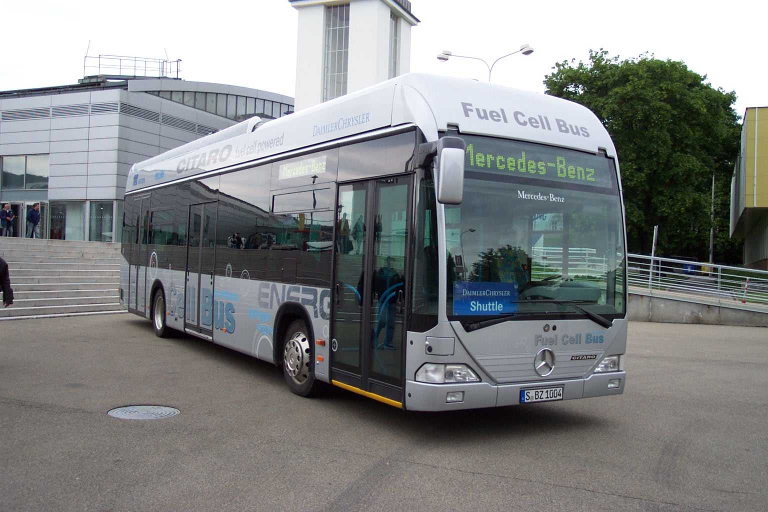
Teaser photo credit: A Mercedes-Benz O530 Citaro powered by hydrogen fuel cells, in Brno, Czech Republic. Author: Aktron Self-photographed, CC BY-SA 3.0, https://commons.wikimedia.org/w/index.php?curid=836604





Comments
We changed commenting systems on September 10, 2026 as part of a site-wide functionality and security upgrade. Your past comments have not disappeared, and you can still log in with your old Disqus account credentials if you wish. Contact us with any questions.
Pretty much, it’s just that people cannot give up the fantasy future they’ve been promised for generations. They’re grasping at any straw offered. And politicians can’t correct their error, even if they wanted to, because they’d simply be voted out of office. Corporations will do anything they can make a short-term profit at – even government incentives (free money).
It’s not hate, per se, for hydrogen – it’s just the physics of a low-density, high-pressure, explosive, highly-destructive cryogen that you don’t have petaWatt hours of energy to make vs. a simple liquid like kerosene or gasoline that is already made. (if you’ve never worked with hydrogen, then think: Hindenburg)
It’s been said that green tech will be the “last great scam” of Western Civilization (Tainter/Patzek). It’s been very clear for generations of (honest) scientists that nothing exists which can replace the role hydrocarbon fuels have played in our civilization. (Where do you get the 2 petaWatt-hours of zero-carbon electricity every year to make hydrogen? Unknown.) But that knowledge is beyond the ken of people. The mind revolts against it – the thought of how much we have to loose is overwhelming.
Haha – about the “last great scam” idea – very clear from sources as diverse as System Dynamics (Meadows, et al.) and Thermodynamics (Schramski, et al. [2015]) that the planetary resources are massively depleted. That alone invalidates all “green tech,” leaving a world of increasing shortages and much lower populations. Meadows estimates a billion? https://youtu.be/Dbo6uvJBtZg
As a metallurgist and combustion researcher, hydrogen is awful! As a safety engineer or firefighter, hydrogen is awful! Give me nice, well-behaved hydrocarbons in the laboratory for combustion research…