“The future is not so much to be predicted as to be selected.” Donella Meadows, 1941-2001, Author of The Limits to Growth and Beyond the Limits
Each section in this page is structured according to the “see, judge, act” method proposed by Pope Francis in the encyclical Laudato Si’ No. 15:
“I will begin by briefly reviewing several aspects of the present ecological crisis, with the aim of drawing on the results of the best scientific research available today, letting them touch us deeply and provide a concrete foundation for the ethical and spiritual itinerary that follows. I will then consider some principles drawn from the Judaeo-Christian tradition which can render our commitment to the environment more coherent. I will then attempt to get to the roots of the present situation, so as to consider not only its symptoms but also its deepest causes. This will help to provide an approach to ecology which respects our unique place as human beings in this world and our relationship to our surroundings. In light of this reflection, I will advance some broader proposals for dialogue and action which would involve each of us as individuals, and also affect international policy.”
Human Supremacy
See ~ Since the inception of the patriarchal culture (ca. 10000 BCE) we have become conditioned to assume that human supremacy over nature is “natural law.” But there is nothing natural about human supremacy and derivatives such as male supremacy, white supremacy, and other such ideologies of domination. Just look around. Humans are part of nature and are embedded in the natural biosphere, not the other way around.
Judge ~ Ideologies of dominion are bad for human development. Modern neuroscience confirms that a culture of partnership is more conducive to nurture our humanity than a culture of dominion, especially as it pertains to parent-child and gender relations. Patriarchal gender ideology, and other ideologies of dominion, are also detrimental for human ecology, because the mindset of dominion brings about population overshoot, ecological footprint, toxic pollution, biodiversity decimation, resource depletion, climate change, etc., and humans cannot flourish in a planet devoid of clean air, potable water, and healthy food.
Act ~ Therefore, it is imperative to evolve our global culture from a mindset of domination to a mindset of partnership. All human institutions must cooperate in fostering this cultural evolution. Religious institutions are not exempt, because religious patriarchy derives from, and in turn exacerbates, the very mindset of domination that is now becoming ecocidal. A patriarchal ecology stinks. Humans may be at the center of the living world, but certainly not at the top. Human body-persons, male and female, are unique in self-consciousness and, therefore, uniquely responsible for the entire community of creation.
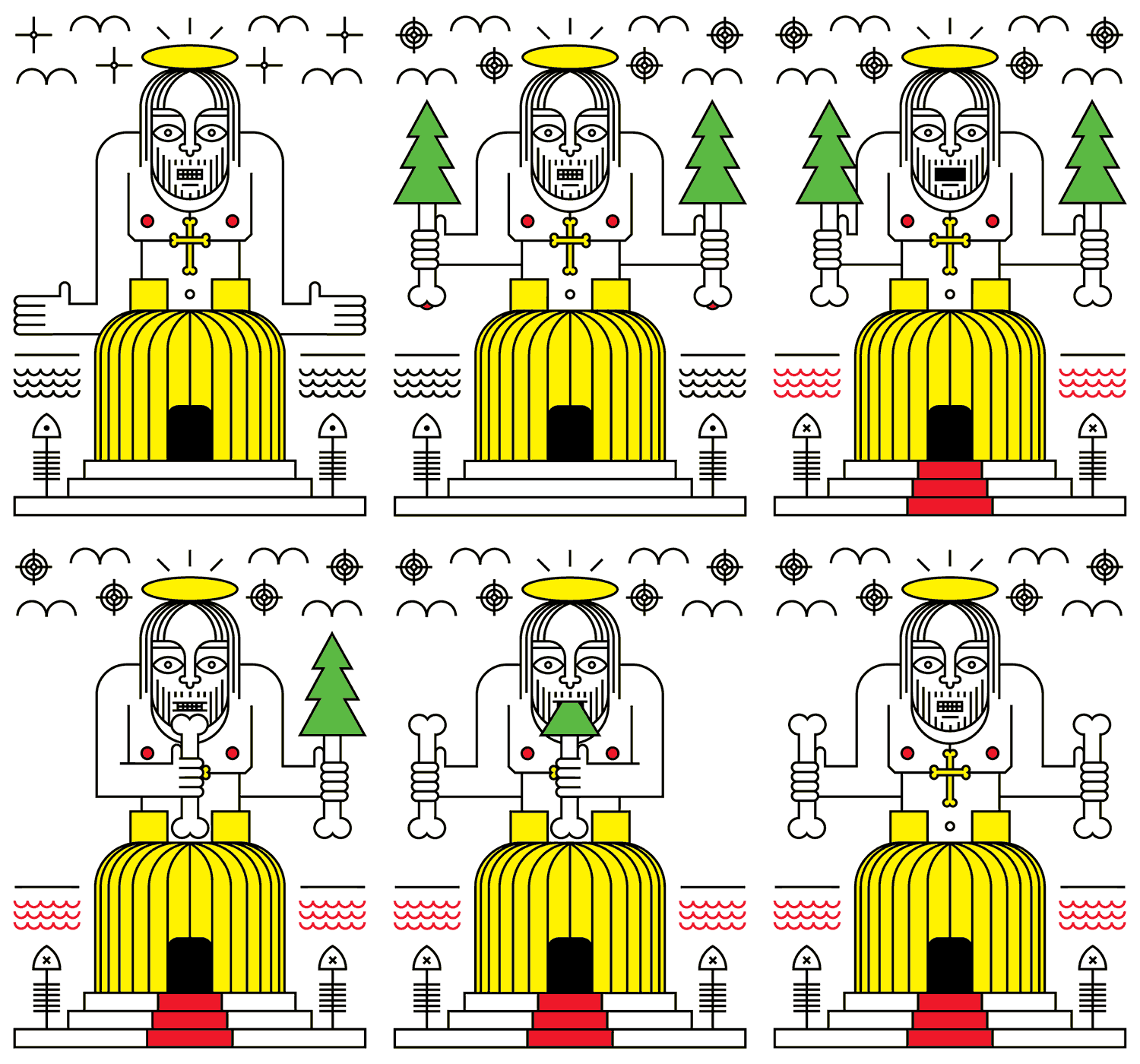
[slide-anything id=’3472166′]
Religious Patriarchy
See ~ There is abundant historical evidence about the bad consequences of fanatical religious dominion. In the Christian world, the crusades and the inquisition come to mind as repulsive examples of religious violence. Similar examples abound in the history of other religious traditions, and recent atrocities by the ISIS caliphate show that humans still have a propensity to use God for ungodly purposes. The Catholic Church is the largest and most influential religious institution in the world. Crusades and inquisitions have now morphed into a more benign institutional ethos. However, the hierarchical structure of the church retains a rigid patriarchal semblance that conveys male supremacy and is, therefore, an obstacle to cultural evolution from domination to partnership, socially and ecologically.
Judge ~ For over fifty years now, the Vatican has been evading coming to terms with the fact that religious patriarchy is cultural, artificial, unnatural; an accretion of the patriarchal culture that emerged long before the Bible was written. This is understandable, given institutional inertia and resistance to change after millennia of Judeo-Christian patriarchy. However, religious doctrines based on patriarchal gender ideology are no longer credible. Patriarchal gender ideology is an anthropological falsehood rooted in the misconception that men and women are essentially different as human persons (thus implying that there are two substantially different human natures, male or female), whereas the Theology of the Body clearly explains that man and woman are somatically homogeneous and jointly constitute the full image of God as a communion of persons. There is but one human nature in two incarnations, male and female.
Act ~ It is time for all religious institutions to let go of patriarchal gender ideology. In the Catholic Church, the issue is not going away, and it is not just a matter of “cultural movements that question the place of women in the Church” (see this announcement). It is a fundamental issue of theological anthropology that pertains to ministerial vocations. Indeed, “changes cannot be dictated by cultural pressures, but neither should they exclude the fact that in the issues that prompt change, there is a call to free the faith from encrustations of the past” (same announcement). The patriarchal priesthood is a cultural accretion, not divine revelation. It is doing much harm by perpetuating ideologies of male supremacy. It is time to ordain women to the priesthood and the episcopate. Else, the credibility of appeals such as Laudato Si’ and Fratelli Tutti is compromised.
Industrial Ecology
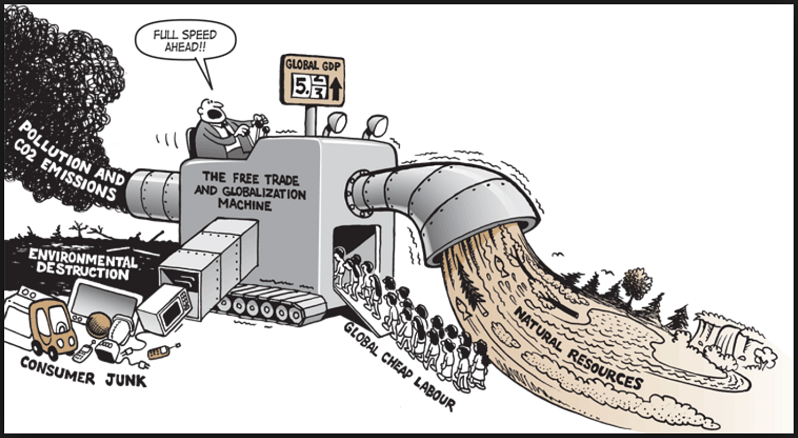
See ~ Industrial ecology is about the flow of natural resources (materials, energy) through the industrial economy, and how such flows (from the point of extraction to the point of disposal) affect the environment in terms of resource depletion, supply chains, toxic pollution, ecological dynamics, etc. This cartoon is an image of the ecocidal human propensity to abuse natural resources when they are abundant, accessible, and cheap. The myth of infinite growth in a finite planet is leading us to catastrophic destruction of the human habitat. It is hard to find people willing to take the antidotes of frugality (Laudato Si’) and fraternity (Fratelli Tutti). As long as we don’t reach peak oil, peak food, peak water, and peak everything, most humans seem to be incapable of moderation in human reproduction and consumption. Why is this so?
Judge ~ The modern myth of infinite growth in a finite planet is rooted in the ancient myth of human supremacy, whence many other nefarious ideologies derive, including male supremacy and white supremacy. Religious patriarchy further exacerbates the human propensity to seek dominion over others, and to do so in the name of God. Modern technology, based on the power of fossil fuels, has enabled the myth of human supremacy to induce the great acceleration in food production, population growth, and monetary economic indicators such as GDP. But humans are responsible for eroding the resource base. Mother Nature is innocent. However, Pope Francis recently reminded us of an old saying: “God always forgives, we forgive sometimes, but nature never forgives.” If human supremacy leads us to resource depletion and climate disruption, the human species may go the way of extinction like any other species, because we are utterly dependent on nature to survive. So, what can we do?
Act ~ The pervasive dominion culture of human civilization must change. In a seminal article published in 2009, entitled Overcoming Systemic Roadblocks to Sustainability: The Evolutionary Redesign of Worldviews, Institutions, and Technologies, a team of scholars analyzed the global system whereby culture (worldviews), institutions, and technologies interact in response to the cheap surplus of fossil energy that triggered the industrial revolution. The role of culture is decisive. Cultures shape institutions (culture shapes gender, and gender shapes the world). The culture of human supremacy, manifested as both secular and religious patriarchy, has permeated the collective human mindset to the point of forgetting that we must take care of our common home. There is no way in the world that humanity can survive (let alone flourish) as long as GDP is king. Ergo, the culture must change. Technology is morally neutral. It is the human institutions that must evolve from dominion to partnership. If human institutions fail to move from dominion to partnership, from patriarchy to solidarity, there can be no social/ecological justice, and we might as well forget about exploring other planets.
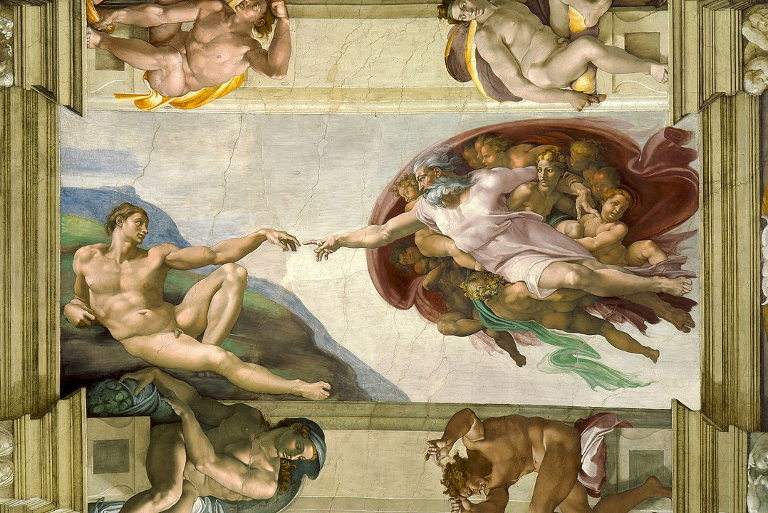
Teaser photo credit: By Michelangelo – Not necessary, PD by age., Public Domain, https://commons.wikimedia.org/w/index.php?curid=16022922