

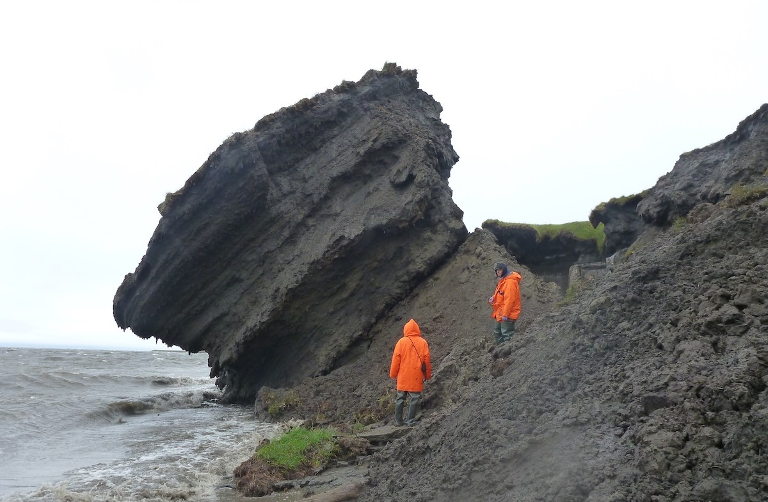
The carbon-rich permafrost warmed “in all permafrost zones on Earth” from 2007 to 2016, according to a new study.
Most ominously, Siberian permafrost at depths of up to 30 feet warmed a remarkable 1.6°F (0.9°C) in those 10 years, the researchers found. The permafrost, or tundra, is soil that stays below freezing (32°F) for at least two years.
Permafrost warming can “amplify global climate change, because when frozen sediments thaw it unlocks soil organic carbon,” warns the study, which was released Wednesday by the journal Nature Communications.
The thawing releases not only carbon dioxide but also methane (CH4) — a far more potent greenhouse gas — thereby further warming the planet. And as the planet continues to warm, more permafrost will melt, releasing even more greenhouse gases in a continuous feedback loop.
Thawing permafrost is an especially dangerous amplifying feedback loop because the global permafrost contains twice as much carbon as the atmosphere does today .
Normally, plants capture CO2 from the air during photosynthesis and slowly release that carbon back into the atmosphere after they die. But the Arctic permafrost acts like a very large carbon freezer — and the decomposition rate is very low. Or, rather, it was.
[slide-anything id=’3472166′]
Humanity is leaving the freezer door wide open. As a result, the tundra is being transformed from a long-term carbon locker to a short-term carbon un-locker.
A 2017 study found the Alaskan tundra is warming so quickly it had become a net emitter of CO2 ahead of schedule. That study was the first to report a major portion of the Arctic had already become a net source of heat-trapping emissions.
The lead author, Dr. Roisin Commane, told ThinkProgress at the time, “We’re seeing this much earlier than we thought we would see it.”
The new study released on January 16 is the first “globally consistent assessment of permafrost temperature.” Four dozen researchers from around the world found that the ground temperature tens of feet below the surface “increased in all permafrost zones on Earth” — in the Northern Hemisphere, the mountains, and Antarctica.
“My take home [on the new study] is that the anecdotal site thawing that I heard about this winter is part of a region-wide warming that seems to be accelerating faster in this decade than in previous decades,” Dr. Commane told Inside Climate News.
That’s no surprise given that “Arctic air temperatures for the past five years (2014-18) have exceeded all previous records since 1900,” as the National Oceanic and Atmospheric Administration reported in its annual Arctic Report Card last month.
The only surprise is that the world continues to ignore this gravest of threats to humanity, even as it speeds up, triggers amplifying feedbacks, and rapidly approaches a climate death spiral.



Comments
We changed commenting systems on September 10, 2026 as part of a site-wide functionality and security upgrade. Your past comments have not disappeared, and you can still log in with your old Disqus account credentials if you wish. Contact us with any questions.