

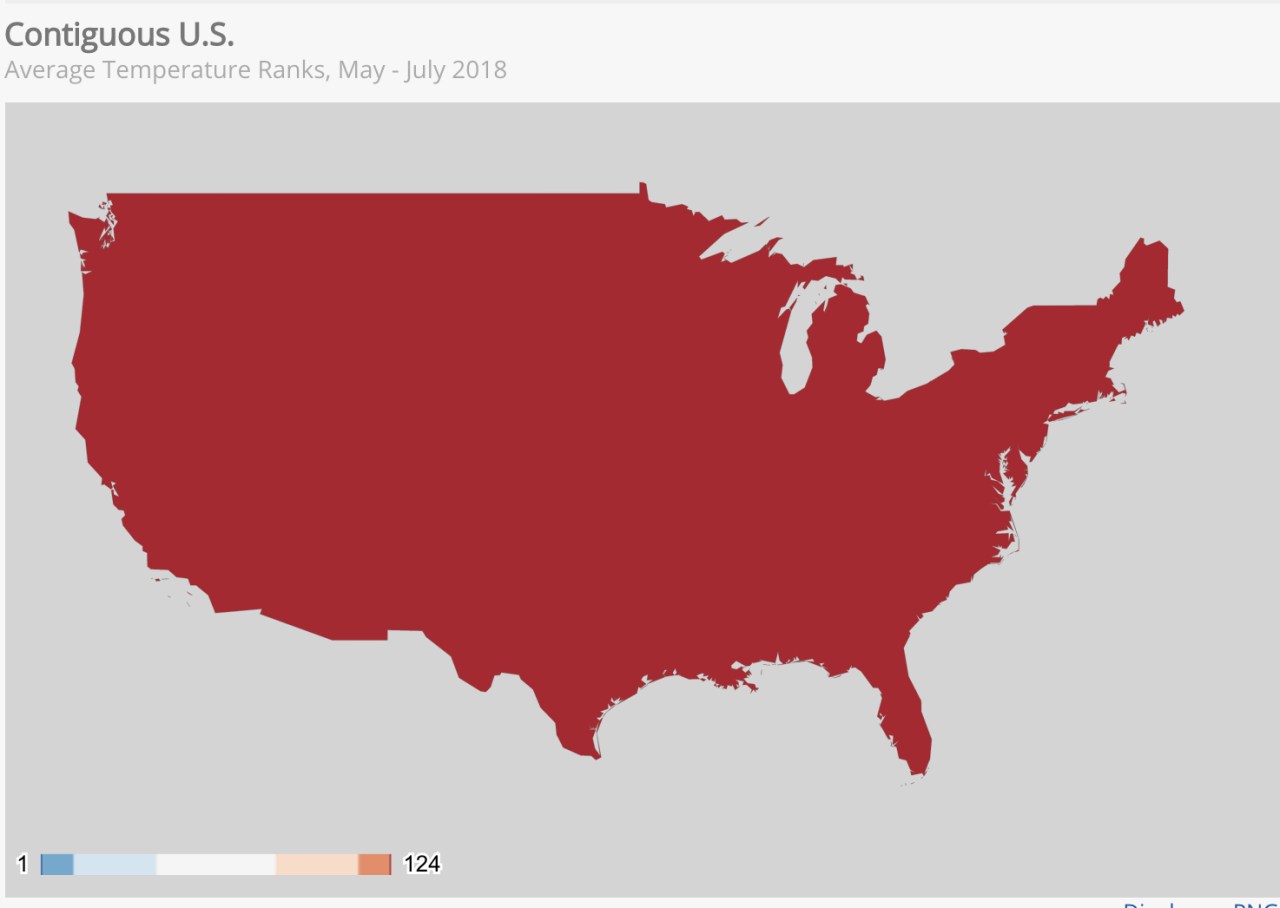
If you found yourself thinking it was scorching hot in recent weeks, well, you were right.
For the three-month period of May to July, the entire contiguous United States (CONUS) “ranked hottest on record,” as the National Weather Service in Los Angeles, California tweeted out Wednesday, adding that “records go back to 1895.”
No need to adjust your screen. The entire CONUS ranked hottest on record for the 3-month period May-June-July at 70.9 degrees F. Records go back to 1895. #CAwx #LAheat #heatwave pic.twitter.com/JPQVvO1K4L
— NWS Los Angeles (@NWSLosAngeles) August 15, 2018
That map comes from the National Oceanic and Atmospheric Administration (NOAA) report, “Assessing the U.S. Climate in July 2018,” released last week.
But NOAA didn’t mention the May-June-July heat record in its report, and that left it to the NWS in Los Angeles to point out the sea of red across the contiguous U.S.
NOAA did point out that in California in particular, “July was off the charts: The state saw its hottest July and hottest month on record with an average temperature of 79.7 degrees F.”
[slide-anything id=’3472166′]
No wonder the state has been ravaged by deadly, record-smashing wildfires this summer.
“At 108.1 degrees F,” NOAA noted, “Death Valley, California, had the hottest average monthly temperature for any recording station in the world.”
As the National Park Service points out, “If that doesn’t sound hot to you, realize that is the average temperature for the month, including overnight lows.”
In July, the aptly-named Furnace Creek in Death Valley “reached a high temperature of 127 degrees F four days in a row.”

And in case you were wondering, yes, U.S. temperatures have been going up for a long while, and humans are the cause.





Comments
We changed commenting systems on September 10, 2026 as part of a site-wide functionality and security upgrade. Your past comments have not disappeared, and you can still log in with your old Disqus account credentials if you wish. Contact us with any questions.