Click on the headline (link) for the full text.
Many more articles are available through the Energy Bulletin homepage.
‘Transition in the UK’: my talk at Sunrise Off Grid 2011
Rob Hopkins, Transition Culture
Here, thanks to those good people over at PermanentCultureNow, is a film of the talk I gave at this summer’s Sunrise Off Grid Festival in Somerset. Part 3 also includes the ‘milling’ exercise with the ingredients cards which will be available to download and use on October 27th, the official launch date of The Transition Companion.
Part 2 | Part 3 | Part 4 | Part 5
(21 September 2011)
Exploring the Ingredients for Transition: webcast now available
Rob Hopkins, Transition Culture
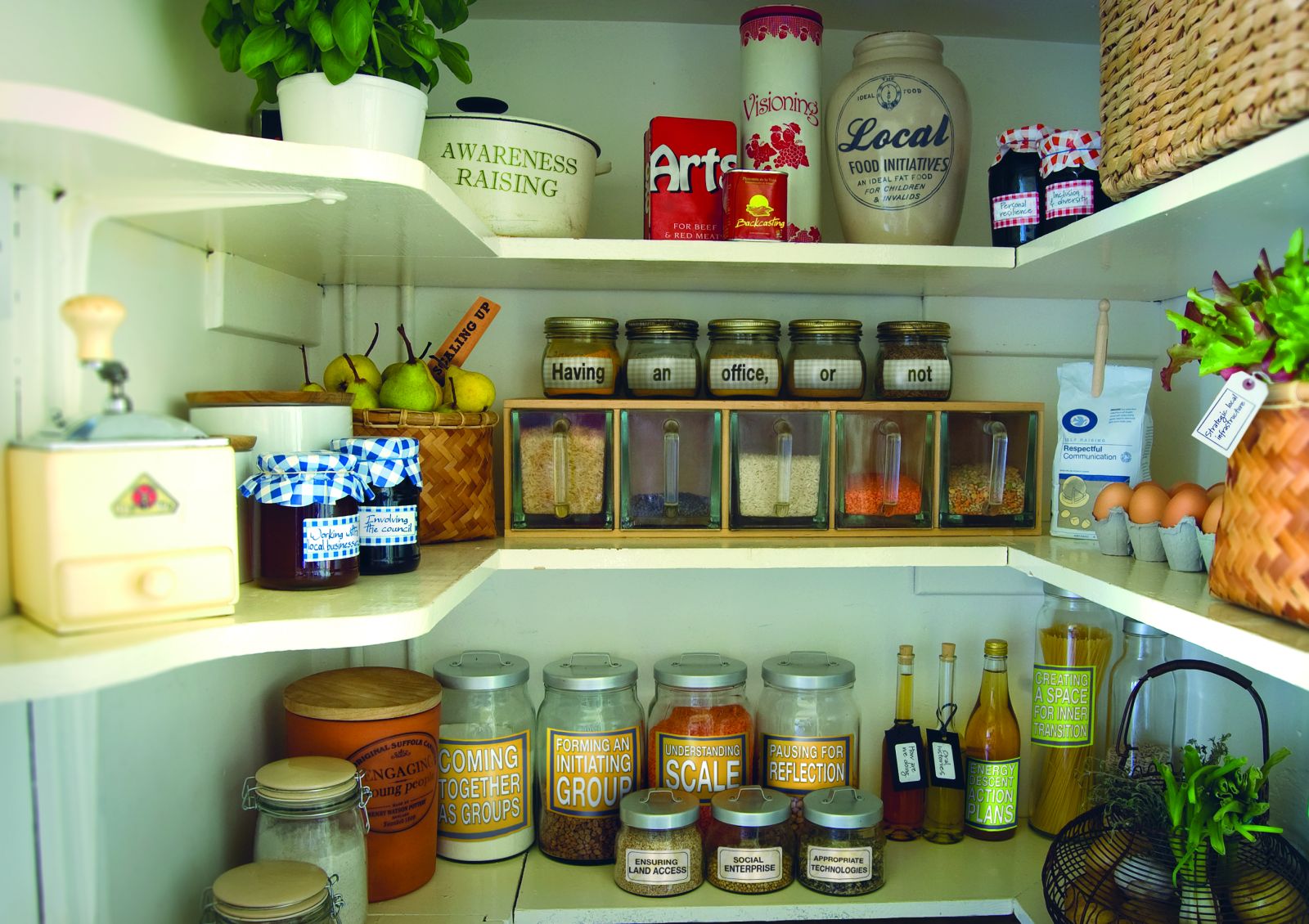
On Monday I did the second webinar for Transition US, looking at the ‘ingredients’ of Transition, and answering lots of questions about Transition sent in by people from across the US. You can now listen to it in full here. I started out by telling people that it was, in a way, an illustrated talk, in that I had uploaded a picture online they could look at, taken from the forthcoming ‘The Transition Companion’ (which you can pre-order now). Beautifully created by Marina Vons-Gupta, it communicates the idea of embarking on Transition being like opening the larder door and picking the ingredients for creating what you have decided to create. Anyway, thanks to everyone who made it possible, and enjoy the recording.
Transition US says:
Join us for an insightful conversation with Rob Hopkins, author, Permaculturist and founder of the Transition Towns Movement.
In this conversation we will be asking Rob to go more deeply into the “ingredients of Transition” as well as answering questions supplied by participants. Transition US board member, author and visionary Vicki Robin will be the host for this call.
In July our call with Rob, hosted by Richard Heinberg has been listened to by well over 1,000 people in just a few short weeks. If you have not heard that yet – listen to a recording of our last call with Rob here.
(15 September 2011)
The audio for the webcast is available at Transition US. -BA
Top 5 Ways Hippies Can Make You Rich
Ben Zolno, Huffington Post
… the economy of scale in communal living with you and your closest dozen best friends will have you dropping your jacket and tie and for a tie-dye t-shirt and flowers in your hair.
Besides some of the cliches you’ll see in this satire promoting the Art of Community conference starting a week from today (September 23- 25 in California), community living has serious advantages that are looking more and more appealing to the average American feeling the hard times of the recession, especially those able to connect the dots of our daily headlines to see the future of food, oil, water and world economy.
Here are the Top 5 Ways Hippies Can Make You Rich, with the life-time value of each.
#1 Cheap Land
Worth: $500k+
On your own, if you have only $50k to put down for a land deposit, your choices are limited. If you got together with 20 community members, you’re looking at a million bucks, just to start. That’s the choice between mortgaging a shed on an empty lot or owning several hundred acres outright in some parts of the country. With that much space and lower debt, you can build a home much larger than you’d be able to afford to otherwise.
From there, you can either tend the land and preserve it for generations to come, or all work together and hope to flip it and get filthy rich, if you still have that capitalist streak in you.
#2 Cheap Child Rearing …
#3 Cheap Labor …
#4 Cheap Therapy …
#5 Cash …
(16 September 2011)
Great way to look at group living. However, group living is a big step and requires a lot of work to make it successful.
One does not have to go completely hippie and live on a commune to take advantage of the benefits listed by Ben Zolno. It might be easier to try expanding connections with your extended family. Jan Lundberg pointed out to me the cocept of a “virtual” commune, in which households stay in their own homes, but share (some) resources and activities.
The New York Times reported on the wave of communes a few years ago: Extreme Makeover, Commune Edition.
-BA
Interview with Slow Money Founder Woody Tasch
Don Hall, Transition US
Thanks to Don Hall for sharing this interview with Woody Tasch for Greater Sarasota’s EAT LOCAL! Resource Guide & Directory, a project of Transition Sarasota, Florida.
Woody Tasch, Founder and Chairman of Slow Money, pioneered the integration of asset management and philanthropic purpose in the 1990s as treasurer of the Jessie Smith Noyes Foundation and founding chairman of the Community Development Venture Capital Alliance. For ten years, through 2008, Tasch was chairman of Investors’ Circle, a network of angel investors, family offices, and social purpose funds and foundations that has invested $133 million in 200 early stage sustainability-promoting ventures and venture funds, since 1992. Woody is also the author of Inquiries into the Nature of Slow Money: Investing as if Food, Farms, and Fertility Mattered (Chelsea Green).
Eat Local Guide: To start with, what is Slow Money, and what was the inspiration behind it?
Woody Tasch: Slow Money is basically two things. It’s a new vision of reconnecting money to the soil and investors to local economies, and it’s the network of people who are bringing those ideas into action. It’s a national network that’s composed of an emerging group of local chapters. Between the national network and the local chapters, we are setting up an infrastructure to help people put their money to work in local food systems.
I don’t think I can answer the second part of the question, because there are too many different facets. I can say readingSmall is Beautiful or working in international development in the 70’s or doing small-scale venture capital in the 80’s or being a foundation treasurer in the 90’s. Through all of this, I’ve been circling around the idea of bringing social purpose and environmental responsibility together with the way we invest. Unfortunately, the vehicles that are out there now don’t get to the root problem of connecting people to the places where they live and to the soil. That’s about as fundamental as you can get.
ELG: Why do we need Slow Money now? What’s the urgency?
WT: I can’t think of anything more important than getting control of our money. At this point in our history, we seem to have abdicated our sense of purpose to something called “The Market,” even though, deep down, millions of us know that “The Market” is the institutionalization of consumerism and industrialization: tobacco, weapons, and cars. Things, which, in the aggregate, are probably starting to cause more harm than good. Certainly more harm for future generations.
The only way to solve this is to address it directly. I am not big on federal policy and regulations because it seems to me you can’t get the answer at that scale. It’s too big, too abstract, too corrupted by special interests. To me, our only hope is for a lot of us over time to take a little of our money and start moving in a radically different direction. The good news is we have something very concrete we can start doing, which is investing in local food systems and small food enterprises.
There are a whole bunch of financial arguments you can make, but the real impulse for doing it is cultural, environmental, and social. We need to do this. We are going to save farms and help young farmers get on the land and develop soil fertility. We have to do this. Whatever we call it or however much money we make at it, we still have to do it.
(6 September 2011)