Click on the headline (link) for the full text.
Many more articles are available through the Energy Bulletin homepage.
Six casualties of the world food crisis
Various authors, Guardian
Extreme weather and market forces have affected the price of everything from Israel’s tomatoes to South Korean cabbage
—
Cabbage in South Korea
To outsiders it is just another vegetable. To South Koreans, the long-leafed cabbage is part of the national identity as the most common staple ingredient of kimchi, the spicy pickled vegetable dish that accompanies every meal.
But a frosty spring and hot summer followed by autumn floods ruined this year’s crop and caused prices to rise between three- and fivefold – though some whisper darkly that hoarders have contributed to the problem.
Chinese press reported that heads of cabbage were selling at a record high of 13,800 won (£7.75) in Seoul last month. Radishes, also used in kimchi, are two to three times more expensive than last year. Some restaurants have even started charging for kimchi – a development akin to McDonald’s asking people to pay for ketchup. …
Garlic in China …
Tomatoes in Israel …
Corn in the United States …
Bread in Russia …
Sugar in Pakistan …
(25 October 2010)
Shutdown of two small cheesemakers raises more doubts about food-safety legislation
David Gumpert, Grist
In all the acrimony that has settled over Washington, one major legislative matter has continued to receive bipartisan support: food safety legislation intended to give the U.S. Food and Drug Administration vastly expanded powers to reduce the amount of contaminated food getting into distribution.
Highly publicized outbreaks over the last few years involving everything from spinach to peanut butter to ground beef to eggs have only seemed to heighten the support from consumer groups and the media alike. Grist contributor Elanor Starmer last week argued that we have a serious food safety problem only this legislation can resolve. The proposed legislation, strongly encouraged by the Obama administration, sailed through the U.S. House last fall, and then through a Senate committee earlier this year.
And then the legislation stalled.
… In actuality, though, even as it has taken on an aura of inevitability, doubts about the legislation have been growing. A number of organizations representing family farmers and consumers — such as the Cornucopia Institute and the Farm-to-Consumer Legal Defense Fund — have expressed concerns that the legislation gives too much power to the FDA. Not only would the agency have the power to require HACCP plans, but it would also be able to inspect and examine the financial records of any food producer at its whim, rather than having to obtain court permission, as it does now. Moreover, it would have the power to declare food emergencies and quarantine large parts of the U.S., at its discretion, as well as decide on so-called “good agricultural practices” for America’s small farms covering irrigation, crop rotation, and other matters traditionally under farmer purview.
The FDA hasn’t helped its cause among foodies and farmers in the last few weeks by involving itself in the shutdown of two premium-quality raw-milk cheesemakers — Morningland Dairy in Missouri and Estrella Family Creamery in Washington — because of the presence of the pathogen listeria in some cheese samples or on the premises. Now, you might say, isn’t this just an example of the FDA doing its job by protecting us from pathogens?
It might be a positive thing except for two problems. First, neither of these cheese producers has made anyone ill in many years of operations, including the last few months, since the presence of the pathogens was discovered. Indeed, scientists are divided about the danger of listeria in trace amounts, and some have advised the FDA to change from a zero-tolerance approach to something more realistic, given the ubiquitous presence of listeria.
Second, the FDA almost never shuts companies down for the simple presence of pathogens. It gives them opportunities to clean things up.
(1 November 2010)
Global food crisis forecast as prices reach record highs
John Vidal, Guardian
Rising food prices and shortages could cause instability in many countries as the cost of staple foods and vegetables reached their highest levels in two years, with scientists predicting further widespread droughts and floods.
Although food stocks are generally good despite much of this year’s harvests being wiped out in Pakistan and Russia, sugar and rice remain at a record price.
Global wheat and maize prices recently jumped nearly 30% in a few weeks while meat prices are at 20-year highs, according to the key Reuters-Jefferies commodity price indicator.
… However, opinions are sharply divided over whether these prices signal a world food crisis like the one in 2008 that helped cause riots in 25 countries, or simply reflect volatility in global commodity markets as countries claw their way through recession.
“A food crisis on the scale of two or three years ago is not imminent, but the underlying causes [of what happened then] are still there,” said Chris Leather, Oxfam’s food policy adviser.
… But other analysts highlight the food riots in Mozambique that killed 12 people last month and claim that spiralling prices could promote further political turmoil.
They say this is particularly possible if the price of oil jumps, if there are further climatic shocks – suchas the floods in Pakistan or the heatwave in Russia – or if speculators buy deeper into global food markets.
(25 October 2010)
Guardian podcast: Food security
The Guardian (UK)
With nearly 1 billion people around the world already going hungry each day and dozens of countries facing food shortages in the near future, food security has become an urgent issue
—
In this week’s Focus podcast, we look at the issue of food security.
In September, Mozambique erupted in a series of food riots, provoked by sudden hikes in the price of bread. At least 14 people died and hundreds were injured. In 2007-08, similar rises in the cost of staple foods triggered protests all around the world.
This week, John Vidal reported that rising food prices and shortages could produce a further food crisis.
Felicity Lawrence is joined by Oxfam GB’s head of research, Duncan Green to discuss the issue.
We hear from Jayati Ghosh, leading professor of economics at Jawaharlal Nehru University, in India; Raj Patel, award-winning author of The Value of Nothing, and a fellow at the Institute for Food and Development Policy, also known as Food First; and Olivier de Schutter, the UN’s special rapporteur on the right to food.
(29 October 2010)
Focus on Hunger: Interview with Vandana Shiva
Natasha Burge, Conducive Chronicle
… Everything about world hunger is unfair. The fact that there are nearly 1 billion people starving in the world right now speaks to the vast amounts of injustice that our global system is built on. That 1 out of 6 human beings goes to bed hungry every night while there is more than enough food to feed everyone generously, seems to me the very definition of unfair. When I began my first exploration of world hunger last May, the endless stream of inequality and injustice was enough to make me want to scream. But out of all of the rage inducing facts and statistics, the one that haunts me the most, that makes me lose sleep at night, that I still find hard to believe, is that the people who grow the world’s food, our farmers, are some of the most likely to experience hunger.
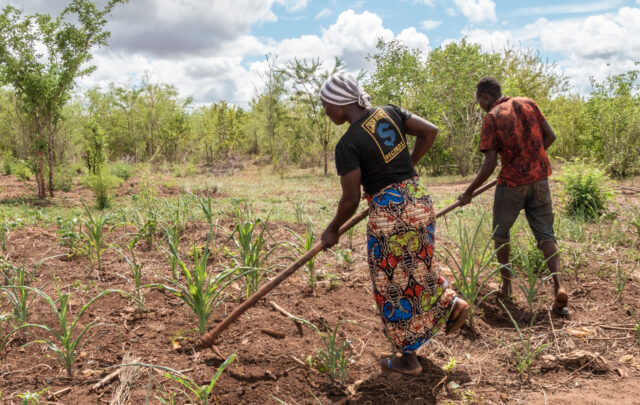
In our world, farmer means woman. 80% of the developing world’s food supply, and 60% of the world’s food in total, is grown by women’s hands. Women plant, nurture, and harvest the food we all need to survive, yet they own less than 1% of all farmland, and are generally the last to eat. 70% of those suffering from chronic poverty and hunger are women and girls. They feed us, and while we eat they starve. The industrialization of our food system has led us to a place where we are now so removed from the food we eat that most of us barely know what’s in it, let alone where it came from or who grew it. What kind of life did she live? Was she well fed, able to enjoy the literal fruits of her labor? Or was she drowning in debt, a slave to the chemical and agricultural companies that have quickly devoured our world?
… It was in this environment, to fight these wrongs, that world renowned global south activist, physicist, and eco-feminist Vandana Shiva created Navdanya. Founded in 1984, Navdanya is providing an alternative to the modern global food system by promoting biodiversity conservation, farmer’s rights, and organic farming methods, with an emphasis on seed saving. Navdanya means nine crops, in reference to the nine crops that represent India’s collective source of food security, and it is this self-sufficient food security that it hopes to preserve. Over the past 26 years, Navdanya has created an ever expanding alternative to the culture of death and debt pushed by the transnational corporations.
… Burge: Women grow the majority of the world’s food and 60% of India’s farmers are women. Women also make up 70% of the world’s chronically hungry people. Why is it that women, the people who grow the majority of the world’s food, are the last to eat?
Shiva: Just as farmers who grow the food are the largest number of hungry people in the world, women who produce and process food constitute the majority of malnourished people. The denial of food to the producers of food is a result of the injustice built into industrial food systems and social discrimination.
Burge: Navdanya calls itself a ‘women centered movement’, holds female heritage learning and preservation classes known as Grandmothers’ University, and has a gender program, Diverse Women for Diversity, that is a global campaign of women advocating for bio-diversity and food security. Could you tell us why it was so important for Navdanya to focus on the empowerment of women? Why do you consider the partnership of ecology and feminism to be a partnership of liberation?
Shiva: The dominant model of agriculture has come out of capitalist patriarchy and is based on war. These wars begin as wars in the mind, become wars against the earth, and result in wars against our body. Women need to lead the movement for a non-violent food system because they have not been part of the war economy. Grandmothers hold the heritage of non-violent knowledge which protects the earth and our health.
(12 October 2010)
Food Security for Europe (online publication)
Joint publication
The Food Security news insert was published with the support of The European Commission, The FAO, United Nations Environment Programme and DEFRA.
The editorial synopsis contains interviews with Achim Steiner (UNEP), George Kell (UNGC) Minoru Takada (UNDP) Carlo Scaramellar (UNWFP) Alexander Muller (UNFAO) Caroline Spelman (DEFRA) The briefing was inserted into and distributed by The Financial Times on October 14th 2010.
It is often forgotten in our well-fed corner of the world that a year-round supply of affordable, health-giving food is the mainstay of social stability and our quality of life. This means forward thinking food policies are a categorical imperative for Europeans as they come to address the food supply challenge ahead. Simply put, we must produce more food to feed a growing population on the existing agricultural land base, while adapting to the impact of climate change, preserving biodiversity, reducing greenhouse gases, safeguarding the environment and staying within the narrowing limits of the public purse.
As the briefing discussed that’s some challenge, and not just for farmers and the food industry, but for European legislators and science. Failure to tackle the problem poses a real threat to ordinary people’s lives. That human society is based on agriculture herd farming and the sea and has been for some eight thousand years is a fact which urban dwellers, that is most of us, must be reminded. We can take comfort, however, that we have the technology and know-how to meet the challenge and produce the food: we just have to deploy it wisely and scientifically.
Food Security concerns is not an unfortunate condition of some distant land but a very European problem. Europe is the world’s largest producer of food, the biggest exporter of food and the biggest importer, and our imports exceed our exports by a very substantial margin. In other words, what Europe does with food counts, globally, and Europe will either be a big problem or part of the solution to the Food Supply challenge. This is not to suggest that Europe must feed the world, although as time goes by, the moral and ethical weight of this question will mount for those in relative abundance. The big challenge must be reckoned with right here in Europe for very Eurocentric reasons: the linked needs for affordable nutrition and social stability being chief amongst them.
As these challenges to food production unfold the population’s demand for food will increase. The FAO estimates that agricultural production will need to increase by 70% by 2050 to cope with a 40% increase in world population. This translates into an additional one billion tonnes of cereals to be produced annually by 2050.
The briefing discussed how doing all this will require a science-based governmental policy framework that enables farmers to meet the production challenge.
This calls for consistently forward thinking food policies that are sadly lacking at the moment. …
(November 2010)
Click on the “Food Security” cover photo on the site to see the document. The ideas are probably good, but the format radiates Bureaucracy. There are no links, no opportunities to interact, no pointers to people who are active. Instead, we have an expensive, awkward publication, with general and bland articles by experts and officials. I find the format disempowering and alienating, even though the ideas may be excellent. -BA