


Click on the headline (link) for the full text.
Many more articles are available through the Energy Bulletin homepage
Watching China Run
Bob Herbert, New York Times
It was primarily a symbolic gesture. Way back in 1979, in the midst of an energy crisis, Jimmy Carter had solar panels installed on the roof of the White House. They were used to heat water for some White House staffers.
“A generation from now,” said Mr. Carter, “this solar heater can either be a curiosity, a museum piece, an example of a road not taken, or it can be a small part of one of the greatest and most exciting adventures ever undertaken by the American people, harnessing the power of the sun to enrich our lives as we move away from our crippling dependence on foreign oil.”
Ronald Reagan had the panels taken down.
We missed the boat then, and lord knows we’re missing it now. Two weeks ago, as I was getting ready to take off for Palo Alto, Calif., to cover a conference on the importance of energy and infrastructure for the next American economy, The Times’s Keith Bradsher was writing from Tianjin, China, about how the Chinese were sprinting past everybody else in the world, including the United States, in the race to develop clean energy.
That we are allowing this to happen is beyond stupid. China is a poor country with nothing comparable to the tremendous research, industrial and economic resources that the U.S. has been blessed with. Yet they’re blowing us away — at least for the moment — in the race to the future.
Our esteemed leaders in Washington can’t figure out how to do anything more difficult than line up for a group photo. Put Americans back to work? You must be kidding. Health care? We’ve been working on it for three-quarters of a century. Infrastructure? Don’t ask.
(13 February 2010)
The Recession is Dead, Long Live the Recession: Life Without Jobs
Sharon Astyk, Casaubon’s Book via Science Blogs
Everyone needs to read Don Peck’s superb Atlantic Magazine piece on why the jobs aren’t coming back anytime soon. It confirms what I began writing back in late 2008 – that most often economic crises of the kind we have been seeing last a decade or more.
Most recessions end when people start spending again, but for the foreseeable future, U.S. consumer demand is unlikely to propel strong economic growth. As of November, one in seven mortgages was delinquent, up from one in 10 a year earlier. As many as one in four houses may now be underwater, and the ratio of household debt to GDP, about 65 percent in the mid-1990s, is roughly 100 percent today. It is not merely animal spirits that are keeping people from spending freely (though those spirits are dour). Heavy debt and large losses of wealth have forced spending onto a lower path.
So what is the engine that will pull the U.S. back onto a strong growth path? That turns out to be a hard question. The New York Times columnist Paul Krugman, who fears a lost decade, said in a lecture at the London School of Economics last summer that he has “no idea” how the economy could quickly return to strong, sustainable growth. Mark Zandi, the chief economist at Moody’s Economy.com, told the Associated Press last fall, “I think the unemployment rate will be permanently higher, or at least higher for the foreseeable future. The collective psyche has changed as a result of what we’ve been through. And we’re going to be different as a result.”
…Our assumptions about the baby boomers and what they can expect economically, about how our children will grow up and what they will do, about college and education – all of these things are brought into play simply by our economic crisis. Racial inequities, inequities between the sexes and among immigrant communities are heightened by this situation. Add in the other crises and things get complicated and painful indeed. We have somehow managed to compartmentalize our thinking – so our assumptions about the future still include the idea that we can grow and expand as much as we like. But those days are over.
… It is not a perfect response by any means, but the one thing that perhaps can be offered to people outside the conventional workforce is a chance to make a real economic contribution in the informal economy. Building on the work of Teodor Shanin and other Peasant Economists, I argue in _Depletion and Abundance_ that the informal economy, the world outside of GDP statements that includes subsistence labor, household labor, under the table labor, barter, crime (note, I’m not suggesting crime as a career here, just including this for the sake of accuracy – at this point, crime is often the only segment of the informal economy available to people, as Peck points out in his sections on minority and urban unemployment – strengthening the non-criminal informal economy is obviously to everyone’s advantage) and other work that exists outside conventional calculations can do something not only to mitigate the economic costs of unemployment, but also to mitigate the social costs – that living in the informal economy, as hard as it can be, can offer people a place rather than the “no place” of unemployment.
… The reality is that the odds are good jobs aren’t going to grow quickly – in fact, there’s a real chance that they will continue to decline. Yes, we should do what we can to soften the employment blow, but most of the money we’ve spent has done no such thing. Instead, we need to invest money in creating an informal economy that can support people and give them a reason to go forward – we need to invest in our safety nets, of course, to keep them stable as people struggle, but also in ways of decoupling identity from employment, and providing ways to live outside the formal economy without feeling like a failure.
The informal economy constitutes 75% of the world economy – most people don’t instinctively realize that the world of GDP statements is the smaller, rather than the larger components. This size implies a resilience that the formal economy manifestly does not have. Removing the stigma from subsistence labor, from household work, from cottage industry and other subsistence work, and valorizing it is a far more possible reality than magically creating full employment. It is not a magic bullet – but it isn’t based on false assumptions, either.
(12 February 2010)
How a New Jobless Era Will Transform America
Don Peck, the Atlantic
HOW SHOULD WE characterize the economic period we have now entered? After nearly two brutal years, the Great Recession appears to be over, at least technically. Yet a return to normalcy seems far off. By some measures, each recession since the 1980s has retreated more slowly than the one before it. In one sense, we never fully recovered from the last one, in 2001: the share of the civilian population with a job never returned to its previous peak before this downturn began, and incomes were stagnant throughout the decade. Still, the weakness that lingered through much of the 2000s shouldn’t be confused with the trauma of the past two years, a trauma that will remain heavy for quite some time.
The unemployment rate hit 10 percent in October, and there are good reasons to believe that by 2011, 2012, even 2014, it will have declined only a little. Late last year, the average duration of unemployment surpassed six months, the first time that has happened since 1948, when the Bureau of Labor Statistics began tracking that number. As of this writing, for every open job in the U.S., six people are actively looking for work.
All of these figures understate the magnitude of the jobs crisis. The broadest measure of unemployment and underemployment (which includes people who want to work but have stopped actively searching for a job, along with those who want full-time jobs but can find only part-time work) reached 17.4 percent in October, which appears to be the highest figure since the 1930s. And for large swaths of society—young adults, men, minorities—that figure was much higher (among teenagers, for instance, even the narrowest measure of unemployment stood at roughly 27 percent). One recent survey showed that 44 percent of families had experienced a job loss, a reduction in hours, or a pay cut in the past year.
There is unemployment, a brief and relatively routine transitional state that results from the rise and fall of companies in any economy, and there is unemployment—chronic, all-consuming. The former is a necessary lubricant in any engine of economic growth. The latter is a pestilence that slowly eats away at people, families, and, if it spreads widely enough, the fabric of society. Indeed, history suggests that it is perhaps society’s most noxious ill.
The worst effects of pervasive joblessness—on family, politics, society—take time to incubate, and they show themselves only slowly. But ultimately, they leave deep marks that endure long after boom times have returned. Some of these marks are just now becoming visible, and even if the economy magically and fully recovers tomorrow, new ones will continue to appear. The longer our economic slump lasts, the deeper they’ll be…
(March 2010 edition)
See Sharon Astyk’s response above. -KS
Why GDP Is No Measure of Quality; and What We Can Do About it
Erik Rothenburg, Huffington Post
Imagine a world in which all people, institutions, governments and corporations engaged in enlightened, rational behavior that served all life on earth. Imagine if the reward system of our global economy that provided a true economic incentive for us all to thrive collectively toward an ideal vision of life on earth.
This is not a dream, just a shift in perspective; it all begins with paying attention to the right things. What we measure strongly influences what we do. By measuring the right things, we get right outcomes and vice versa.
First, we need to conceive what kind of ideal world we would like to live in, then look at our social, economic, environmental, legal, political and technological activities, determine which aspects of those must be measured and improved, and work together to do it — forever.
Let’s look at our current way of measuring and improving things, which fail when it comes to quality of life. Take America’s Gross Domestic Product, or GDP. Our eyes glaze over reading about this stuff in the news, but this and other so-called indicators of our country’s economic health are meaningless at best and misleading and dangerous at worst. For example, last week, the Wall Street Journal announced that GDP growth rose to a 6-year high while wages and benefits hit a 1-year low, all while inflation erodes those lower wages.
GDP is simply the total aggregate of all our economic activity; if output is up, the country must be economically healthier, right? But what if that output is harmful to people and the environment? If we cut down a forest to make junk mail or remove a mountaintop to burn coal, GDP measures all that but ignores the economic, not to mention social and environmental effects of the resulting mudslides, soil erosion, water table poisoning, air pollution or global warming…
(2 Feb 2010)
Athens protest: ‘We are at war with them, as they are with us’
Helena Smith, Guardian
They called it a “river of fury”. And the seemingly endless flow of Greeks who marched in protest today over the government’s painful fiscal policies were motivated by a single force: rage.
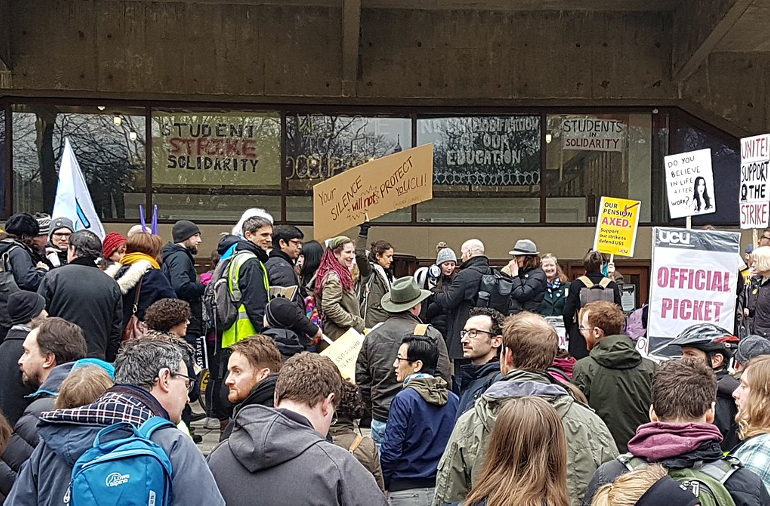
Anger in Athens starts with graffiti and by dawn the calls to battle were daubed across the facades of banks and shops and government buildings. By noon it had morphed into a “resistance movement” as militant leftwingers and striking civil servants – some holding banners, some pounding drums, some shouting themselves hoarse – took to the streets to denounce measures seen as the only way to extract Greece from its worst economic crisis in decades.
“We are at war with the government because it is clearly at war with us,” snapped the former communist MP Dimos Koumbounis. “The working class will respond with ever greater force and intensity to overturn these unjust and antisocial policies.”
Under unprecedented pressure from markets and his EU colleagues, the socialist prime minister George Papandreou said he had no other choice but to implement the “painful but necessary” policies last week. The measures include public sector pay freezes, the raising of the retirement age, slashing of bonuses on salaries and tax rises across the board.
(10 February 2010)
Related at UK Times: A continent looks on nervously as Greek union flexes muscles.


Comments
Welcome to the new Resillience commenting system!
We have moved from the former Disqus commenting system to a new system as of September 10, 2026.
We made this change because of privacy concerns regarding Disqus. It's also part of a set of changes to bring more services to the Resilience community under a single login: commenting, (coming September 2026), and online courses (coming 2027). Unfortunately, your old Disqus comments may not reliably link to your account in this new system. Please contact us if you have any questions or concerns.