 Ted Trainer You may remember recently Ted Trainer’s first draft of his paper “The Transition Towns Movement: its huge significance, and a friendly criticism”, and my subsequent response. Ted subsequently sent some more detailed thoughts, and has since rewritten his piece, which you can download here. Brian Davey of Transition Nottingham responded to Ted’s piece in a beautiful, heartfelt and fiery response, which he has kindly allowed me to share with you, as many of you might find that his key points resonate quite deeply. My thanks to both.
[Rob Hopkins, Transition Culture]
Dear Ted,
Whatever the truth of your message, it will in many cases not be welcome, and will in many ways occasion irritation and rejection. There are specific reasons for this. 40 years ago I was a Trotskyite, and learned from that bizarre experience that the more comprehensively that you demand changes in society the fewer people that you are able to address – this is above all because a very comprehensive and very specific vision of a radical change in society is a much bigger job to achieve and, while a tiny number of people may be prepared to contemplate its alleged ideological necessity, most others, even those with a ideological pre-dispostion to look at it, would reject it out of hand as being such a big agenda, that they wouldn’t even know where to start.
After being a Trotskyite and many things going wrong in my life – some of which were because I bit off huge agendas that were far more than I could chew and drove myself to nervous breakdowns trying to achieve them – I became a development worker. As a development worker it was my job to start from scratch and set things started up at the community level which I did with an environmental project working for and with people with a mental health problems.
At that point I HAD TO GET REAL. Ted, it took me years with others to develop a successful community garden project. When I look at your description of all the things that you say that the Transition Movement must do I want to scream with frustration: are you joking? It is not an ideological objection – because I have a taste for consumer goods and big cars and want to defend consumer capitalism – it is a practical objection – because I and others are already struggling with insufficient time with the very small initiatives that we are making.
We are struggling already – the number of people with the organisational and social entrepreneurial skills to set things up is small. There are lots willing to follow but few willing, or able, to lead – or we have not yet found the way to encourage and help people learn to lead, to learn to organise and to become social/environmental entrepreneurs (not in the profit seeking sense). Probably, mainly, this is because most people are used to working in large organisations and they always assume that one has to start off too big and “build” things like architects and developers – assembling complex organisational structures – rather than develop through “planting things”, then tend them, letting them evolve and grow step by step. (It is also because people have this habit of assuming, if something needs doing, that they must “call on” politicians to do it…..as if….)
What I learned as a development worker was that you have to start small and build things up step by step – sure you may have a long term and comprehensive vision of the type that you put forward – but here and now the Transition Initiatives are conceived of as just that – “transitional” – starting with down on the ground practicalities like learning to garden and learning to mend socks.
I know its not all that you think is necessary to challenge consumer capitalism as a system both practically and ideologically but your vast agenda is way above anything most of us have time for and serves more to discourage than anything else because it tells us all the other things that we have to do and that what we are doing already, in many cases run ragged with voluntary overwork – is still not enough.
It is also, in its flavour one of those “building documents” – it reminds me of my Trotskyite days where a familiar phrase was “Comrades, what we have to understand is the need to…” which translated is “you lot who I have just commandeered into my audience, I understand somethings a lot better than you and these things are this……(lead into a lot of technical *highly meaningful* ideological jargon – the magical formula which the orator knows, just knows, will set the whole world alight….if only his audience will say “hurrah, you’re right, we are right behind you comrade…)
As a matter of fact several of the people who started off Transition Nottingham were anarchists and if you scratch the surface you will find it full of radicals with a starting point ideology not dissimilar to yours – but they are struggling to make the transition from being communicators of grand visions to being practical developers of organisations and practical activities – as I had to. It’s a big difference. They may still have a residual sympathy for that ideological background and I don’t know anyone who defends consumer capitalism – but I don’t know anyone who has time to develop a city wide development co-op either – but I do know some people who I rate very highly are looking to set up a wind turbine where the revenue from which will go to fund energy efficiency work in a poor neighbourhood where the people otherwise would not be able to afford energy efficiency work. I don’t need to tell any of these people about consumer capitalism and what we should be doing…
The main point I would make however is this. Given the lack of time that there is, given the sheer magnitude of the task – a huge work agenda of the “comrades, these are the institutions to replace consumer capitalism that you have to create type” is beside the point – none of us have the time to set about “building” these institutions – unless this happens within a framework where it would happen anyway because it is already built into the operating system of the movement and will evolve out of its later development anyway.
Now I happen to believe that WHEN we have evolved further and WHEN we can therefore set things up which are bigger than sock darning and tree pruning workshops – and when the community gardens become too big to be organised in the old way, there are indeed ways that we can evolve which encourage community level and a certain global solidarity if we try to build these things into the small things that we do now and then build the same principles recursively into the slightly larger things that we subsequently do and then huld the same principles into the larger organisations and networks as we evolve and spread these networks and activities what we are doing onto bigger scales.
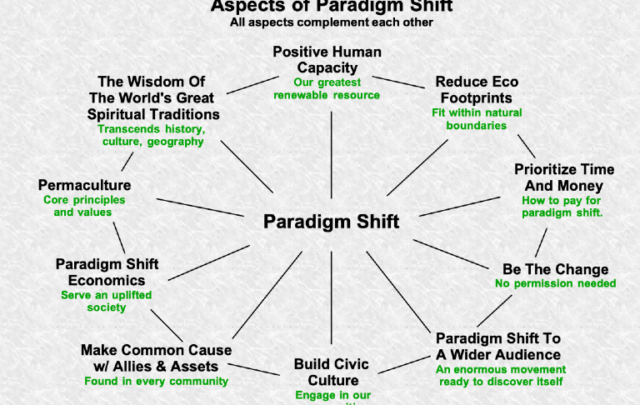
That is to say – instead of specifying the institutions that every non consumer capitalist town must have – we specify the principles that every initiative small and large should try to embody in itself at each scale. In this regard I think you’ll find that most Transition Iniatives are supposed to be informed by Permaculture ethics and principles which include care of the earth, care of people, co-operation not competition, distribution of surplus. If you successfully build those into the Transition Movement then as it evolves it should evolve in the direction that you want anyway….
Well maybe, there is more that can be said here so that these principles can be given an organisational expression when applied at larger scales. The best option for this that I know of, which is not currently or explicitly a set of principles adopted by the Transition Movement, is to use the ideas of viable systems modelling developed by Stafford Beer. These were being successfully applied in Chile before the Chicago boys moved in after Pinochet and they are essentially the same principles employed at the Mondragon co-ops.
Check them out…it may not be the whole answer – but of one thing I am sure, prescriptively trying to design a simple society in advance will not work. Suggesting principles which can be used in each and every initiative during the transition process might work and thus serve to guide the way that the movement evolves might.
With best wishes
Brian