Click on the headline (link) for the full text.
Many more articles are available through the Energy Bulletin homepage
It’s not a Twitter revolution in Iran
Reese Erlich, ZNet
Iran is not undergoing a Twitter Revolution. The term simultaneously mischaracterizes and trivializes the important mass movement developing in Iran.
Here’s how it all began. The Iranian government prohibited foreign reporters from traveling outside Tehran without special permission, and later confined them to their hotel rooms and offices. CNN and other cable networks were particularly desperate to find ways to show the large demonstrations and government repression. So they turned to Internet sites such as Facebook and Twitter in a frantic effort to get information. Since reporters were getting most of their information from Tweets and You Tube video clips, the notion of a “Twitter Revolution” was born.
We reporters love a catch phrase and, Twitter being all a flutter in the west, it seemed to fit. It’s a catchy phrase but highly misleading.
First of all the vast majority of Iranians have no access to Twitter. While reporting in Tehran, I personally didn’t encounter anyone who used it regularly. A relatively small number of young, economically well off Iranians do use Twitter. A larger number have access to the Internet. However, in the beginning, most demonstrations were organized through word of mouth, mobile phone calls and text messaging.
But somehow “Text Messaging Revolution” doesn’t have that modern, sexy ring, especially if you have to type it with your thumbs on a tiny keyboard.
More importantly, by focusing on the latest in Internet communications, cable TV networks intentionally or unintentionally characterize a genuine mass movement as something supported mainly by the Twittering classes.
(28 June 2009)
Hyperlocal Journalism Business Model
RJI News Collaboratory
The goal is to find models (templates) for journalists who want to start sites or blogs to profitably cover local news.
(June 2009)
Articles and comments from journalists who are struggling to find a new direction. Hardcopy newspapers are in decline, and journalists are looking to the web and local newspapers.
Unfortunately they are thinking in terms of a “profitable business model,” rather than in terms of supporting a community. This ignores the basic rule of old fashioned capitalism — if you provide a needed service, chances are you can eventually earn money at it.
I look forward to the day when the Transition Movement meets hyperlocal journalism, and we see flourishing community newspapers again.
For any journalists out there, the parent RJI News Collaboratory site looks like a good one. Its motto is “Entrepeneurial journalists in action.”
– BA
Fibber McGee, Molly, and Your Energy Future
Debbie Cook, The Oil Drum: Campfire
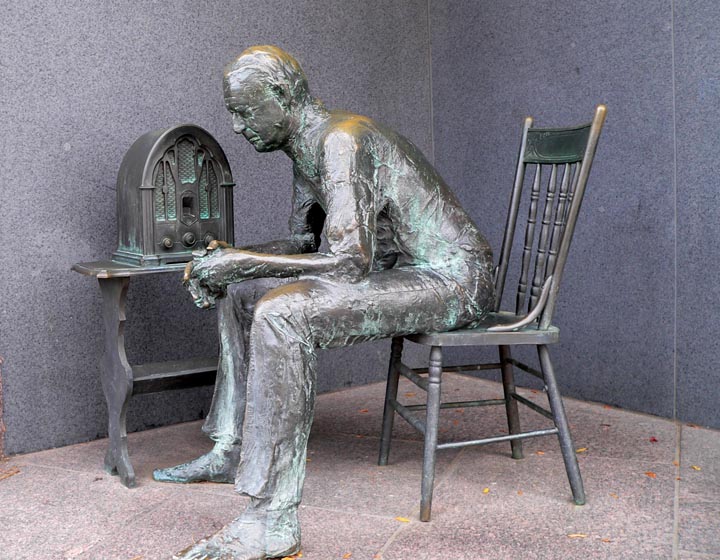
… I love the old time radio programs and keep hundreds on my ipod for long drives or sleepless nights. One of my favorites is Fibber McGee and Molly, a popular 30-minute comedy that entertained America from 1935 to 1956. During the war years, propaganda (I imply no value judgment here) was used by all governments; radio provided a perfect venue for this important component of the war effort. For those of us who did not grow up during that era, the war time radio programs give us a glimpse at the saturation of the messages and also an idea of the efforts that might be enlisted in the future to deal with our energy transition.
From an unlikely source, I found the following episode of Fibber McGee and Molly, entitled Gas Rationing, to cause me to adjust my grasp of my vision of the future. I thought it might make a good Campfire discussion on TOD. There are a number of interesting jumping off points. Here are a few that came to my mind, feel free to suggest your own:
1. Is fuel rationing likely (check out the link to Leon Henderson)
2. How would propaganda play out in a world where media comes in many forms and everyone is a journalist
3. Numerous frames of the issue are presented throughout the program, which are unpersuasive to Fibber until the final one. How might energy transition be framed to get the greatest buy-in.
4. Fibber expresses many of the opinions of the day regarding Government. How similar/dissimilar are ours from those of that era.
I have transcribed the first five minutes of the program below, but I encourage you to listen to the entire program. If nothing else, you are likely to fall in love with Fibber McGee and Molly.
Title: Gas Rationing
Download or listen here: http://www.archive.org/details/FibberMcGeeandMolly1942
Announcer: Mileage rationing has just come to Wistful Vista and in spite of it being a meatless day, get a load of the beef being put up by an average citizen as we meet Fibber McGee and Molly.
FM: I tell ya it ain’t fair Molly. They can’t do this to me. Four gallons a week. Why that’s ridiculous.
Molly: I think so too.
FM: You do?
Molly: Yes, you don’t need four gallons.
FM: Doggone it, I do too. Four gallons is outrageous. Where can I go on four gallons of gas.
Molly: Where do you wanna go, Dearie.
FM: Well gee whiz, what if I did want to go some place…in an emergency or some place.
Molly: You mean like running out of cigars.
FM: Yes….No! Running out of cigars ain’t an emergency.
Debbie Cook is the former Mayor of Huntington Beach and a former congressional candidate. She currently serves as a board member of ASPO-USA and Post Carbon Institute.
(27 June 2009)