Click on the headline (link) for the full text.
Many more articles are available through the Energy Bulletinhomepage
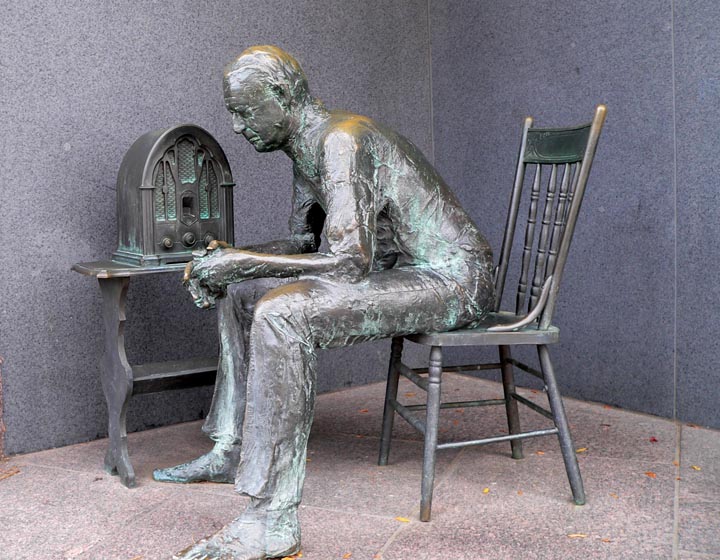
The Pleasures of the Obsolete
Sharon Astyk, Casaubon’s Book
… I come from a family of late technology adopters. We didn’t have a tv a lot of my childhood, but when we did get one, it was a teeny, tiny black and white tv, which was the only option into the middle 1980s. But the thing I remember most from when we converted to color wasn’t this sudden revelation, a la the shift of Dorothy from Kansas to Oz. It was the opposite – you see, when you watch black and white long enough you become adept in the ways of shades of grey – it wasn’t that different. You could figure out roughly what the colors were supposed to be by the light and texture of the film. What really struck me was that when our new color set broke down a few months later, and we brought out the black and white, that I’d lost the ability to translate black and white into color – sure, the color was nice, but it also cost me something.
Perhaps that’s the origin of my taste for obsolete technologies. My husband and I chronic late adopters of technology – my guess is that we’re ten years from our first blu-ray acquisition, if ever. I still don’t have an Ipod, and we just broke down and bought our first cell phone in years – a tracphone with no camera, no internet. I recently replaced our cracked glass topped electric stove with an old style electric burner one, because you can’t can on the glass top stoves. Our one car is nearly twice as old as my oldest child, and even my bicycle can claim the same.
That’s not to say that I can’t see the virtue of some technological improvements – the big revelation this year was that the Chanukah fairy brought me wireless internet, something that until now has been impossible in my little rural hollow, away from any tower. And in many ways that is a huge improvement – I can listen to youtube music while I type and surfing runs a lot faster. On the other hand, I can already tell there’s a price too – I used to surf the web with a book on my lap, reading poetry or essays while I waited for pages to load. I have the odd feeling that I’m going to miss the justaposition of Frank O’Hara and the Oil Drum or John Donne with The Automatic Earth.
(26 December 2008)
Sharon quotes Karl Denninger on how much crap do you really need?.
The ugly truth behind the markets: Not even the experts have a clue
Charles Lewis, National Post (Canada)
… When things were good, there was no end of optimistic advice. Suddenly, though, between market crashes and political turmoil and a massive alleged Ponzi scheme, when most everyone was looking for some explanation about how everything could seemingly unravel so quickly, no one had any real answers. And apparently none of the experts had seen the disaster coming or could say with any certainty what’s coming next.
Thomas Homer-Dixon, a teacher and author whose research has focused on how societies adapt to complex social change, said the bleak truth is no one really knows what is going on.
“The experts with real insight and integrity will simply admit they don’t know what’s happening at this point,” he said. “Whether we’re talking about the global economy or climate or any one of the other challenges we’re facing right now — any kind of prediction is pointless.
“What’s been damaged here is confidence in a really profound way. Every time these experts shift, or jettison some policy that they announced as the sure-fire fix, it gets worse.”
… But it may also be that everything has become so complex that it is beyond any one person or even government to understand all the links, let alone come up with workable solutions. Rome collapsed under the weight of its own complexity but what the ancients faced then was nothing compared to what we going through now, said Prof. Homer-Dixon, who teaches at the University of Waterloo.
(27 December 2008)
Worldwatch: ‘On the verge of an energy revolution’
Ken Ward Jr., West Virginia Gazette
New technologies will move the world economy away from coal and other fossil fuels much more rapidly than experts from the energy industry would have the public believe, according to a new study by the Worldwatch Institute.
Hundreds of old coal-fired power plants that provide 40 percent of the world’s power could be retired in the process, eliminating up to one-third of global carbon dioxide emissions, while creating millions of new jobs, the study asserted.
“We are on the verge of an energy revolution,” said Christopher Flavin, president of Worldwatch and author of the report, “Low-Carbon Energy: A Roadmap,” issued earlier this month.
Worldwatch, a nonprofit that follows environmental and poverty issues, argues that reducing dependence on fossil fuels will not only “strike a defiant blow to the climate crisis,” but also act “as an agent of recovery for an ailing global economy.”
The 49-page report disputes arguments from coal industry advocates who say the world’s energy future must be based mostly on finding ways to capture greenhouse emissions from coal-fired plants and pump those emissions underground.
(28 December 2008)
Original report from Worldwatch:
http://www.worldwatch.org/press/prerelease/EWP178.pdf
A road to revolution? (Greek student/youth demonstrations)
Uri Gordon, Haaretz
… In the first few days of the [Greek student/youth] revolt, bloggers were trying to put together a list of all the solidarity actions taking place, but the task proved impossible: There have been literally hundreds of them; thousands of people have taken to the streets. Last Saturday, a global day of action against police violence saw raucous demonstrations in over 30 cities worldwide.
The corporate press has trotted out various theories to explain the cause of the unrest – frustration with a corrupt government, the global financial crisis, and discontent among Greece’s youth, who face meager prospects of secure employment or welfare rights – the riots being a blind reaction to objective conditions.
But all these explanations are in fact decoys intended to silence and ignore the rebels’ own declared motivations.
… These are no single-issue protests or vague grievances. This is full-blooded revolutionary anarchism.
The mainstream media simply cannot stomach the notion that what is happening in Greece is by now a proactive social revolt against the capitalist system itself and the state institutions that reinforce it. It is time to acknowledge that the Greek anarchist movement has successfully seized the initiative after the killing of one of its own, framing the issues in a way that appeals to a larger – albeit mostly young – public.
Few people realize that the Greek anarchist movement is appreciably the largest in the world, in proportion to its country’s population. It also enjoys wide social support due to its legacy of resistance to the military dictatorship from 1967 to 1974.
… Will the riots in Greece lead to an anti-capitalist revolution? Only if the opening they have torn in the social fabric widens and deepens, involving ever-growing sections of society and creating new grass-roots institutions alongside the destruction of the old. This seems unlikely in the short term, as bureaucratic labor unions and the Communist Party attempt to domesticate the revolt and cut their own political coupon with their demand to disarm the police.
But there is no doubt that a new benchmark has been set for what can be expected in Western countries during the coming era of economic depression and environmental decay.
(26 December 2008)
Also at ZNet
European leaders are watching Greece carefully. -BA