Click on the headline (link) for the full text.
Many more articles are available through the Energy Bulletin homepage
Voters Show Darker Mood Than in 2000
Kevin Sack, New York Times
Whatever their ideological differences this election year, Americans seem able to agree on one thing: the political landscape being crisscrossed by the 2008 candidates is barely recognizable as the one traveled by George W. Bush and Al Gore a mere eight years ago.
Obviously, Sept. 11 and its aftermath have changed the country in countless and irretrievable ways. But even beyond the emergence of war and national security as pre-eminent concerns, there has been a profound reordering of domestic priorities, a darkening of the country’s mood and, in the eyes of many, a fraying of America’s very sense of itself.
While not universal, that tone pervaded dozens of interviews conducted over the last week with Americans of all political stripes in 8 of the 24 states that hold primaries or caucuses on Feb. 5, as well as with historians, elected officials, political strategists and poll takers. As the candidates fan out to New York and California and here to the heartland, they are confronting an electorate that is deeply unsettled about the United States’ place in the world and its ability to control its own destiny.
Since World War II, the assumption of American hegemony has never been much in doubt. That it now is, at least for some people, has given this campaign a sense of urgency that was not always felt in 2000, despite the dramatic outcome of that race.
Several writers and historians remarked on the psychological impact of such a jarring end to the Pax Americana, just as it seemed that victory in the cold war might usher in prolonged prosperity and relative peace (save the occasional mop-up operation). Its confluence with an era of unparalleled technological innovation had only heightened the nation’s sense of post-millennial possibility.
Now, Americans feel a loss of autonomy, in their own lives and in the nation. Their politics are driven by the powerlessness they feel to control their financial well-being, their safety, their environment, their health and the country’s borders. They question whether each generation will continue to ascend the economic ladder. That the political system seems so impotent only deepens their frustration and their insistence on results.
(24 January 2008)
I’m a brilliant scientist and I fear for the world’s fate
Cary Tennis, Salon
Hello, Cary,
I have mastered many advanced scientific and engineering fields and can mostly understand just about every advanced scientific theory or engineering device currently in existence or previously in existence — like how to build an atomic bomb or an IC (integrated circuit) device from basic raw materials, or create a digital camera array, program a computer, build a complete scientific instrument from basic components, interface a computer and other devices. Or knowing the physics of how the sun works, or how to make any glass act just like a plastic metal (my thesis), or why the entropy of the universe requires that black holes, contrary to theory, are not really a one-way sink for the universe.
To better teach myself quantum mechanics, I wrote my own text (which the quantum professor at the university reproduced and gave his later classes). I have also studied a great deal of mathematics, philosophy, economics and history. I devour current events and have done many strange jobs: flown jets, worked in intelligence, and done cutting-edge research at a number of R&D laboratories both private and governmental.
However, I do not understand faith, nor how it is even possible to hold such a strange idea in the mind. I do miss this mind drug and how it would provide a childlike answer about “after” death. But such a lie is just a pointless waste of my time. (Yes, I have read the Bible in detail, and studied all the other great religions.)
Yet, more to the point, I am baffled by how I can deal with “knowing” the real future — we in America are fucked — at least in our way of life: We cannot control the economic slice of the world pie that we have grown accustomed to, and as is all too clear, our future will be hard and poor.
Worse, we are fast approaching peak oil, and our way of life will soon take an even bigger hit. To see the truth of this, look at the cost of food: It is climbing. The cost of oil has rippled through our economy, caused in part by our stupidity in creating ethanol from corn, but that is just the sign of doom — peak oil is our real doom and the world’s, too.
We do not and will not for many years have any way to handle peak oil; I know the technology and there is no answer we can hope for in under 10 years (if we get started now, that is) — my life, yours, that of all middle-class people are doomed to spiral down.
(24 January 2008)
Someone from The Oil Drum? -BA
Public vs. private commitment
Frank Zaski, Gristmill
Frank Zaski is a retired auto executive who has made something of a name for himself by pursuing a campaign to get shopping mall owners to turn down the heat. He put together some interesting thoughts on how to get people to use energy more wisely:
—
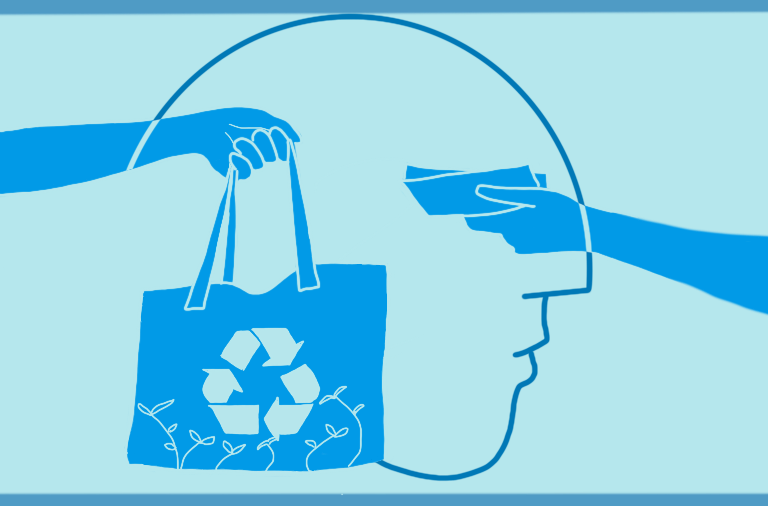
…Research suggests a “private” commitment is not effective, but by going “public,” the commitment can result in real change, become a habit and even help change a person’s self concept. (“Private” commitment is without any public record, follow-up or recognition.)
…Implications (my thoughts):
1. Rather than ask people to make a “private” pledge and leave it at that, ask people to make a “public” pledge by posting their names and commitment on a website.
2. Also, provide a way for people to exhibit their commitment publicly on their own — for example, a sticker or ribbon for their house and/or car. (A bumper sticker could read “I am an energy-conscious citizen.”)
3. Make the initial pledge specific and readily actionable.
4. Ask participants to specify the date they will start fulfilling the commitment.
5. Provide a follow-up program which reminds people of their commitment and provides fulfillment tips, success stories, etc.
6. It takes two to four weeks to form a new habit — it is important for participants to receive a reminder, tips and encouragement during this time.
7. Provide additional web space for recommitment (renew their vows!), bringing in new people, report their achievements, raising their eco efforts to a new level, etc.
8. At a later date, and after the eco habit is formed, research suggests you can ask for an even greater level of commitment.
9. Provide achievement levels to strive for – perhaps similar to Olympic medals – bronze, silver and gold.
(23 January 2008)
Posted by EB contributor JMG. -BA
Peak Oil As Obsessional Neurosis
Peter Goodchild, CounterCurrents
…The value of talking about oil is that it is a fairly tangible issue. Talking about more general matters of systemic collapse, on the other hand, has the tendency to overwhelm the reader – as if peak oil were not overwhelming in itself. Of course, it’s really systemic collapse that matters, and that is why the Club of Rome wrote The Limits to Growth. But that was 1972, and that book still has very few readers.
Systemic collapse means the loss of oil, food, water, metals, and electricity. But these issues in turn lead to more abstract ones, such as the loss of democracy, the loss of freedom of the press, and the loss of educational standards. Not to mention money melting like snowflakes. When the material substructure is rotten, the more fragile matters of civilization also tend to deteriorate.
It would be possible to write an entire book on the psychology of disaster. Fire and flood, earthquake and tornado, explosion and collision, robbery and arrest – our response is always the same. The Irish potato famine, the 1929 stock-market crash, and the rise of Nazism were all received in the same manner: widespread denial, followed by a rather catatonic apathy. But those historical events at least reached an end. The systemic collapse that we are now undergoing has no such end. There will be no return to normal. There may very well be a return to happiness, but there will be no return to “normal.” We will become like the Australian aborigines: naked on the outside, but with a rich interior life. There will be no more television. And that is why it may be obsessional and ultimately self-destructive to be talking about disaster.
It would be more positive, more pro-active, to deal with survival skills, rather than with prophecies of doom. Instead of reading one more article about the fact that food prices are skyrocketing worldwide, it may be healthier to get out the seed catalogs – which are being published at this time of year – and ask oneself: Which corn is better, Iroquois White, Mandan Bride, or Painted Mountain?
It’s strange how little it takes to get into a better mood. Depression isn’t a matter of neurotransmitters, serotonin, endorphin, or any other biochemical that results in a doctor’s prescription for ten-dollar tablets. It’s more a matter of what Abraham Maslow called the hierarchy of needs. The higher needs involve such issues as security, freedom, love, curiosity, and that mysterious thing called self-actualization. Not that Maslow is the final word on psychological matters, of course; perhaps one could do as well reading Tolkien.
(24 January 2008)
UPDATE: Added this item later in the day.
Davos 08: Reasons to be anxious
Julian Glover, Guardian
The conference centre is full of people worrying about all sorts of doom: economic, environmental and political
—
It’s easy to become paranoid at Davos. Perhaps it’s the oddity of working in a windowless bunker, packed with people like Henry Kissinger, guarded by the Swiss army, knowing that somewhere outside there is sunshine, snow and the Swiss Alps.
Everyone here is competitive: there is always the sense that in some other part of town a better meeting, a more exclusive lunch and a celebrity party might be taking place. But this year the unease is deeper. There’s an obvious reason for that: the markets are in trouble and the evidence is on trading screens all over the centre, full of numbers in red.
This town is full of rich people getting poorer.
But there’s a different anxiety too, not just driven by the markets; a sense that the world is on the edge of big changes. The conference centre is full of people worrying about all sorts of doom: economic, environmental and political. Things that not long ago seemed certain are suddenly in question. Here are five to worry about:
1) Does the US dollar matter any more? Oil is traded in it, and the world’s biggest economy still spends it, but the dollar suddenly looks tatty. It’s not just that it has fallen in value – though that has knocked its status. The euro is supplanting it as the global currency of choice. Asia’s big economies could decide its fate. Davos is losing faith in the greenback. What does that mean for the rest of us?
2) Does democracy have a future? …
3) Can climate change be managed? There’s no shortage of climate change optimists here in Davos, lots of high-tech entrepreneurs selling eco-towns and solar panels, and big players from the energy industry promising to change their ways. But no one knows what the US will do after the presidential election, and no one really knows what is going on in China, although I have heard plenty of positive talk today. And if there’s a recession, will expensive long-term schemes to cut carbon emissions be ditched in favour of a short term search for jobs?
4) Is capitalism collapsing? Millionaires make good Marxists, it seems. There are voices here at Davos predicting a crisis of global capitalism. At a lunch today George Soros – the man who broke the Bank of England on Black Wednesday – spoke of the fallibility of markets. He thinks a new global economic sheriff needs to step in to bring the big banks to heel. But would that simply add to the panic?
5) Is there a hidden threat to humanity? What if the world is hit by medical disaster – flu pandemic, for instance?
(23 January 2008)
UPDATE: Added late in the day January 24. Contributor JZB writes:
It’s odd to hear thoughts that I had thought were deeply radical and fringe being thought by the world elite. Not so shocking– they’re smart folks as well as sometimes conformist.