Click on the headline (link) for the full text.
Many more articles are available through the Energy Bulletin homepage
The Interoperation (post-peak science fiction)
Bruce Sterling, MIT Technology Review
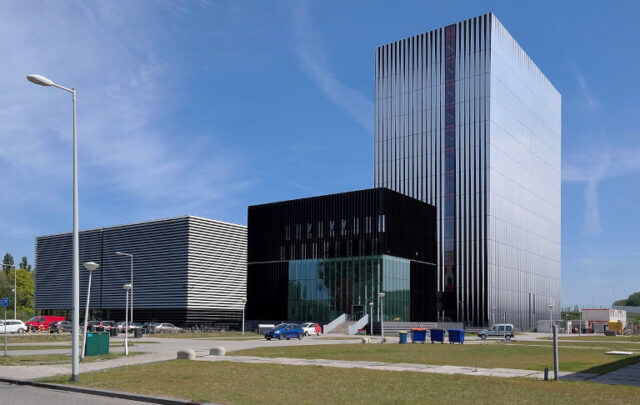
Architecture had given way to software management. So he turned buildings into construction programs.
—
Yuri pulled his sons from school to watch the big robot wreck the motel. His wife had packed a tasty picnic lunch, but 11-year-old Tommy was a hard kid to please. “You said a giant robot would blow that place up,” Tommy said. “No, son, I told you a robot would ‘take it down,'” said Yuri. “Go shoot some pictures for your mom.” Tommy swung his little camera, hopped his bamboo bike, and took off. Yuri patiently pushed his younger son’s smaller bike across the sunlit tarmac. Nick, age seven, was learning to ride. His mother had dressed him for the ordeal, so Nick’s head, knees, feet, fists, and elbows were all lavishly padded with brightly colored foam. Nick had the lumpy plastic look of a Japanese action figure.
Under the crystalline spring sky, the robot towered over the Costa Vista Motel like the piston-legged skeleton of a monster printer. The urban recycler had already briskly stripped off the motel’s roof. Using a dainty attachment, it remorselessly nibbled up bricks.
The Costa Vista Motel was the first, last, and only building that Yuri Lozano had created as a certified, practicing architect. It had been “designed for disassembly,” way back in 2020. So today, some 26 years later, Yuri had hired the giant deconstruction-bot to fully reclaim the motel’s materials: the bricks, the solar shingles, the electrical fixtures, the metal plumbing. The structure was being defabricated, with a mindless precision, right down to its last, least, humble hinges
(November/December 2007)
Laurence Aurbach writes:
“The Interoperation” is a short story by Bruce Sterling, award-winning science fiction author and futurist. Sterling has always been one of the most canny and entertaining prognosticators of architectural futures, and this latest work does not disappoint. “The Interoperation” deftly and fondly sends up starchitecture, obsolescence, digitization, networking and the vagaries of fame. It explores the design process more deeply than his previous fiction. Like most works by Sterling, the story is shambling, episodic and lacking in coherent structure.
While Sterling has in the past been skeptical of Peak Oil and Kunstler’s Long Emergency thesis in particular, note that “The Interoperation” is set firmly in an imagined post-Peak Oil era. Travel is mostly by bike and train; cross country trips are rare; recycling is a pillar of the economy; and sustainability saturates business practices thoroughly.
Big Gav notes:
The story draws from the Cradle to Cradle mindset and Bruce’s vision of what we need to do to implement it – “the internet of things” (and the spimes and blobjects that inhabit it), described in his book “Shaping Things”.
Our science fiction fate
Brian Aldiss, The Guardian
The planet’s dire state makes the imaginative leaps of dystopian SF writers redundant
—
…We have multiplied beyond our means, just as SF always said. No one took much notice. Except, that is, for Gaia. As James Lovelock has said, Gaia stands for Earth with its rocks, seas and atmosphere, together with all living things: Mother Earth. And mothers won’t stand for too much abuse. Mothers can get nasty.
Some years ago, I dubbed SF “hubris clobbered by nemesis”. That is what we’re into right now. The prescription is all too true. Mother is offended. That, indeed, is what the SF movie The Day After Tomorrow vividly expresses. When the waves hit Wall Street, we are all done for.
We fought and did not heed the wounds, we were greedy and did not count the cost. For a while after the second world war, a spirit of optimism prevailed in SF magazines. It was a time of great projects, when rockets reached Mars, or we held what wars were available on Pluto, or we even dreamed of fleets of ships reaching far into the galaxy. It was Vasco da Gama time in the head. The unknown thrived. Hydroponic farms were built on asteroids, beautiful cities were designed to sail in solar orbits, marriages with sexy green-skinned aliens were arranged. All was stimulating and hopeful. But then the future went the other way – a duller, yet more dangerous way. The cold war began to blow instead. The lights went out in Cybernetics City.
Here is today, 2007, with its diseased ideas of drugs, Darfur disputes and suicide bombers. The truth is that we are at last living in an SF scenario. Little wonder the tiger is almost extinct, the polar bear doomed. How do you think the algae feel, in the great wastes of warming ocean? Can you not hear the ecosystems crashing down? Ideal fodder for SF, one might think. However, one might not if one was brought up on Isaac Asimov and AE van Vogt. SF is not designed for realism but for imagination. Our new and creepy scenario is already in the hands of the scientists, if not MGM.
(19 November 2007)
Brian Aldiss is “a prolific English author of both general fiction and science fiction” who has been writing for over a half century. His latest novel is “Harm.”
rumpeltstiltskin
joshua scott paul, there is a spoon (blog)
Once upon a time, a poor oil and gas producer named loman miller, was out drinking with his Bilderberger buddies. One by one they all got to bragging about their children, and loman, who was so proud of his daughter Jeannie, bragged that his university educated daughter would be a good wife for the president, as she had invented a way to synthesize straw into oil.
One of his friends or enemies told the president, who had Jeannie quietly and efficiently kidnapped on grounds of national security and had her put in a top security facility with all the latest equipment put at her disposal – for her “safety.”
The president came to visit her, “Synthesize this straw in to oil for the good of the nation in 30 days, or you and your father could be abducted by enemies of the state and executed.” The president continued to mock her, “Of course if you succeed I would be happy to ask your father for your hand in marriage,” she was told with a sneer.
First one week passed, then two weeks passed. The third week passed. A few more days flew by, till it was the night before – and still she couldn’t synthesize straw into oil.
From out of nowhere a little man appeared. He looked her up and down and said – ‘what will you give me if I synthesize this straw into oil?’ …
(14 November 2007)
joshua paul is a storyteller in Vancouver, British Columbia.