Click on the headline (link) for the full text.
Many more articles are available through the Energy Bulletin homepage
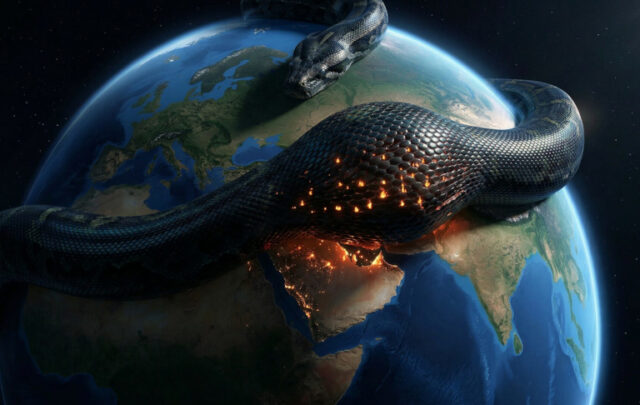
US Army Contemplates Redrawing Middle East Map to Stave Off Looming Global Meltdown
Nafeez Mosaddeq Ahmed, Dissident Voice
In a little-noted article printed in early August in the Armed Forces Journal, a monthly magazine for officers and leaders in the United States military community, early retired Major Ralph Peters sets out the latest ideas in current US strategic thinking. And they are extremely disturbing.
Maj. Peters, formerly assigned to the Office of the Deputy Chief of Staff for Intelligence where he was responsible for future warfare, candidly outlines how the map of the Middle East should be fundamentally re-drawn, in a new imperial endeavor designed to correct past errors. “Without such major boundary revisions, we shall never see a more peaceful Middle East,” he observes, but then adds wryly: “Oh, and one other dirty little secret from 5,000 years of history: Ethnic cleansing works.” ..
Ahmed goes on to cite an un-named American source saying, “Western policymakers are in no doubt that the world faces the imminent convergence of multiple global crises.”, naming them as peak oil, climate change, and global banking collapse.
(1 Sept 2006)
An overview of the military literature on peak oil by Sohbet Karbuz can be found here.
Chavez’s whistle-stop world tour
BBC
In the course of the past six weeks, Venezuela’s left-wing President Hugo Chavez has been on a dizzying round of travel, taking in a dozen countries. His interest in international players like Russia and China may seem obvious, but Mr Chavez also found time to call in on minnows like Benin and Angola. We asked Larry Birns, director of the Washington-based think-tank Council on Hemispheric Affairs (COHA), to assess his itinerary.
(1 Sept 2006)
Straight-from-DowningSt/WhiteHouse spin on Chavez’s travels over the past six weeks, to the Mercosur conference in Argentina, and to Belarus, Russia, Qatar, Iran, Vietnam, Mali, Benin, Cuba, China, Malaysia, Syria, and Angola.
Pakistan to develop coal as gas pipelines stall
Khaleeq Kiani, The Dawn (Pakistan)
ISLAMABAD, Sept 1: The government has decided to develop the Thar coal for power generation on a priority basis to overcome energy crisis following confirmed estimates that its reserves were equivalent to at least 850 trillion cubic feet (TCF) of gas — about 30 times higher than Pakistan’s proven gas reserves of 28 TCF.
“By using only two per cent of the existing coal reserves, we can generate around 20,000 megawatts for almost 40 years,” deputy chairman of the Planning Commission Dr Akram Sheikh told Dawn after presiding over a meeting on energy security. Coal mining in Thar requires a phased investment of $4 billion. ..
Another senior official said the decision to accord top priority to coal was taken because there was no tangible or bankable progress on three proposed gas import pipelines. ..
(1 Sept 2006)