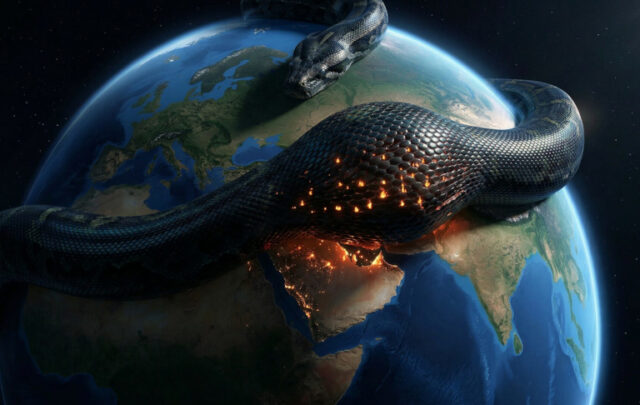
Peak oil is a term for the point in time when world oil production will stop increasing and begin to decline. New reports are coming in from many quarters telling us that this moment is arriving much sooner than expected. The news is alarming; but if it is true, we should be thankful.
Contemplating the end of oil is frightening, even terrifying. Every bit of our economy depends on cheap oil to function properly. No viable substitute lies waiting the wings. The end of oil means a radical change in our way of life. But the truth is that oil has been sowing the seeds of our destruction and the sooner we give it up, the better.
If the peak comes soon we can be thankful because more oil would just dig us deeper into the climate change hole. Climate change appears to be accelerating more rapidly than predicted. We can live without oil and coal. We cannot live without a habitable climate. The worst-case scenarios for climate change involve dying, acid oceans and an atmosphere full of methane. The not-so-bad scenarios could still wipe out agriculture over large regions and drown every coastal city.
We are like the addict who would have died of an overdose if he hadn’t run out of smack first, so let’s be thankful that our supply is being cut off.
We can also be thankful that our human population has not grown any larger before we have to deal with the post-oil transition. When my parents were born, in the 1920s, world population was about 2 billion people. By the time I came of age it had more than doubled, and it is now nearing 6.5 billion.
We cannot feed these billions without diesel-powered farm machinery and fertilizer produced from oil and gas. In the future, population will contract. There will be either a higher death rate from starvation and disease or there will be a lower birth rate from conscientiously applied birth control. There may be both, and our best hope for relieving suffering will be to tilt the balance as far as possible to a lower birth rate.
If peak oil was not to be reached until 2050, say, human population would have ballooned to 9 or 10 billion. The chances of contracting to a sustainable population without massive human die-off would have been nil.
Another thing to give thanks for is our elders. We still have people among us who remember how to pluck a chicken, sew a dress, build a pole barn and produce any number of things that most of us would just go buy at Wal-Mart. I’m confident that there is still a large reservoir of practical common sense in the American population. It will just take a new, post-oil reality to encourage us to ask our elders for help.
In America, we have nearly lost a generation to consumerism. Too many of us work without producing anything. Our labor goes to grease the wheels of commerce and globalization that break the backs of workers overseas and float an endless train of goods to us on an ocean of oil.
We Americans have become like plants basking in our own oil sun: “Consider the lilies of the field, how they grow; they toil not, neither do they spin.”
Plants and photosynthesizing algae are the only life forms that don’t need to compete for energy. Because they get their energy directly from the sun, they only compete with other plants for space to unfurl their leaves and soak up the endless radiant power of our star. This is how we have been in America, competing for space to build bigger and bigger houses to hold all of our oil-soaked bounty.
Living as plants has not been healthy for us. We are junk-food-consuming couch potatoes entertained by mass media living in exurbs with no sense of community. We are alienated, and we turn to pharmaceuticals to relieve our depression and anxiety. Our bodies are loaded with a thousand different manufactured chemicals soaked up from the goods we buy. We are dying of cancer.
But ultimately we are not plants, and our oil sun is about to burn out. We will return to our animal existence and remember how to make hay when the sun shines and abandon the idea that we could just buy a hundred thousand BTU gas heater to make the hay sometime when it’s more convenient for us.
The final thing I am thankful for is just to be here, participating in this moment. It is an amazing planet that we live on. She wastes nothing; everything is recycled and turned into new life. Oil itself is an example of the Earth’s awesome power.
Colin Campbell is a petroleum geologist who has worked for governments and major oil companies. He predicts that we will start seriously sliding down the oil production curve in 2010. Here is his explanation of how oil was formed:
“Advances in geochemistry over the past twenty years have made it possible to relate the oil in a well with the source-rock from which it came…. In fact, the bulk of the world’s oil comes from only a few epochs of extreme global warming, which caused the proliferation of algae, effectively poisoning seas and lakes. The resulting organic material was preserved in favourable plate-tectonic settings. Thus, most of the oil from the United States to northern South America, including the vast degraded deposits of Venezuela, comes from a few hundred meters of clay, deposited 90 million years ago. Another such event, 140 million years ago, is responsible for most of the oil in the North Sea, the Middle East, and parts of Russia.”
Our oil was produced during previous episodes of global warming. Now that we have released it into the atmosphere, it is warming the planet and creating the conditions for new algal growth that could be again trapped as oil.
Researchers at the University of New Hampshire and elsewhere are growing oil-rich algae in shallow ponds and turning it into biodiesel. Growing algae in ponds fed by sewage or other kinds of waste could produce a significant amount of biodiesel.
Perhaps we will be smart enough to take a basket of technologies that include this kind of biodiesel along with photovoltaics, wind power and ocean energy and build ourselves a new energy infrastructure that we can base a new kind of civilization on. It won’t be easy, and it won’t replace oil. We will have to conserve and cut back as well.
Perhaps we will also be smart enough to refrain from burning up all of the coal we can dig out of the ground and to keep our hands off the methane hydrates now locked up in various places along the continental shelves. Going after every last hydrocarbon to fuel our wasteful vegetative ways would do untold damage to our future prospects on the planet. Above all, I am thankful that there is still time to avoid the worst.
Kelpie Wilson is the environment editor for truthout.org. Her first novel, Primal Tears, has been published by North Atlantic Books.