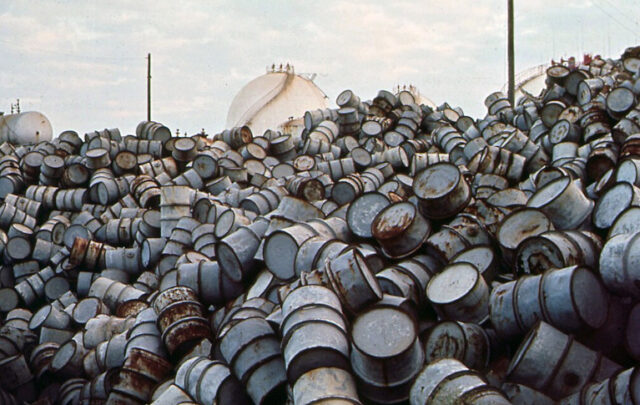
John D. Rockefeller’s Cleveland refineries launched the Oil Age.
A superhighway in China may end it.
Almost 150 years ago, barges plied the Cuyahoga River ferrying black gold for oil lamps. There was no turning back. Cheap, plentiful crude would power cars, mold plastics, birth the suburbs and grease the path to a prosperous American century.
Much of today’s world slides along that same industrialized path. A 52,000-mile superhighway system is under construction in China. Millions of prospering Chinese browse auto showrooms looking for a new lifestyle based on crude.
But recent spikes at gas pumps worldwide hint that, for the first time, oil won’t come cheap. Analysts and traders alike suspect we are on the verge of demanding more oil than we can produce.
Prices hover around $50 per barrel despite a global effort to pump more oil. Producers try to squeeze more out of old wells, scour the Earth for undiscovered fields and develop technologies to process thick heavy crude that’s harder to refine.
Tight oil supplies are likely to spark fantastic technological development in a global struggle for energy supremacy. Scientists are developing hydrogen-powered cars, coal-made gasoline and corn-based plastics. Engineers try to harness the 200-million-degree fires of nuclear fusion for future power plants.
Will these high-tech solutions come in time?
How will we cope when gas prices permanently zoom beyond $2.50 a gallon? When food costs rise because of expensive fertilizer and diesel? When plastics become precious?
When the time comes, will we be ready to live with less oil?
“The sky is not falling, but it is coming closer,” said James Halloran, energy analyst with National City Private Client Group in Cleveland.
“The next generation is going to have to deal with more expensive energy,” he said.
Here and in Europe, a cottage industry has sprung up forecasting imminent oil shortages that will disrupt modern society.
U.S. oil production began an irreversible decline 30 years ago as older wells began to play out and most of the easily accessible fields had already been tapped. Analysts predict oil production in other nations outside of the Organization of Petroleum Exporting Countries will begin a similar decline this decade.
Non-OPEC fields will still contain plenty of oil, the theory goes. But what’s left will be harder to reach and more expensive to refine.
That would hand over price control to Saudi Arabia, Iran and other politically unstable OPEC members.
Many analysts also predict that OPEC production will peak before 2020 – though OPEC ministers hotly deny it.
But under either prediction, as supply dwindles, prices will climb.
Those are the worst-case scenarios. The immediate and more realistic problem is volatile prices.
Oil demand is surging and no one is certain whether producers, including OPEC, can keep up.
Reserve capacity – the ability to pump extra oil as a cushion against a crisis – is estimated today at just 1 percent to 1. 5 percent of total production. The old industry standard was about 4 percent.
Demand typically increases by about 2 percent a year, according to government agencies and most analysts. At the same time, production at the world’s oil and gas fields is declining 4 percent to 6 percent a year, Stuart McGill, senior vice president at ExxonMobil, told analysts earlier this year.
That decline means that, just to stay even, in 15 years the world must find as much new oil as it is pumping now.
The United States has continued to chug oil at a record-setting pace, devouring a quarter of the world’s production. But the rapid industrialization of what was once the developing world – particularly China and India – has exacerbated our problem and driven up prices of all fuels, from oil to natural gas to coal.
The “7918 Network” is Asia’s future oil epicenter.
That’s the name of China’s massive highway project that will connect nearly 250 cities – all with populations of more than 200,000.
When completed, 33 highways will crisscross the countryside providing 1 billion people access to easy travel.
The Chinese are ready to drive: A record 250,000 automobiles were purchased in April, according to the China Automobile Manufacturers Association. That’s paltry compared with the more than 1.2 million sold in the United States every month, yet it is symbolic of a new, prospering economy with more than 1.3 billion people.
This development means greater demand for oil. Twenty years ago, China used about 2 million barrels a day. In 2003, China consumed 6 million barrels, an 11.5 percent jump over 2002, according to the widely respected BP Statistical Review of World Energy.
Consumption reached 6.5 million barrels per day by the end of last year, according to the Paris-based International Energy Administration.
Estimates for 2005 vary but the annual rate of growth, while less than in the past, is expected to stay ahead of the global 2 percent average.
India, another growing Asian industrial power, uses less oil than China: 2 million barrels a day. But India’s consumption will grow faster than China’s, said Henry Groppe, a senior analyst at Groppe, Long & Littell in Houston.
So why – if there is such an impending crisis – have gasoline prices dropped in recent weeks?
The average price of a gallon of regular gasoline in Greater Cleveland on Friday was just under $2.04, down 26 cents from the $2.30 record set on April 8, according to AAA.
Refineries have been running hard to prepare for summer driving. But demand has slackened in the face of higher pump prices, explained National City’s Halloran.
The combination of increased production and the dip in demand has created larger stockpiles, he said.
“You will get the inevitable conservation,” Halloran said. “Not a lot, but enough to make a difference. A 2 percent reduction in demand can move prices dramatically.”
Despite the increased demand, many experts don’t believe oil is close to running out. They debate whether the latest price peaks are a fundamental change or a cyclical high.
At the least, they caution against calling the situation a crisis.
High prices and high technology have meant new exploration.
%%bodybegin%% Now that oil prices have started to steadily rise, companies have an incentive to drill more and pursue oil reservoirs that are harder – and more expensive – to explore.
Old pumping methods meant producers abandoned wells that often had more than 60 percent of their oil left. New methods use steam to loosen up heavier oil. And innovative horizontal drilling techniques can tap into previously unreachable oil resources.
Houston-based Anadarko Petroleum Corp.’s robotic equipment plunges up to 8,000 feet to the sea floor of the Gulf of Mexico to drill 30,000-foot-deep oil and gas wells. Computerized three-dimensional seismic imaging makes finding oil pockets more likely and helps minimize some of the financial risk.
“I liken it to the space program – cutting-edge technologies, a number of diverse disciplines, and tremendous investments before you actually see a drop of oil or molecule of gas,” said Stuart Strife, Anadarko’s exploration manager for the Gulf of Mexico.
Once reserves are found, it takes seven to 12 years to finally produce the oil, Strife said, at a cost of between $660 million and $1.82 billion.
Oil and gas rig counts across the nation are up from a year ago, according to Baker Hughes Inc. of Houston.
In Ohio, applications for drilling permits this year are up dramatically – 28 percent – creating a critical shortage of drilling rigs, said Tom Stewart, executive director of the Ohio Oil and Gas Association.
Small gas-drilling companies are boring 3,000-foot wells in places like Gates Mills and Hudson to capitalize on prices that have tripled in three years.
Energy companies work the remote Canadian Alberta tar sands, thought to hold as much oil and gas as Saudi Arabia but harder and more expensive to refine. Venezuela also has vast reserves of heavy-oil deposits that will require special refining.
The problem isn’t limited to oil.
American natural gas supplies are strained. Homes and businesses face oil-like quandaries when it comes to heating buildings.
By 2020, the U.S. Department of Energy wants the American home to produce most of its own energy with solar panels and to cut consumption through conservation and better insulation.
There are scores of products to help decrease home energy bills: tankless water heaters, high-efficiency furnaces, foam insulation and high-efficiency e-glass.
The department’s goal is 15 years away for a reason. Power companies resist plugging solar panels into their electrical networks. Even seasoned homebuilders are just starting to use energy-saving technologies.
Businesses wanting to embrace conservation do so only with the help of state subsidies. For example, Whole Foods has put solar panels in a handful of its grocery stores backed by state incentives in New Jersey, Rhode Island and California. It saves 8 percent to 25 percent a year on the stores’ energy bills. Because of the cost, it will take a Whole Foods store five years to make back its investment even with the subsidies, said John Jurey, who sits on the company’s National Green Mission Task Force.
Policymakers also debate when and how aggressively to respond to an impending oil crisis. Congress is struggling to pass an energy bill, and President Bush has tried to pressure, without success, Saudi Arabia and other OPEC nations to cap the price of oil.
In Washington, the perennial congressional battle over drilling in the Arctic, in the Rockies or offshore plays out against the backdrop of a new voice from the right — hawks for conservation. The president recently called for the construction of refineries on old military bases, more drilling for gas and oil on lands previously off limits, and for making it easier for utilities to build additional nuclear power plants. No matter what policy emerges, it’s almost certain there will be no new Rockefellers.
Oil has been so dominant for so long that to replace it, even partially, will take multiple sources of energy.
“The end of the stone age didn’t mean the end of stones,” quips Paul Portney, president of Resources for the Future, a nonpartisan energy think tank in Washington, D.C. “The end of the oil age won’t mean we’ll run out of oil.”
Instead, Portney predicts that what oil is left will become so expensive that Americans will be pushed into alternative fuels, like corn-based ethanol, or into fuelefficient cars that run on hydrogen or are electric-gas hybrids. Ohio’s lagging coal industry could get a renewed boost from the hunt for gas alternatives. The Department of Defense is experimenting along with the state on gasification, a process that takes coal and converts it to a liquid fuel that can be added to diesel, jet fuel and regular gasoline. Eight Midwestern and Appalachian states, including Ohio, together hold more oil in coal and shale than the Middle East, according to Ted Barna, assistant deputy undersecretary of defense. Efforts to engineer our way out of the situation could take decades. Some ethanol production methods require more energy than they get back. Even the task of replacing the nation’s 200 million cars with hybrids would take years.
Turning to other fuels such as coal for transportation does not offer an immediate solution. Such fuels couldn’t meet demand the way oil does. Plus, they are extremely expensive.
Ohio tested coal-based gas in the 1980s. But the state gave up, said Jackie Bird, director of the Ohio Coal Development Office. “Technologically, it worked,” Bird said. “Economically, it did not.”
It turns out the solution and the problem are the same.
If gas prices climb, governments are more likely to pay for alternative-fuels research. Business, too, will chase expensive energy like the oil in Alberta and in the deep waters of the Gulf of Mexico.
Working against this are the government and consumers. They want to keep gas prices low. When a gallon of gas drops below $2, fuel is too cheap to make exploration for new wells or the sale of fuel-cell cars economically attractive. People stop clamoring for alternatives.
“There is only one real appeal to the American public: price,” said Charles T. Maxwell, senior energy analyst at Weeden & Co. in Greenwich, Conn. Groppe, the veteran petroleum and chemical consultant, agreed. “Depletion is real,” Groppe said. “World oil production is peaking. The question is: What price level will be required to slow consumption?” Portney, of Resources for the Future, doesn’t want to wait for a price rise to push people toward new fuels. He favors a shove.
Portney would like the United States to pass a gradually increasing tax on fuel that would force Americans to abandon our gas-guzzling cars, cut down our oil use and move us toward alternatives. “I think [higher gas prices] are an unpleasant and uncomfortable new economic reality,” he said.
But Maxwell said we already have gone beyond unpleasant. The United States is facing a “crisis price.”
“It’s like Social Security,” he said. “If nothing is done, there will be a crisis [in Social Security] in 20 years. But, eventually, the 20 years is up.
“This is different,” Maxwell said. “When you talk about a supply and demand in balance in ’05 and then it’s slightly off in ’06 or ’07, we are talking about a crisis that is much closer at hand.”
To reach these Plain Dealer reporters: [email protected], 216-999-4169 [email protected], 216-999-4138
© 2005 The Plain Dealer
© 2005 cleveland.com All Rights Reserved.