

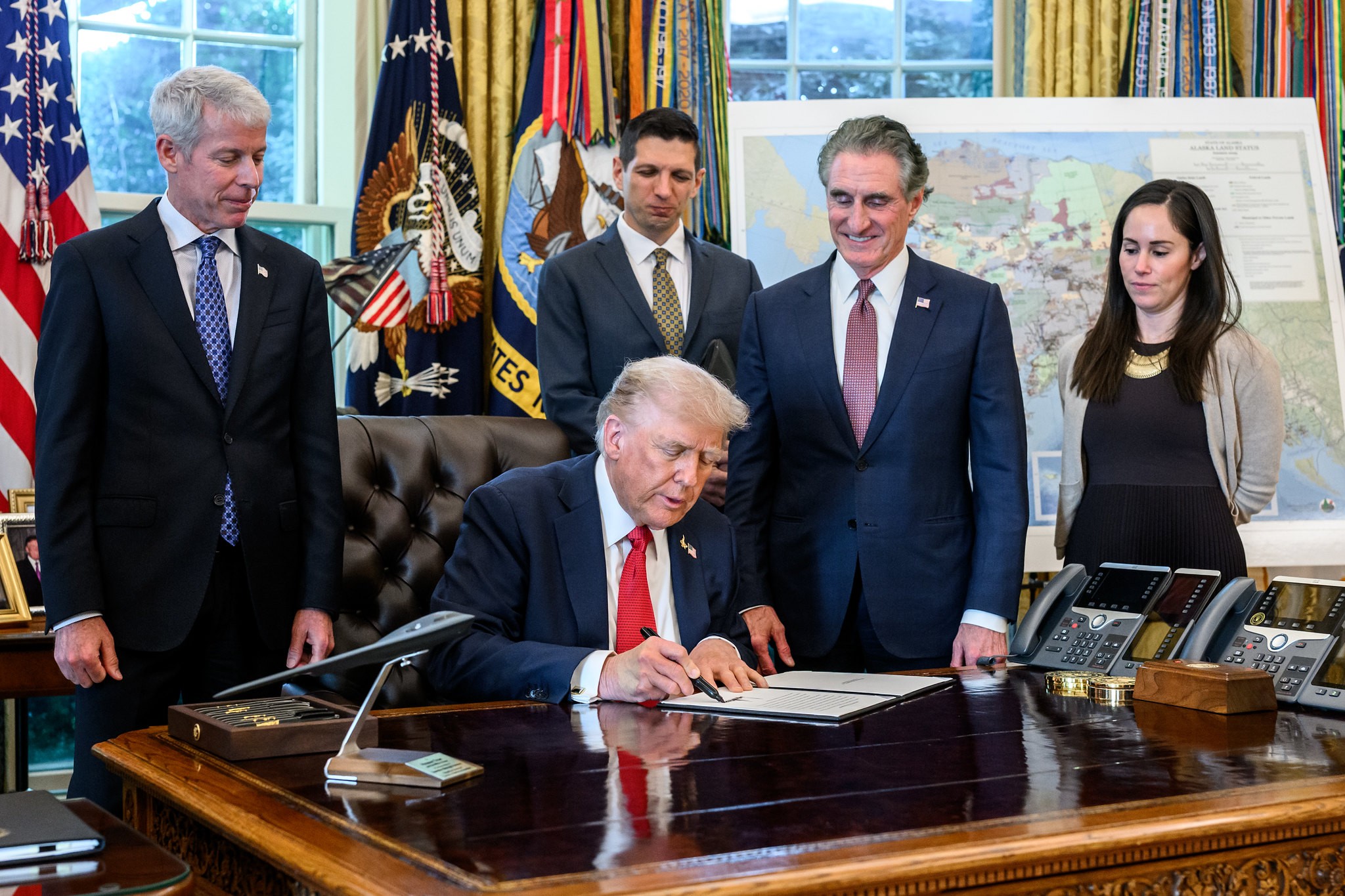
President Trump has finally found a national monument he believes deserves protection for all eternity. It has four rooms, a great deal of gold trim, and a very convenient commute. He works there.
On November 5, Trump signed a presidential proclamation establishing the Oval Office National Monument, invoking the same 120-year-old conservation law presidents have used to protect some of America’s greatest natural and historic treasures.
This came barely four months after Trump used that very law to strip national monument protections from nearly three million acres of Bears Ears and Grand Staircase-Escalante in Utah.
The ancient archaeological sites, sacred Indigenous places, dinosaur fossils, and magnificent geological formations of the American West could do without protection, according to Trump. His office, however, warranted a presidential proclamation and a new management plan from the Department of the Interior.
At last, a conservation victory from the Trump administration.
A Peculiar Anniversary
On November 5, 1902, President Theodore Roosevelt reported for his first day of work in the newly constructed West Wing of the White House.
Exactly 124 years later, to the day, Donald Trump declared the Oval Office a national monument.
The date invites a comparison that does Trump no favors.
Roosevelt had commissioned the new executive offices because the White House residence was becoming impossibly crowded. With six children running around upstairs and a growing presidential staff conducting business in the same building, something had to give.
Congress appropriated $65,000 for a modest, one-story office building. Roosevelt considered it temporary, a practical arrangement that could eventually be removed when no longer needed.
The first Oval Office wouldn’t appear until 1909, when President William Howard Taft expanded the West Wing. Franklin Roosevelt moved it to its present location in 1934.
Trump’s new monument encompasses the Oval Office, the adjoining Outer Oval Office rooms, and the Cabinet Room. Interior Secretary Doug Burgum, through the National Park Service, must now develop a management plan protecting their historic character and requiring reviews before substantial alterations or demolition.
The White House, of course, has been a National Historic Landmark since 1960, and its grounds are already administered by the National Park Service. Trump’s proclamation acknowledges these existing protections before declaring that additional ones are necessary.
At the signing ceremony, Trump announced that his action would make the rooms a “landmark for the ages.”
He even invited those present to contact him after his presidency if some future occupant attempted to knock down the walls. He promised to return and prevent such vandalism, regardless of where he might be.
A touching commitment to historic preservation from a man who recently demolished the entire East Wing of the White House to make room for his enormous 90,000-square-foot ballroom.
And there’s another historical detail worth knowing.
The East Wing Trump demolished was originally built under Theodore Roosevelt in 1902, the same year as the West Wing he’s now protecting. Franklin Roosevelt substantially expanded it in 1942.
One wing gets the wrecking ball. The other gets a national monument.
Trump’s proclamation also explicitly preserves the president’s authority to redecorate the rooms and select their furnishings.
Heaven forbid the Antiquities Act should interfere with the gold trim.
The Arc de Trump
Trump’s architectural ambitions extend well beyond the White House.
On the same day he designated his office a national monument, the National Capital Planning Commission voted 8-4 to approve his proposed 250-foot triumphal arch near Arlington National Cemetery.
The colossal structure, widely dubbed the Arc de Trump, would stand more than 80 feet taller than the Arc de Triomphe in Paris, crowned with enormous golden statuary and an eternal flame.
Napoleon had Austerlitz. Trump has a traffic circle.
A federal judge temporarily blocked construction, questioning whether the administration had any authority to build the gargantuan thing without Congress.
Between the White House ballroom, the triumphal arch, and now the Oval Office National Monument, our president has developed a taste for the sort of architectural extravagance favored by emperors and pharaohs.
George Washington never commissioned an obelisk to himself. Abraham Lincoln never ordered a temple built in his honor. Americans erected those monuments afterward, in recognition of the lives those men had led and the service they had rendered.
Trump, unwilling to leave the matter to history, has decided to get a head start.
Our presidents are elected to serve the Republic. Building shrines to themselves at public expense is a tradition better left to the world’s dictators and assorted megalomaniacs.
And the particular law Trump has chosen to accomplish his latest act of self-glorification makes the whole affair considerably worse.
What Roosevelt Actually Intended
Four years after moving into his temporary West Wing offices, Theodore Roosevelt signed the Antiquities Act of 1906, giving presidents the authority to protect America’s irreplaceable natural and cultural treasures.
His first designation was Devils Tower in Wyoming, a towering geological formation sacred to numerous Indigenous peoples.
Over the next three years, Roosevelt established 18 national monuments, including Grand Canyon, Olympic, Muir Woods, Chaco Canyon, and the Petrified Forest.
He was protecting places threatened by commercial exploitation, vandalism, and the greed of men who couldn’t look at an extraordinary landscape without wondering how much money they could make from destroying it.
Roosevelt knew the type.
Writing about conservation, he warned that the nation’s duty to future generations required restraining an “unprincipled present-day minority” from squandering their inheritance.
He understood that the government had an obligation to protect America’s natural treasures from the very people who stood to profit most from their destruction.
Roosevelt was hardly modest. He possessed an ego of positively presidential proportions and wasn’t shy about exercising his considerable power. But his conservation achievements rested on an understanding that the nation’s natural inheritance belonged to the American people, including generations yet unborn.
And he knew that once some things were destroyed, no amount of money or political power could bring them back.
Trump has spent years making a mockery of that principle.
In July, he reduced Bears Ears National Monument from approximately 1.36 million acres to 121,100 acres. Grand Staircase-Escalante was cut from 1.87 million acres to just 181,500 acres.
Together, those reductions stripped monument protections from approximately 91 percent of the lands previously within their boundaries.
The White House called it “rightsizing.”
Bears Ears contains thousands of archaeological sites, ancient cliff dwellings, and places of profound religious importance to Native American tribes. Grand Staircase-Escalante is among the world’s great paleontological treasure troves, containing fossils that have fundamentally changed our understanding of prehistoric life.
Three million acres of irreplaceable American heritage, sacrificed to satisfy the demands of politicians and extractive interests who have spent decades trying to get their hands on these lands.
And the man responsible has decided his office requires extraordinary federal protection.
The legal contradiction is almost as ridiculous as the spectacle itself. Trump has repeatedly asserted that presidents possess the authority to reduce national monuments established by their predecessors. Yet he now insists that his own monument will be beyond the reach of future presidents.
By his own reasoning, the next president could simply undo the whole thing.
Meanwhile, across Washington, Trump continues building his monuments, decorating his offices, and pursuing the sort of personal glorification that our founders rather deliberately sought to discourage.
He has invoked Roosevelt’s conservation law to strip protections from ancient landscapes that have endured for millennia, then invoked that same law to preserve the room where he signs the orders.
Theodore Roosevelt considered his office temporary and America’s natural treasures worth preserving forever. Donald Trump is doing everything in his power to reverse that arrangement.



Comments