

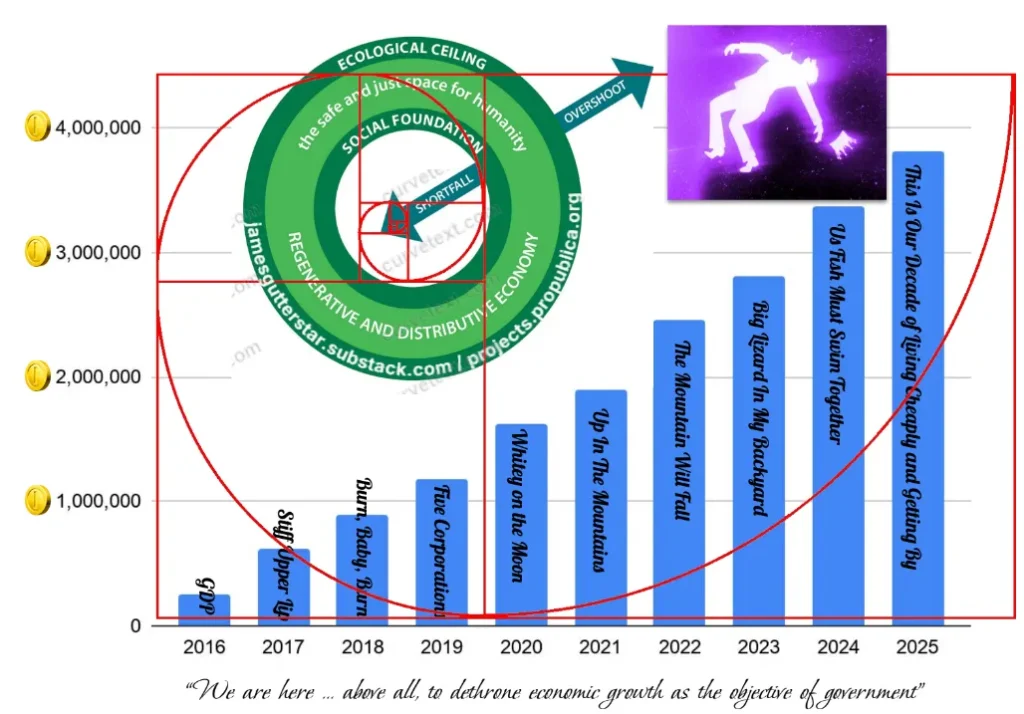
I’m no visual artist. Generally, I’d write a scathing firestorm about the entity or issue in question that would be read by small numbers of lucky and sympathetic supporters. But to move forward, you’ve got to step outside sometimes. While making this (see below), I thought it was a hideous piece of artwork to represent a hideous economy. But I kind of like it now. It’s jank-filled, but effort-filled too. You don’t always have to bleed at the typewriter to get it out. Even if the typewriter’s still fundamental. The concept of Cultural Degrowth has loomed large in my imagination in recent years, and this is an attempt to develop it, I suppose. It’s not a solidified idea, and it’s not about advocating for a reduction in culture as a whole. But it does feel like an underdeveloped field of discussion.
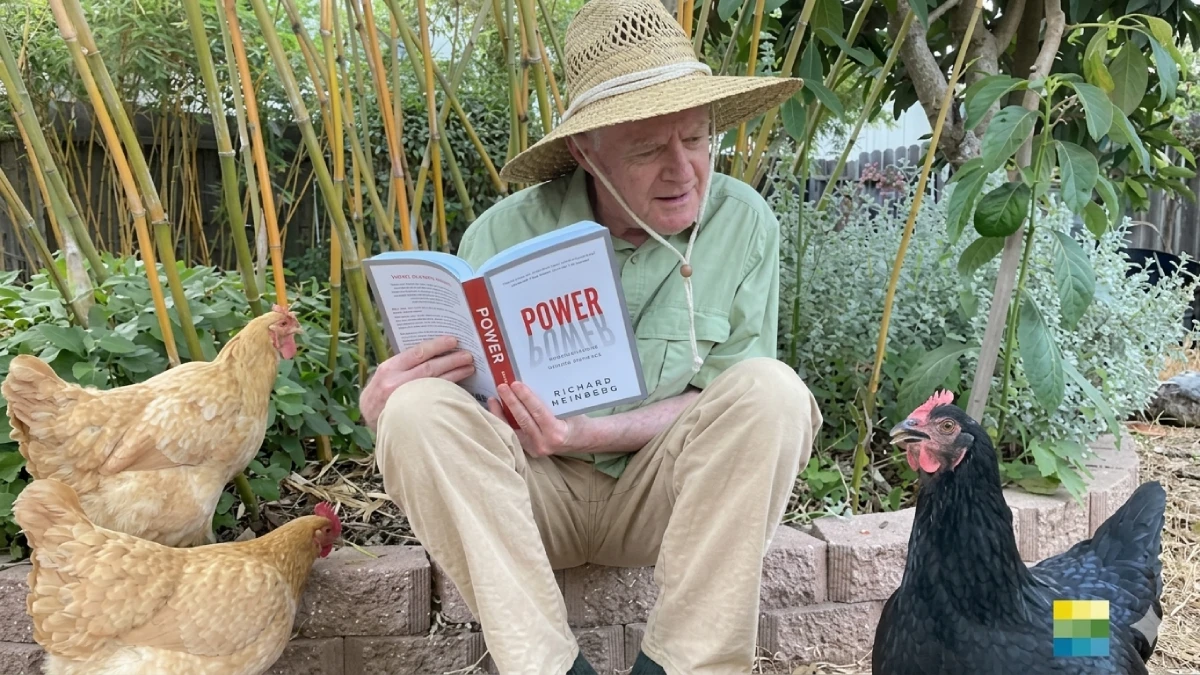
Someone that I often kept in mind when thinking about these things was Richard Heinberg. I think I first learned of Richard when he appeared in the 2004 documentary The End of Suburbia. When discussing the distant global peak in oilfield discoveries, he said: “I remember 1964, that’s when The Beatles appeared on Ed Sullivan Show – so that was a long time ago.” It would be many years later than that – 2021 – when I first spoke with him, while I was producing the CASSE podcast The Steady Stater.
To the best of my knowledge, Richard had little to no higher education. I have a bachelor’s, so his self-built career was always an inspiration to me (though I’m sure he’d be quick to point out all the co-operative work that helped him along the way). The seeming lack of avenues into the more academic spaces I might want to work in partly drove me to dig deeper into what I do know: music. Richard also clearly had a great love for it and believed it was an essential tool for the anti-collapse coalition, championing music and art creation in his writing alongside all the talk of entropy, economics and empires.
In the last of his MuseLetters published before his death (#399 – the aesthetically titled #400: “As America turns 250, its attention to continued survival fades and fractures”, would arrive posthumously), Richard wrote of his love for New Orleans and what it can teach us about “cultural survival.”
A few years ago I wrote to him about my attempt at a socio-cultural fusion podcast, Let’s Push Things Forward, and he recommended that if I wanted to learn more about funk I should listen to Professor Longhair’s last album, Crawfish Fiesta. He also mentioned that he was “on a Thelonious Monk binge” trying to learn some of his songs on piano, and spoke of his contributions on the 1980 album Electrophonic Funk by Shock, for which he expected to “forever be revered by all lovers of syrupy disco strings!” His Discogs profile reveals further intriguing background lore. He played violin, violas and lead guitar on the 1982 track Up In The Mountains by the non-Cliff-Richard-affiliated band The Shaddos (featured in my art piece; the song doesn’t appear to currently be available on streaming – if anyone reading has a sharing economy copy). Also of note is his 2017 performance and speech on Post-Carbon Music.
Richard died just two weeks after being diagnosed with an illness, due to the exponential growth of cancer cells in his body. When I learned of his death in late July, I was most of the way through making the image (already titled after the Edward Abbey quote), and reading the final pages of his final and definitive book, Power. It took some effort not to label his description commemoration “Rest In Power” – although he certainly deserves such an epitaph. (As a tangent, I was slightly alarmed this week to learn that another sustainability writer I admire, George Monbiot, is currently also working on a book about social power.)
A man who radiated the kindness and beauty that he encouraged, I was surprised at how sad the news of his passing was for me. The messages and body of work that he leaves behind encourage us all to keep striving, creating, and living well within our planet’s limits.
Around a month ago I wrote a late-night note for myself that I no doubt intended to eventually send, at least in the inebriated moment I wrote it.
Dear Richard Heinberg,
Is the collective sum of human music a superorganism? (Maybe answers in book). So awesome nobody can ever see it all and that’s beautiful.
Here is my Cultural Degrowth playlist. I hope you like it.
I’m currently in the thick of reading Power. It’s inspiring work!
Sincerely,
Your fan James.
moves so slowly
grows so smoothly
takes so neatly
it’s as if they
belong and they’ve
been here all alonggrows so smoothly
moves so slowly
takes completely
it’s as if they
belong and they’ve
been here all alongthis one’s ours
lets take another
this one’s ours
let’s take another
this one’s ours
let’s take anothercheck the math here
check in ten years
clusterfuck theory
buy them up and
shut them down
then repeat
in every townevery town will
be the samethis one’s ours
let’s take another
this one’s ours
let’s take another
this one’s ours
let’s take anotherfive corporations
there is a pattern-Fugazi, 1998





Comments
We changed commenting systems on September 10, 2026 as part of a site-wide functionality and security upgrade. Your past comments have not disappeared, and you can still log in with your old Disqus account credentials if you wish. Contact us with any questions.