

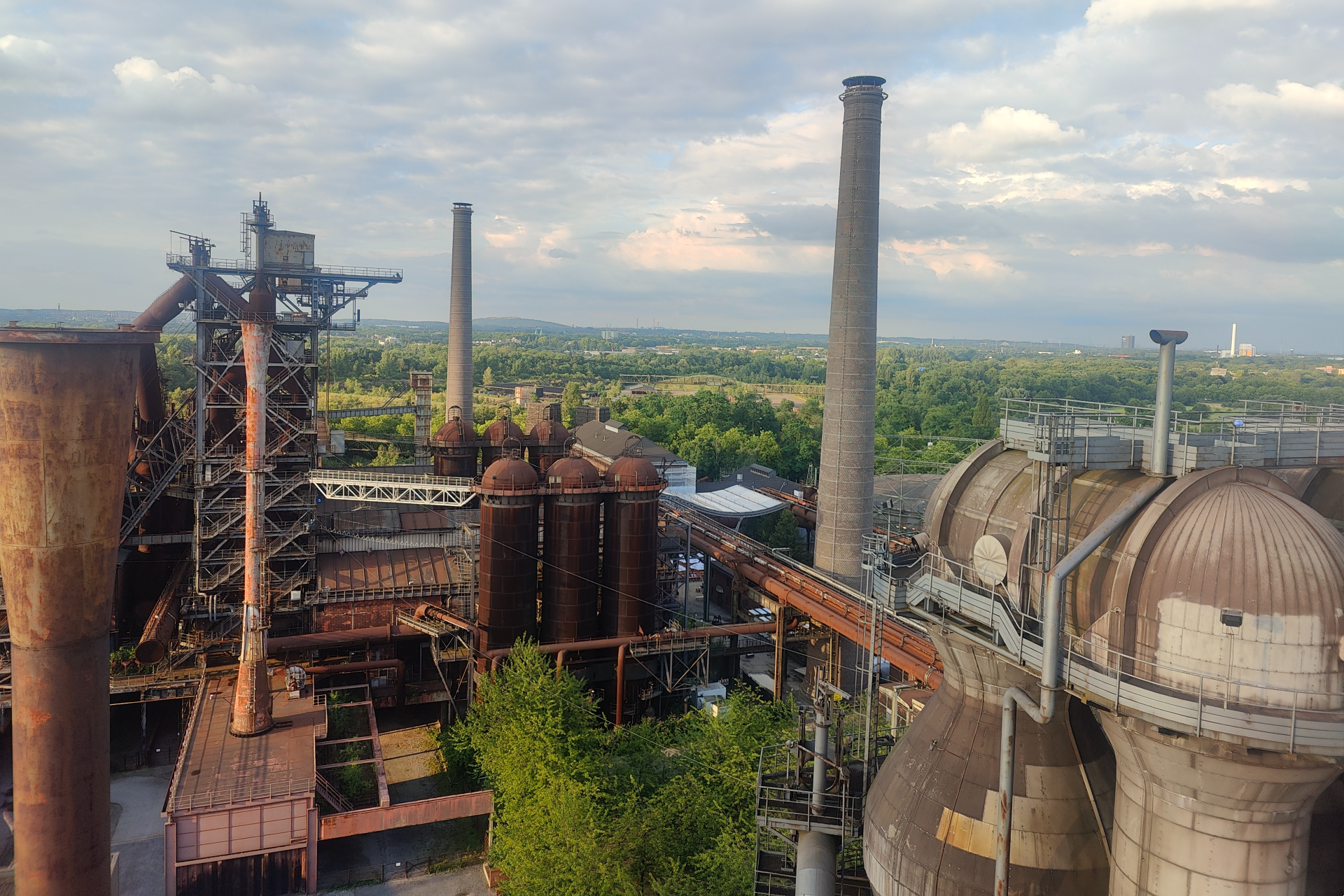
The Thyssen Ironworks factory was a key site of the coal-powered industrial age. It was part of the Ruhr district in western Germany, which, in the 19th century, was Europe’s largest industrial area. For centuries, coal was mined and steel was smelted there, transforming the landscape, polluting the air and permanently altering the social fabric. When coal mining was offshored in the 1960s, the region was left poor, densely populated and plagued with toxic tailings and disfigured landscapes. By the mid-1980s, the factory itself had been completely abandoned.
Now standing as a monument, turned into the spectacular Duisburg Landschaftspark Nord by landscape architect Peter Latz. Stems and leaves climb their way up the massive structure of what was once a cold blast furnace. Roots grow in the formerly toxic soil that the steel industry had polluted.
Sites like these expose the entangled histories of humans and the Earth and remind us of our responsibility to remember them. Instead of covering up the past, Latz made a deliberate decision to work with the industrial infrastructure: the remarkable park memorializing the irreversible and ongoing effects of this bygone era.
Duisburg is also the hometown of Professor Sabine Höhler of the KTH Royal Institute of Technology in Stockholm. She leads a new research program on the Anthropocene as head of the recently founded Center for Anthropocene History, which aims to mend the long-standing separation between human and Earth history – a fresh approach to remembering the past, navigating the present and imagining possible futures.
“The fossilist era will stick with us. It was our past future, and it will be our future past,” said Höhler. Much like Latz, she wants to remember and acknowledge the effects of industrialization rather than pretend a zero-carbon world can be built on a clean slate.
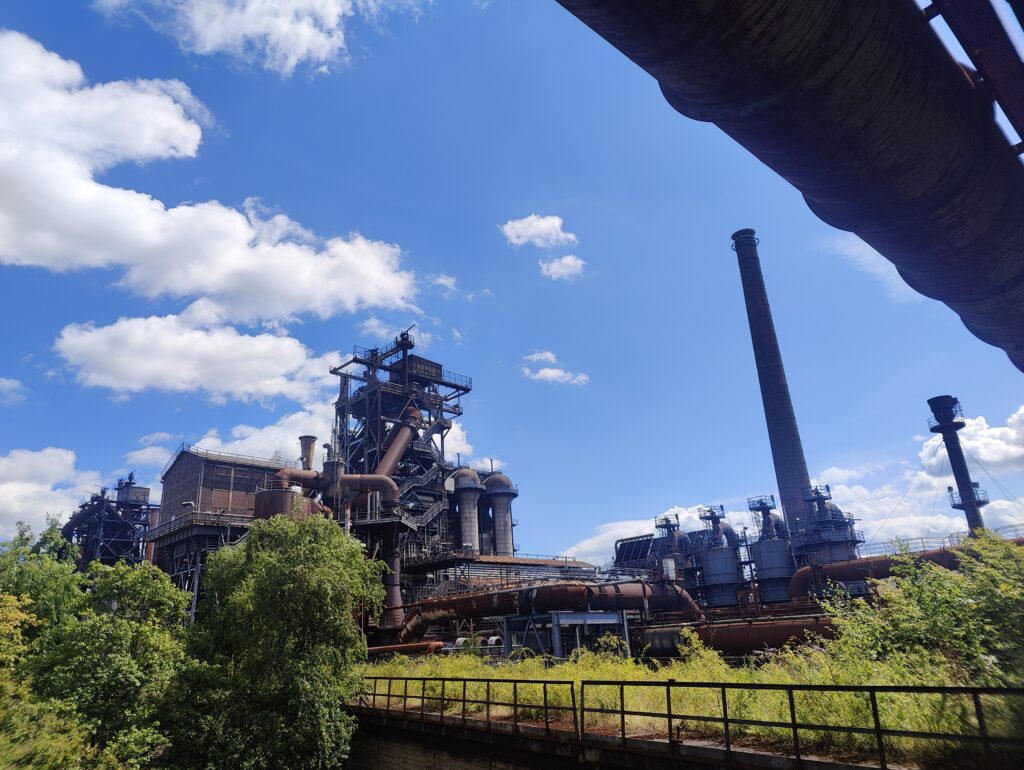
To her, the abandoned steel works of Duisburg constitute a “scar of industrialization” – a concept developed by her colleague Anna Storm. Such scars confront us with the enormous force by which humans have consumed millions of years of fossilized carbon in a geological instant, permanently altering the trajectory of the Earth system. To live with these scars requires a new understanding of how we as humans are inseparable from our environment. It calls for new memories of the Anthropocene Epoch.
The Anthropocene Epoch is the name some scientists have proposed for a new chapter in Earth’s history, beginning in the 20th century: an era marked by our unprecedented and irreversible reshaping of the planet. While recently rejected by the geological community, the concept, however, holds great potential for humanities scholars concerned with the state of the planet:
“The Anthropocene denotes our current experiment with the entire Earth – the age of terrestrial reorganization,” said Höhler. “It is a name for how things connect”.
The Anthropocene Working Group, an interdisciplinary scientific body, has proposed the year 1952 as the formal beginning of this epoch, marked by the stratigraphic deposition of radioactive plutonium from nuclear weapons testing – the first human trace among the markers of geological timekeeping.
In the Anthropocene, human activity has become a force that reshapes the planet itself. According to the Anthropocene Working Group, the number of human-made minerals and chemical compounds has exploded from about 5,000 before industrialization to roughly 300,000 since 1950.
“Next to ore and coal mining, we have colonized our past and our future through petroleum extraction, uranium mining, radioactive contaminants and nuclear waste, and through microplastics pollutants and so-called forever chemicals — persistent synthetic materials that accumulate in the environment and in human and animal bodies,” said Höhler.
Human agency has folded and stretched time and space, transforming hundred-million-year-old coal into the motion of machines, while generating environmental maintenance projects that will last an eternity. Again, the fossil fuel industry will stick with us, and we have to learn how to live with it.
History of more than humans
History is a human endeavor. Time and events have been segmented and conceptualized according to a human timeline: Kings, wars, migrations. But we cannot separate humans from their environment, and a new mode of history writing has to take that into account.
To make sense of our current situation, living in an environment humans themselves have shaped, we need the tools to understand a reality happening on different time scales at once: the life of a human, the movement of a glacier, the cycle of a carbon atom. This is what the Center for Anthropocene History aims to do, bringing the long natural timelines into the 20th-century histories:
“We need a history that integrates human history, measured in generations and centuries, and natural history, measured in millennia and eons,” she said.
Such a history must necessarily be cross-disciplinary. It invites historians to look up from their books and consider the plants, rocks, soil, and air – the material archives of the Earth itself.
Explaining how a new perspective on the past helps us navigate the crises of today, Höhler described history as a “meaning-making and navigational tool for understanding our contemporary world” and pointed to the geopolitical tensions of the Arctic as a striking example.
Within living memory, Arctic trade routes were effectively impassable, Höhler explained. But as more solar energy becomes trapped in the Earth’s atmosphere, the polar regions are warming at an accelerated pace. This melting of Arctic ice is opening new trade routes and exposing previously unreachable underground mineral deposits as the icy cover gradually disappears.
“The geopolitical shift is not only political, but also planetary – a change of the planet itself,” said Höhler.
The historian, as a gatekeeper of our common memories, has a responsibility, she noted. The time of indulging in the lives of ancient kings and long-lost scripts of the past, she stresses, is nearing an end. Historians are not neutral observers but responsible subjects with the power to change how we know the past. However, Höhler added, our aim is not to alarm. Rather, it is to understand how we entered this conundrum, how we can continue to live with it, at what costs – and for whom.
“As historians, we need to ask ourselves, what kind of knowledge does the world need?”
Anyone who has stood atop Duisburg’s 54-meter-tall blast furnace and looked out over the vast industrial landscape will likely recognize a shift in perspective: your place on the steadfast body of steel that feels as if it will stand into eternity, yet offers a panoramic outlook on all things changing.
For Höhler, viewing the past through the lens of the Anthropocene does something similar: it shows us which futures our industrial past opens – and which it closes – and gives a clear line of sight to redefine what is possible.
This article is based on an interview with Sabine Höhler following her talk on Anthropocene History at the Center for Applied Ecological Thinking.



Comments
Welcome to the new Resillience commenting system!
We have moved from the former Disqus commenting system to a new system as of September 10, 2026.
We made this change because of privacy concerns regarding Disqus. It's also part of a set of changes to bring more services to the Resilience community under a single login: commenting, (coming September 2026), and online courses (coming 2027). Unfortunately, your old Disqus comments may not reliably link to your account in this new system. Please contact us if you have any questions or concerns.