United States politicians, even Democratic ones, no longer mention climate change, according to a recent report by Grist. Evidently, after their 2024 election losses, Democrats concluded that global warming isn’t a winning issue. Their calculus is somewhat confirmed by a recent Pew poll that ranks climate change only ninth among Americans’ top concerns.
Meanwhile, hard-won US national climate data, scenarios, and analyses are quietly disappearing from official government websites. A prime example is the Fifth National Climate Assessment, a county-by-county description of likely risks from 1.5 degrees and 2 degrees of warming over pre-industrial levels. This preeminent report on climate impacts and responses is a congressionally mandated, interagency effort to provide “the scientific foundation to support informed decision-making across the nation.” A clone of the government website is being hosted by Climate.us; the Trump administration has taken down the official site, which was here.
Those seeking to downplay climate change did a victory dance in May, when the Intergovernmental Panel on Climate Change (IPCC) announced it was retiring its RCP8.5 scenario—the worst-case trajectory in which humanity continues increasing its greenhouse gas emissions through the end of the century. We at Post Carbon Institute have been saying for a decade or more that this scenario was unrealistic and should be dropped, since it assumes the burning of more fossil fuels than the Earth can reasonably supply. However, axing RCP8.5 at this politically fraught moment has simply fed a predictable gloat-fest on the part of climate deniers. For example, the New York Post editorial board proclaimed that the revision showed climate warnings had done “untold damage” to the public, the economy, and “the average man’s pocketbook.” Fox News host Sean Hannity asserted that a “top U.N.-backed climate change panel is now waving the white flag of surrender” and “quietly admitting that the Earth will not in fact be destroyed by climate change.” Donald Trump claimed on Truth Social that the United Nations had just admitted that its own climate projections were “WRONG! WRONG! WRONG!” and called global warming research a “Green New Scam.”
Meanwhile, back in the real world, it’s becoming clearer that Earth is breaching the 1.5 degrees Celsius limit to which world leaders pledged, in 2015, to limit global warming in their effort to avert a catastrophic future. Earth first exceeded the 1.5-degree threshold in 2024; however, in 2025, the global average surface temperature cooled to 1.44 degrees above baseline (2025 was still the third-warmest year on record). The 1.5°C limit is defined in the Paris Agreement as a multi-year average temperature; by that standard, many climate scientists expect the limit to be breached before 2030. Overall, Earth’s march toward 2 degrees of warming is accelerating. The question climate experts are now asking: will it still be possible to keep warming below 3 degrees by the end of the century? The difference in impacts between 1.5, 2, and 3 degrees would be monumental: at 3 degrees, 3.25 billion people would be exposed to deadly heat-humidity conditions at least annually.
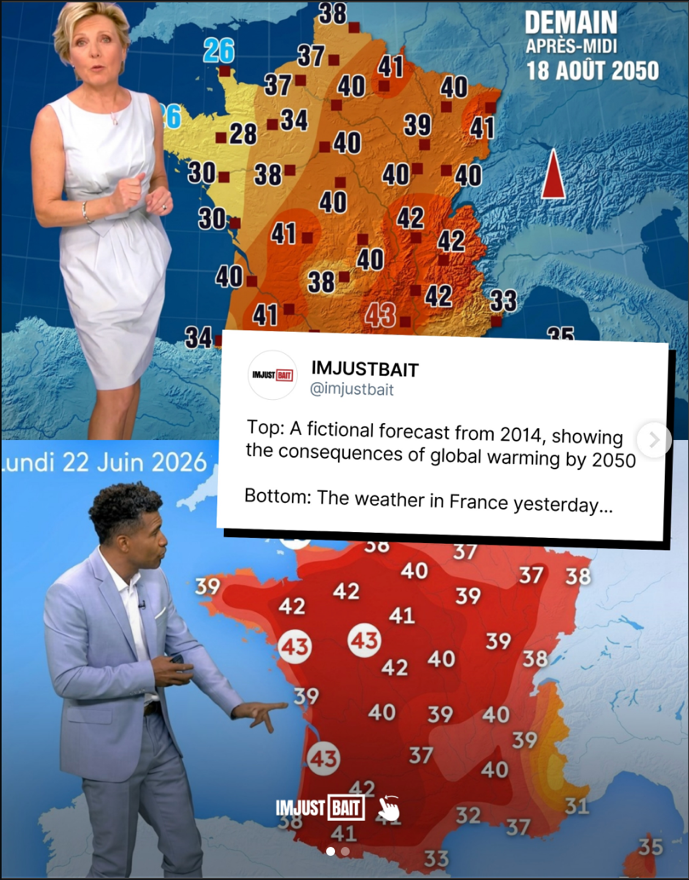
As I write this, Europe is emerging from an unprecedented heat wave in which over 1,300 people died from causes linked to high temperatures. Europe is the fastest-warming continent, heating at twice the global average—but its people are unaccustomed to, and unprepared for, sustained searing heat. According to research associate Theo Keeping at Imperial College, London, “this heat wave would have been virtually impossible even 50 years ago without human-caused climate change.” On the other side of the pond, as the US is celebrating its 250th Independence Day, a heat dome has settled over the eastern half of the country, with more than 160 million Americans under extreme heat warnings.
Also, an unusually strong El Niño is developing in the eastern Pacific. Expected impacts of this “super” El Niño include increased flood risks in the southern US, drier and hotter weather in South America, and prolonged drought and reduced agricultural output in southern Asia. Climate change is a contributor to the unusual strength of this El Niño: due to continued global heating, ocean temperatures are now at the highest level ever recorded. While El Niño is a naturally occurring climate cycle, hotter ocean waters are driving that cycle to extremes.
One more result of climate change: the Atlantic Meridional Overturning Circulation (AMOC), a global deep-ocean current that, among other things, helps keep Europe warm, is slowing. Cold meltwater from Greenland and Arctic sea ice is diluting the dense, salty ocean water that drives the current. The complete halting of the current before the end of this century, once considered a remote possibility, is now being given higher odds by climate scientists and oceanographers. See the recent Crazy Town podcast episode featuring Emily Schoerning for a fascinating discussion of this globe-changing development.
Collectively, we seem to have wandered into a peculiar new psychological-political terrain: as we approach the collapse of Earth systems and therefore of civilizational support pillars, rational worries are being replaced with delusions. The reasons are no doubt complex and include the rise of social media, the consolidation of media companies, the politicizing of climate discourse by fossil fuel companies, and the emergence of right-wing centi-billionaires intent on shaping the attitudes of entire nations.
But I’ll add one more possible explanation in half-jest. In his science blog, Ugo Bardi suggests that rising CO₂ levels in Earth’s atmosphere, in addition to warming the planet, will also gradually degrade human intelligence. As evidence, he cites a 2024 paper by neuroscientist Richard Buxton of the University of California San Diego showing that “the oxygen-to-CO₂ balance in brain tissue is crucial. As CO₂ rises, the energy available to sustain neural activity falls.” The US has always been a conflicted, if not crazy, country (after all, it tolerated slavery for decades and elected Donald Trump as president twice). Maybe now, with the nation at age 250, the extra CO₂ that it’s breathing is starting to erode whatever remains of its collective rationality.
If you want to buck that trend, don’t lose sight of the big picture (Earth is a system of systems, nature must be at the center of human concerns, and energy is the true currency). Adjust your views as needed to incorporate new data and events. Don’t succumb to political doom scrolling. And surround yourself with green plants producing lots of oxygen.
Thank you for your Attention to this Matter.