

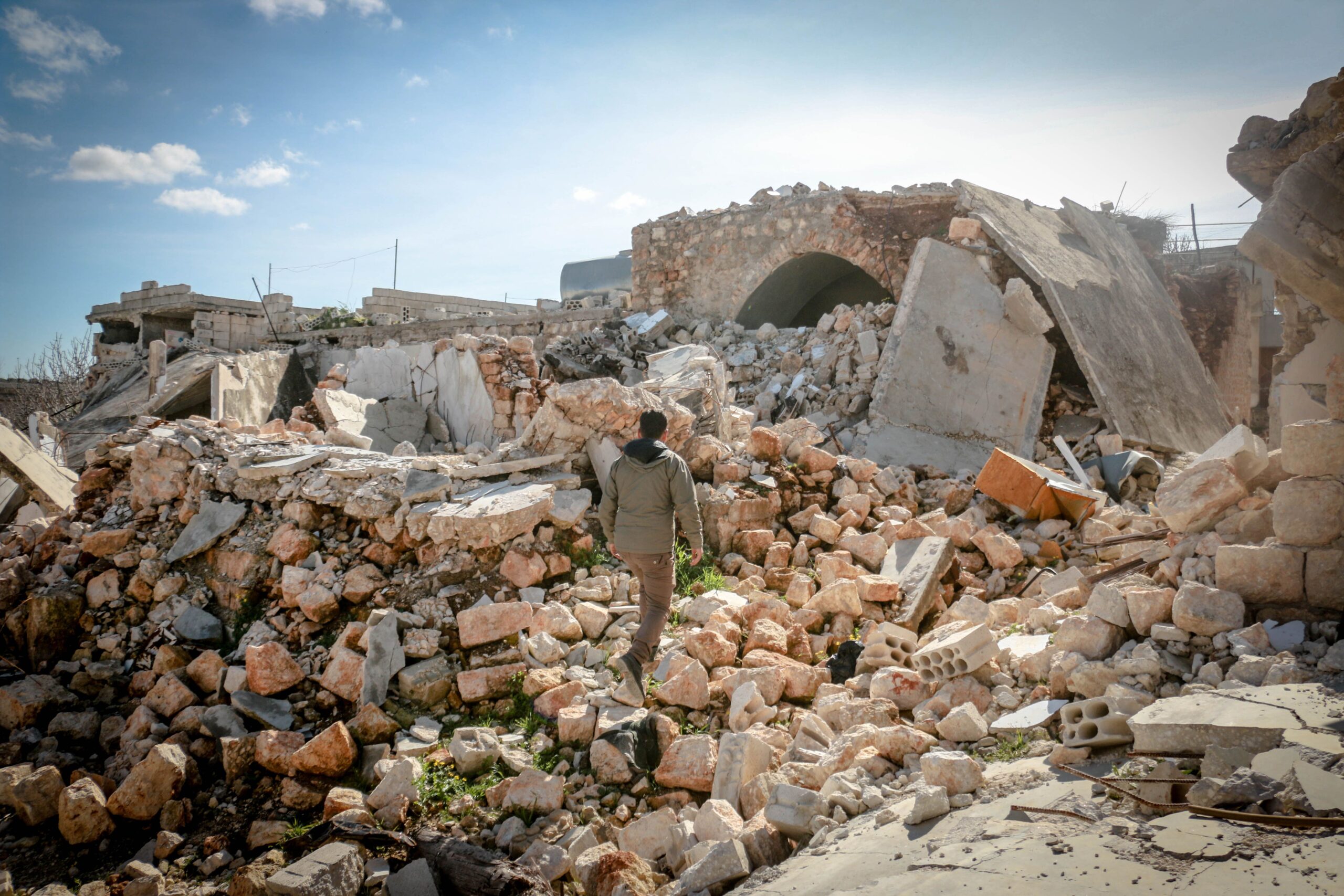
As you might have noticed, the world’s descent into chaos has been accelerating lately. The war started by the United States and Israel in the Middle East has triggered an unprecedented disruption of critical energy and material supply chains, delivering a shock to the global economy that is about to ripple through the world for a long period of time and is unlikely to leave any country, society or economic sector unaffected.
Coming after 2008’s Great Financial Crisis and Great Recession, the COVID-19 pandemic, and Russia’s war of aggression against Ukraine, this new systemic global crisis is likely to be more severe and consequential than the previous ones as it occurs in a geopolitical environment that has already been fragilized and fragmented and is thus less capable of withstanding its cascading effects. These effects are likely to be multiplicative rather than additive, and they could bring the world’s institutional architecture to a breaking point, triggering a global systemic rupture or even a global system collapse.
In other words, the 2020s, which already felt rather miserable so far, are now taking a turn for the worse. The world in 2026 increasingly resembles a runaway train gathering speed towards a dangerous storm, with no emergency brake in sight and no Hollywood hero willing to divert it onto a safer track.
Just like some animals can physically sense the arrival of impending storms, more and more of us have an increasingly unsettling feeling that something unpleasant and dangerous is about to hit us. When animals sense an approaching storm, their natural reaction is to seek shelter, but their heightened awareness often leads to increased agitation, panic, and, in some cases, aggression. Our reaction is not fundamentally different. Some of us try to seek shelter by retreating from the crowd, stocking up and boarding up, ‘prepping’ to survive the looming disaster. But most of us don’t have the psychological or the physical capacity to withdraw from society and become preppers or survivalists – plus, the chance of successfully sheltering oneself and one’s people from what is coming seems to be rather dim anyway.
Hence, for most of us, the reaction rather consists in becoming increasingly restless and aggressive. Unable to stop the runaway train’s fateful ride into the perfect storm ahead, we’re lashing out. We recriminate each other for our increasingly desperate situation and for the impending disaster, ever more loudly, ever more radically, ever more violently.
We blame and curse the misguided neoliberal ideologues – or the enraged and hapless leftists; the cruel austeritarians – or the fiscally irresponsible spendthrifts; the authoritarian neofascists – or the ‘woke’ deconstructivists.
We blame and curse crazy Donald Trump and his clique of moronic or cynical sycophants – or the clueless, rudderless and hypocritical progressives; the ever more imperialistically brutal Americans – or the ruthless and increasingly assertive Chinese communists; the extremist and genocidal Israeli government – or the fanatical and terroristic Iranian regime; the NATO-proxied Ukrainians and their vassalized European backers – or the savage Russians and their sneaky enablers in Beijing.
We blame and curse the lunatic ‘tech bros’ who want to accelerate our journey towards post-human, multi-planetary consciousness – or the technophobic neo-luddites resisting and sabotaging our march towards transhuman bliss; the religious zealots advocating a return to faith-based life and social order – or the nihilists rejecting and undermining established and traditional moral, spiritual, and political values.
The list of those we can choose to blame for the various aspects, dimensions, and layers of our predicament is virtually endless. Our social media-infused culture, which continuously reinforces our respective biases, prejudices and skewed certainties while obliterating our attention span and impairing our cognitive abilities, promotes, amplifies and exacerbates this never-ending blame game.
Collapse? What Collapse?
In many cases, there is actually some truth to the particular responsibility we choose to lay onto others. That choice is increasingly shaping our perception of the storm we feel is coming. For some, what’s ahead of us is the downfall of the American empire, with its abusive financial and monetary dominance, its military adventurism and its nefarious politico-cultural hegemony.
For others, it’s the collapse of neoliberalism, the debt-fueled consumerism and the financialization of everything it engendered, the extreme concentration of wealth and power and the absurd levels of inequality it generated. For others still, it’s the fall of the West, after five centuries of global domination rooted in military conquest, slavery, colonialism, resource appropriation, extractivism, racism, cultural hegemony and unequal patterns of trade. Then there is, of course, the version in which what is coming is the deserved and even overdue divine retribution for our sins and for our impudent attempts to free ourselves from our essence as the Almighty’s creations.
Again, there could well be elements of truth – or at least elements of usefulness – in some of these narratives that some of us want to believe and sometimes elaborate on and propagate. Overall, however, these narratives and the increasingly ferocious blaming and scapegoating they bring and constantly feed do precious little to slow down our runaway train or change its course. The policy choices that they underpin do little more, at best, than reshuffle the composition of the train’s cars, some groups bullying their way towards the rear cars and pushing others towards the front carriages, in the vain hope that pushing others into the storm first will somehow enable them to avoid the worst for themselves. In concrete terms, this translates into a relentless rise in conflict within and between human societies, and into the decline of decision-making processes based on collective deliberation and compromise, which are increasingly degenerating into, or being replaced by, processes based on authority and coercion.
As previously explained, many analysts who warn us of the impending trouble ahead tend to base their assessments and forecasts on one form or another of cyclical historical theory, namely, the idea that the history of civilizations and societies does not move in a linear way but along repeated cycles of birth, growth, peak, decline and collapse – with collapse being typically conceived as a necessary stage intended to bring about renewal.
Yet these cyclical historical theories do not provide much help in understanding how the whole world ended up becoming a runaway train accelerating towards a perfect storm. Contrary to what cyclical theories typically posit, it’s not just a specific society, or even specific societies (the West, the USA, Europe, capitalist industrial society, etc.) that are going down the decline phase of their lifecycle – even if that may be the case as well. It is all of humanity that seems to be on its way towards some sort of reckoning with the accumulated consequences of its collective past choices and actions.
In fact, the accelerating, worldwide integration of material and energy flows required to sustain the growth of modern industrial societies over the last two centuries has globalized humanity’s social metabolism (the continuous exchange of energy and materials between human societies and their environment). It has created a world where production, consumption, and waste disposal are spatially and socially separated, yet all form part of an integrated system that uses the Earth simultaneously as a bank of resources to be relentlessly plundered and as a giant garbage dump to be relentlessly filled up. Various societies and cultures have participated to very different degrees in setting up this system and have benefited to very different degrees of its spoils. Hence, they bear very different degrees of responsibility for producing the resulting storm of consequences. Yet all of them have been aboard the runaway train of global industrial civilization, with no possibility of safely getting off.
Understanding where we are now, how we got here and where we are headed requires a conceptual framework capable of accounting not just for the internal sociocultural dynamics of specific human societies, but also for the globalized metabolic dynamics of industrial civilization and for how these two dimensions combine to generate the perfect storm of consequences that our world – and not just specific parts of it – is heading into.
This piece was edited and condensed for length. You can read the piece in full here.


Comments
We changed commenting systems on September 10, 2026 as part of a site-wide functionality and security upgrade. Your past comments have not disappeared, and you can still log in with your old Disqus account credentials if you wish. Contact us with any questions.