

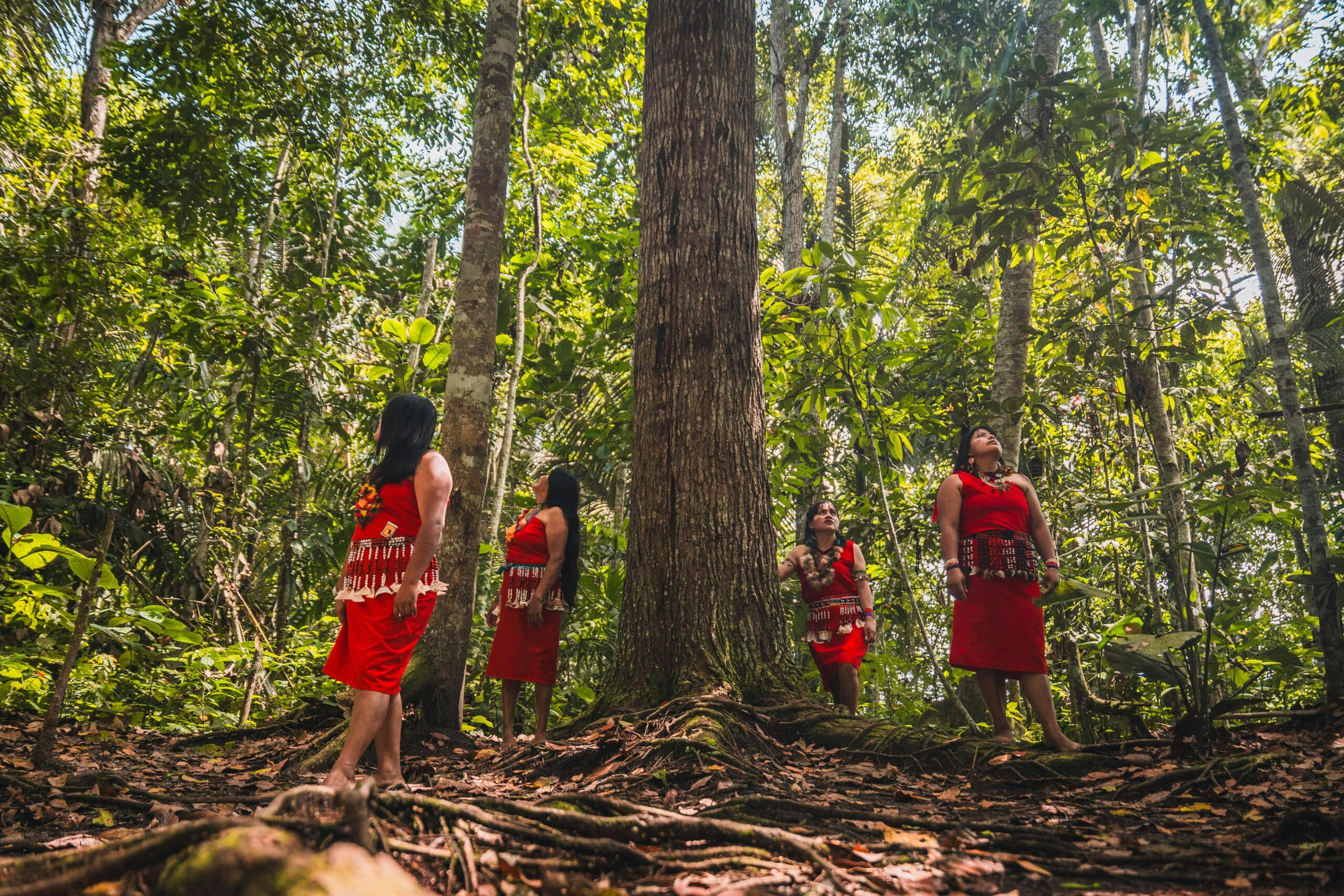
In the current scenario, when the worldviews of Indigenous communities appear to offer the most coherent understanding of what this Earth requires, it may be advantageous to remember some things from the past, not out of nostalgia, but as a wake-up call. With time, we no longer follow the quaint ancestral traditions of earlier generations. Among them was the wisdom of knowing how to coexist with nature.
Preindustrial humans venerated, respected, relied on, and also feared the raw force of nature. To better understand natural phenomena, people personalized many of the elements they encountered. This may not count as legal “personhood” as understood in the 21st century, but rivers, mountains, forests, waters, harvests, and hunts all had deities or spirits. In the West, this is still known through the myths and legends of the Greeks and Romans, as well as the Nordic sagas. In fact, all civilizations and communities across the globe have had their own belief systems and cosmologies.
A brief examination of just one category—the colorful and large assembly of river gods, goddesses, and sacred animals—shows that our ancestors in Asia, Africa, the Americas, Australia, and Europe maintained relationships with their own specific water deities.
Such reverence and respect for natural entities were apparently the normal stance for people who were not yet as estranged from their environs as we are now. In fact, the last 200 to 300 years of rapid, frequently reckless development may have resulted in humanity’s exceptionalism.
The human bond with nature diminished as urban concentrations and megacities grew ever bigger worldwide and agriculture became industrialized. Currently, just 5 percent of Indigenous peoples live on and watch over one-third of the planet’s nonurban land. They have accumulated knowledge and insights for millennia. Indigenous people protect biodiversity and safeguard natural resources. They are also exceedingly vulnerable to insatiable extraction demands—destructive interventions by a world that knows no limits—and to the impacts of climate change.
“As the inheritors of unique ways of living, Indigenous peoples have long suffered discrimination and worse, according to the UN. But despite a history of oppression, their ability to live in harmony with nature is increasingly understood and appreciated… Although they make up less than 5 percent of the global population, Indigenous people protect 80 percent of Earth’s remaining biodiversity,” stated the Business and Human Rights Center.
The imbalance in this situation is harmful, and the recognition that many Indigenous perspectives and cosmologies view nature as alive and possessing intrinsic value aligns well with the rights of nature movement, which is gaining increasing international traction.
Big international gatherings—such as the annual UN Conference of the Parties (COP)—now devote considerable attention to developing legal issues. For instance, at COP28, held in 2023 in Dubai, the world’s most prominent law associations strategized for a sustainable future. Among them were the American Bar Association, the International Bar Association, the Brazilian Bar Association, and the Law Society of England and Wales. COP28 acknowledged the important role of jurisprudence in addressing the climate crisis and in establishing frameworks to meet upcoming obligations. Simultaneously, climate activists and demonstrators urged stronger climate action and demanded accountability from world leaders.
Rights of nature advocates view the relationship between humans and nature as interdependent and have called for a corresponding legal framework. In their view, if all else is reversible and susceptible to rollbacks, only the rule of law and the legal personhood of natural entities can be the shield protecting them from continuing harm.
The scientific community has added further value to the importance and need for protecting the environment. “As scientists have flocked to the [right of nature] movement… they’ve given it a new layer of credibility—and enforceability. They’re helping to craft laws rooted in scientific principles, collaborating with local communities to collect evidence for court cases and drawing on fields like ecology and neuroscience to provide a scientific basis for the movement’s core philosophies, ideas that Indigenous peoples have already validated through centuries of territorial stewardship,” explained the Inside Climate News article.
However, so far, most of the world’s traditional legal systems have tended to regard nature as property that can be used, abused, consumed, constricted, depleted, degraded, poisoned, and sold.
For the philosophical and legal rights-of-nature movement, these abuses necessitate nothing less than a paradigm shift from the anthropocentric to the ecocentric worldview. The Global Alliance for the Rights of Nature (GARN) helps provide a path forward. It brings together a network of organizations and people from all walks of life and about 100 countries dedicated to achieving the “universal adoption and implementation of legal systems that recognize, respect, and enforce Rights of Nature.”
“An essential step in achieving this is to create a system of jurisprudence that sees and treats nature as a fundamental, rights-bearing entity and not as mere property to be exploited at will,” GARN stated.
Challenges and Critiques
The challenges facing a rights-of-nature case are best highlighted by the 2016 ruling granting legal personhood to the Atrato River in northwestern Colombia. The area had endured decades of civil war, illicit drug and mining operations, criminal networks, private armies controlling large territories, and communities being subjected to ill treatment and acute neglect. All this represented the most difficult circumstances for implementing the legal rights of a river.
“In recent years, there has been an explosion of mechanisms that have granted rights to rivers and other natural entities. While this is important to overcome the anthropocentrism that has characterized conventional law, the truth is that the real work begins once the declaration is achieved,” said Rodrigo Rogelis to Scottish Legal News. Rogelis is a researcher with the Socio-legal Center for Territorial Defense SIEMBRA. He has been working alongside the Scottish Catholic International Aid Fund and the University of Glasgow to support the implementation of the court’s decision.
Those involved with the implementation have worked hard and smart, fighting patiently for years against incredible odds. Rogelis said there are “reasons for hope” while he described the activities undertaken to “protect the river.”
“Some may think this is a small thing in relation to the paradigm shift that the rights of nature are invoking, but in the minutiae of the day-to-day work that makes these rights effective, it can be a huge component,” he added.
However, when anthropocentric human rights-based climate litigation clashes with the rights-of-nature ecocentric approach, it becomes clear how things can get complicated. The Earth Law Center (ELC) points out that while the “human rights-based climate litigation has paved the way for the [rights of nature] movement in some ways, its strict anthropocentrism may ultimately prove to be at odds with the [rights of nature] movement’s ecocentric approach. These two legal movements thus have the potential to both mutually reinforce and conflict with one another.”
Despite various legal victories, setbacks occur. An important example is the personhood granted in 2017 to the Ganges and Yamuna rivers in India by the Uttarakhand High Court. However, the Uttarakhand government took the case to the Supreme Court of India. It overturned the earlier ruling and stated that the rivers cannot be “viewed as living entities.” The Ganges “is a lifeline to 500 million people.”
“Who speaks for nature?” emerged as an urgent question, one that resonated at the International Tribunal of Rights of Nature. Created in 2014, the tribunal describes its mission as follows:
“The tribunal aims to create a forum for people from all around the world to speak on behalf of nature, to protest the destruction of Earth, destruction that is often sanctioned by governments and corporations, and to make recommendations about Earth’s protection and restoration. The tribunal also has a strong focus on enabling Indigenous Peoples to share their unique concerns and solutions about land, water, and culture with the global community.”
In July 2025, ahead of the November COP30 in the Amazonian city of Belém, Brazil, Indigenous leaders from the Amazon brought a dark message to the financial center of London. “Earth is ill,” said Dario Yanomami, vice-president of the Hutukara Yanomami Association.
There are too many dark messages out there. And the answer to the question “Who speaks for nature?” remains the same: for better or for worse, humans do.
This article was produced by Earth | Food | Life, a project of the Independent Media Institute, with research support from Meghan Grady. This is Part Three of a four-part series.
Read Part One here. Missed Part Two? Read it here.


Comments
We changed commenting systems on September 10, 2026 as part of a site-wide functionality and security upgrade. Your past comments have not disappeared, and you can still log in with your old Disqus account credentials if you wish. Contact us with any questions.