

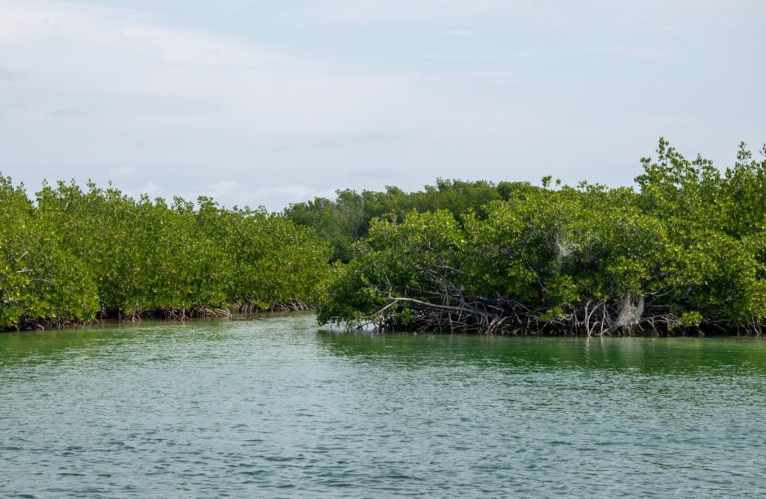
In January, we launched a brand-new Marine Ecosystems Community of Practice – a collaborative initiative bringing together four Ecosystem Restoration Communities (ERCs) working at the frontlines of coastal and marine restoration.
These pioneering initiatives include RegeneSEAS (a programme of ERC The Regenesis Project in the Philippines), ERC Mombassa Mangroves (Kenya), REEFolution (Kenya), and ERC Habiba Community (Egypt). Supported by the NAIAD Foundation, the partnership follows a five-year vision to restore coral reefs and mangrove ecosystems while creating regenerative, ocean-based livelihoods for local communities in the regions.

A GoogleEarth view of the location of ERC Mombasa Mangroves in Tudor Creek, Kenya
Why a Community of Practice?
Each of these ERCs is already doing powerful work in its own region. They are innovators who work together with other stakeholders and experts to find the best routes to restore their ecosystems and create regenerative livelihoods. The Community of Practice adds a new layer of impact – connecting projects so they can collaborate to learn faster, share innovations, and refine what works best. The result? Greater effectiveness for each project, stronger outcomes for nature above and below the waterline, and new insights that can be useful to ecosystem restoration initiatives worldwide!
This approach isn’t new to the ERC movement. Six other Communities of Practice are already active, tackling challenges such as wildfire resilience, regenerative farming in desertified landscapes, and even identifying the most affordable and nature-friendly ways to plant trees. When local, community-based innovators come together, progress accelerates.

A GoogleEarth view of the location of Habiba Community (Red Sea, Egypt), and Reefolution (Wasini Island, Shimoni, Kenya)
Making Reef Restoration Possible at Scale
Reefs are important natural resources that keep our oceans alive. Through tourism, fisheries and coastal protections, reefs are invaluable. But let’s be honest – all of nature is invaluable to our survival as a species. And if you have been following us, you will know that the funding available to restore and protect this value is very limited.
Studies have shown that coral reef restoration at scale is mindboggling expensive. One recent study* indicates that restoring Australia’s Great Barrier Reef could cost around USD 46,000 per hectare. With the Great Barrier Reef alone covering 35 million hectares, it’s clear that conventional, high-cost models won’t be enough to restore degraded reefs across the globe and that new approaches are need for marine restoration.
This is where community-led restoration becomes transformative.
ERCs are rooted in place. They are led by people who live in, depend on, and want to understand their ecosystems from the realisation that they are crucial to their wellbeing and welfare. Through this Marine Community of Practice, we hope to show how community-based and citizen-science approaches can dramatically reduce restoration costs while increasing long-term success.
The results are already promising. Mombassa Mangroves, for example, is demonstrating that community-driven mangrove restoration is not only far more cost-effective, but also achieves significantly higher survival rates.

A GoogleEarth view of the location of The Regenesis Project, Bohol Island, The Philippines
Learning that Ripples Outward
For governments, scientists, NGOs, and anyone committed to the future of coastal ecosystems, this Community of Practice offers something vital: real-world insight into how working with communities can help scale restoration efforts globally.
In practice, the participating Ecosystem Restoration Communities meet regularly online and at one another’s project sites, creating space for deep learning and hands-on exchange. As the Community of Practice matures it will also open its doors to others – inviting additional practitioners to share insights, learn together, and contribute to new innovations. This growing circle of collaboration will further strengthen and amplify the collective impact of the work.
We invite you to follow this exciting new collaboration as it unfolds – and to keep an eye on the many other Communities of Practice across the ERC movement. Together, they are helping to uncover smarter, fairer, and more hopeful pathways to restoring our planet.

Habiba Community Restoration Leader Maged El Said exploring the Nuweiba coral reef on the Red Sea, Egypt
* Cox, Taylor, “A Cost-Benefit Analysis of Preserving the Great Barrier Reef” (2023). Honors Theses. 2888. https://egrove.olemiss.edu/hon_thesis/2888



Comments
Welcome to the new Resillience commenting system!
We have moved from the former Disqus commenting system to a new system as of September 10, 2026.
We made this change because of privacy concerns regarding Disqus. It's also part of a set of changes to bring more services to the Resilience community under a single login: commenting, (coming September 2026), and online courses (coming 2027). Unfortunately, your old Disqus comments may not reliably link to your account in this new system. Please contact us if you have any questions or concerns.